Funds Flow in M&A: How Money Moves at Closing for AI Companies
How funds flow works in M&A — wire transfers, escrow, rollover equity for founding teams, IP escrow structures, milestone payments tied to model metrics, and GPU infrastructure treatment.
What Is a Funds Flow Statement?
A funds flow statement — also called a funds flow memo or closing funds flow — is the document that maps exactly how money moves on closing day. It identifies every source of funds (who is putting money in), every use of funds (who is receiving money), and the precise amounts and wire instructions for each transfer.
In a straightforward acquisition, the funds flow might fit on a single page: buyer sends purchase price to seller, minus an escrow deposit. In an AI company transaction with rollover equity for the founding team, IP escrow for model ownership representations, model-performance earnout structures, and GPU infrastructure carve-outs, the funds flow can run to fifteen or more pages and involve a dozen separate wire transfers and several contingent payment schedules.
The funds flow memo is not a legal formality. It is the operational blueprint for closing. Every dollar must balance — total sources must equal total uses — and every party must agree on the numbers before a single wire is sent. For AI company transactions, this alignment is particularly important: founders who focus on the headline deal price without reviewing the funds flow memo often discover late that escrow holdbacks, talent retention reserves, and IP indemnification reserves significantly reduce the day-one cash they receive.
Why Funds Flow Matters
Most of the attention in an M&A transaction goes to negotiating the definitive agreement — the purchase price, reps and warranties, indemnification provisions, and closing conditions. But the funds flow is where those negotiated terms translate into actual money movement. It is the last major workstream before closing, and the one most likely to surface errors that should have been caught earlier.
Three things make funds flow critical:
Closing certainty. A well-prepared funds flow memo, circulated early and reviewed by all parties, reduces the risk of last-minute disputes over amounts. When the funds flow is left until the final 48 hours, it becomes a source of friction that can delay closing by days or weeks.
Fraud prevention. Wire fraud targeting M&A closings has increased sharply. The FBI’s Internet Crime Complaint Center reported US$2.9 billion in business email compromise losses in 2023, with real estate and M&A transactions among the most targeted categories. Funds flow memos with verified wire instructions and callback procedures are a primary defense.
Regulatory compliance. In cross-border M&A, funds often flow through multiple jurisdictions with different anti-money laundering (AML) requirements, foreign exchange controls, and tax withholding obligations. For AI company transactions involving Japanese or Korean strategic acquirers, the funds flow must account for the timing and sequencing of regulatory approvals — a wire initiated before the necessary clearance is obtained will be blocked.
Anatomy of a Funds Flow Memo
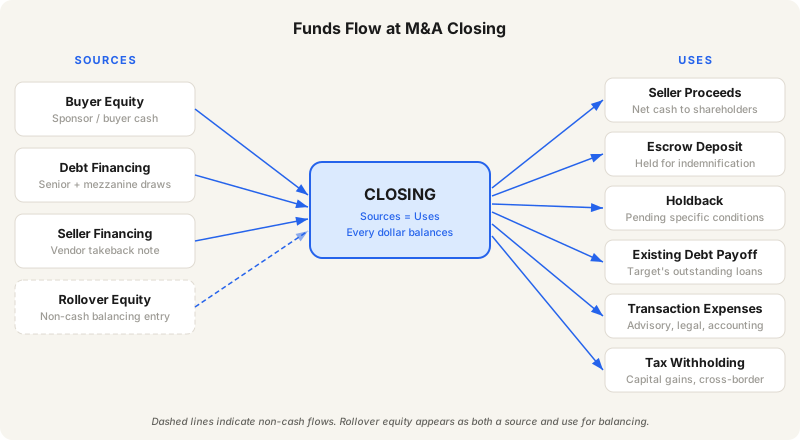
A standard funds flow memo has two sections: sources and uses. These must balance exactly.
Sources of Funds
Sources identify where the money originates. In a simple cash acquisition, there may be a single source. In an AI company transaction, sources typically include:
| Source | Description |
|---|---|
| Buyer equity | Cash contributed by the buyer (or its sponsor) from available capital |
| Debt financing | Senior secured loans, drawn on closing day per the credit agreement |
| Mezzanine financing | Subordinated debt or preferred equity, drawn at closing |
| Seller financing | Vendor takeback notes — the seller effectively lends part of the purchase price |
| Rollover equity | Founding team and existing shareholders retaining equity in the new structure (no cash changes hands, but appears as a non-cash source and use for balancing) |
In an LBO, the debt component is often 50-70% of total sources. For AI company transactions with PE buyers, the debt component may be structured against the recurring revenue base (ARR-based leverage) rather than EBITDA — a structuring approach that reflects the AI company’s cash flow profile.
Uses of Funds
Uses identify every recipient and the amount they receive:
| Use | Description |
|---|---|
| Seller proceeds | Net cash to the selling shareholders after all deductions |
| Escrow deposit | Funds held by an escrow agent to cover post-closing indemnification claims |
| IP escrow | AI company-specific: additional escrow held specifically for model IP representations and training data warranty claims |
| Holdback | Amounts retained by the buyer pending satisfaction of specific conditions |
| Transaction expenses (seller) | Seller’s advisory fees, legal fees, accounting fees, transfer taxes |
| Transaction expenses (buyer) | Buyer’s advisory fees, legal fees, financing costs |
| Existing debt payoff | Repayment of the target’s outstanding debt at closing |
| Working capital adjustment | Estimated adjustment if closing working capital differs from the agreed peg |
| Talent retention reserve | Amounts set aside for key employee retention packages (common in AI company transactions) |
| Tax withholding | Amounts withheld for applicable taxes (capital gains, withholding on cross-border payments) |
| Rollover equity (non-cash) | Balancing entry for shareholders rolling over their equity |
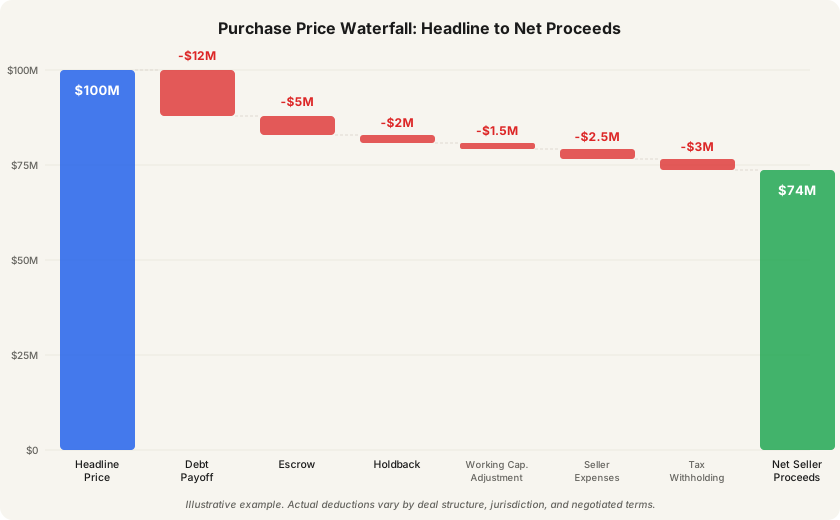
The most common source of surprises for AI company founders is the “waterfall” of deductions from the headline purchase price. A founder expecting to receive $20 million may net $14-15 million after escrow, IP holdback, talent retention reserves, working capital adjustments, and transaction expenses. The funds flow makes this visible — and it is often the first time the founder fully appreciates the gap between headline price and cash in hand. Reviewing the waterfall early — ideally before signing the LOI — prevents closing-day disputes.
AI Company-Specific Funds Flow Considerations
Rollover Equity for Founding Teams
Rollover equity is common in AI company acquisitions, particularly when the buyer — strategic acquirer or PE firm — needs the founding team to continue developing the model post-closing. Rollover equity means that a portion of the founder’s proceeds is not paid in cash at closing but is instead reinvested in the acquirer (or in a new holding structure).
From a funds flow perspective, rollover equity appears as both a source (the deemed contribution of the rolled equity) and a use (the issuance of the new equity instrument). The net cash position of the rolling shareholders changes by less than the headline deal value suggests. Key funds flow considerations for rollover equity:
- Roll percentage: What percentage of the founder’s equity is being rolled vs. cashed out? Typical AI company transactions see founding teams rolling 10-30% of their stake, depending on how central they are to the business’s ongoing value creation.
- Valuation of the rolled equity: The rolled equity must be valued consistently with the transaction — at the same per-share price as the cash consideration. Discrepancies between cash and rollover valuation create tax complications.
- Vesting on rolled equity: The rollover equity typically vests over 2-4 years post-closing, creating the golden handcuffs that retain the founding team. The funds flow must reflect the total value of the rollover and its vesting schedule.
For PE-sponsored transactions specifically, rollover equity gives the founding team upside in the platform’s future exit — aligning their interests with the PE sponsor’s value creation agenda. For strategic acquirer transactions, rollover mechanisms are less common (the acquirer typically doesn’t have a marketable equity instrument to offer) and retention is instead structured through deferred cash, retention bonuses, or earnouts.
IP Escrow Structures for AI Companies
Standard M&A transactions use general escrow for post-closing indemnification claims — a percentage of the purchase price held back for 12-18 months. AI company transactions often include an additional IP escrow, specific to the model ownership and training data representations.
Why? Because AI IP is more complex to represent and diligence than standard software IP. After closing, buyers may discover issues with:
- Open-source licence components embedded in proprietary models without proper licensing documentation
- Training data used under informal or expired arrangements that come to light post-closing
- Model weight ownership disputes arising from co-development arrangements that were not fully disclosed
- Third-party patent claims against model architectures or training methodologies
An IP escrow provides the buyer with financial protection for these risks without requiring every IP issue to be fully resolved before closing — which would often extend timelines unacceptably. The funds flow must reflect:
- The IP escrow amount (typically 5-15% of total consideration, held separately from general indemnification escrow)
- The IP escrow release timeline (often longer than general escrow — 24-36 months — to allow time for post-closing IP issues to surface)
- The conditions for IP escrow release and the claims process
For sellers, negotiating the IP escrow amount and release conditions is as important as negotiating the headline price. An IP escrow that is too large or held too long can materially reduce the effective cash-at-close.
Milestone Payments Tied to Model Performance Metrics
AI company earnouts frequently use model performance metrics rather than (or in addition to) revenue milestones. These earnouts are not part of the closing funds flow — they are deferred payments triggered by future events — but the funds flow memo must clearly define the earnout mechanics so all parties have a shared record.
Common AI company earnout structures and their funds flow treatment:
Model accuracy earnouts: Payment triggered when the AI model achieves a defined accuracy threshold (e.g., 95% classification accuracy on a defined test set) within 12-24 months post-closing. The funds flow at closing shows zero for this item (deferred), with a separate payment schedule specifying the amount and timing if the threshold is met.
Deployment adoption earnouts: Payment triggered when a defined number of the acquirer’s enterprise customers adopt the AI feature, or when the integrated capability reaches a specified usage volume. These are common in strategic acquisitions where the buyer is acquiring AI to embed in their product.
ARR milestone earnouts: For AI-native SaaS platforms, payments tied to ARR reaching $X within 12-24 months post-closing. The closing funds flow reflects zero; separate earnout schedules specify amounts and timelines.
For sellers, the key risk with performance-based earnouts is that post-closing decisions within the buyer’s control — sales resource allocation, product prioritisation, pricing — can prevent an achievable earnout from being earned. The funds flow mechanics should be supported by earnout protection provisions in the SPA: seller approval rights over material decisions affecting the earnout period, good-faith obligations, and anti-sandbagging protections.
Treatment of GPU Infrastructure in Asset vs. Stock Deal Structures
AI companies often have significant GPU infrastructure — either owned hardware or contractual arrangements for cloud or colocation compute. The funds flow treatment differs materially depending on the deal structure.
Stock deal: In a stock acquisition, GPU infrastructure transfers automatically with the entity. The funds flow reflects this simply: the buyer pays for all the company’s assets and liabilities by acquiring the shares. However, the funds flow must account for:
- Prepaid amounts on GPU compute contracts that represent current assets
- Security deposits held with GPU providers or data centres
- Any early termination costs if the buyer plans to migrate compute infrastructure post-closing
Asset deal: In an asset acquisition, GPU hardware must be specifically listed in the asset purchase schedule and valued. Contractual GPU infrastructure (cloud compute agreements, colocation contracts) must be novated or assigned — which may require counterparty consent. The funds flow in an asset deal is more complex: it must separately identify the GPU assets being transferred, reflect any transfer taxes or duties, and account for the cash flows associated with any GPU infrastructure contracts being assumed.
For AI companies with significant on-premise GPU infrastructure, the funds flow discussion should address depreciation treatment: the book value of owned GPU hardware (which depreciates quickly) may differ significantly from its replacement cost value. Buyers and sellers sometimes negotiate separately over GPU infrastructure valuation — a point where the sell-side advisor must ensure the founder is not inadvertently giving away value.
The Funds Flow Process: Step by Step
1. Start Early
The funds flow memo should be initiated at the same time as the SPA drafting process. For AI company transactions with multiple complex components — rollover equity, IP escrow, model performance earnouts, GPU infrastructure — starting late creates compounding complexity that causes closing delays.
2. Map the Transaction Structure
Before drafting amounts, map the structural flow. For cross-border AI company transactions in APAC — a Singapore-based AI company being acquired by a Japanese strategic acquirer, for example — funds may need to flow through multiple entities in different jurisdictions. The funds flow must trace the path from the ultimate source through each intermediate entity to the final recipients, ensuring compliance with local foreign exchange regulations and optimising tax treatment.
3. Calculate the Numbers
AI company-specific calculations that feed into the funds flow:
- Estimated working capital adjustment: AI companies may have unusual working capital profiles — deferred revenue from prepaid SaaS contracts, prepaid GPU compute costs — that require careful treatment in the working capital definition
- Net debt calculation: Outstanding borrowings minus cash on hand. For AI companies with venture debt or credit facilities secured against ARR, the exact payoff amount must be confirmed with lenders
- Rollover equity valuation: The per-share value used for rollover equity must match the cash consideration
- Talent retention reserve: Total estimated cost of retention packages for key engineers and researchers
- Transaction expense tallies: Final invoices from advisors and legal counsel on both sides
4. Collect and Verify Wire Instructions
Every recipient provides wire instructions: bank name, account number, routing number or SWIFT code, and account holder name. These must be verified independently — not by replying to the email that delivered them, but through a separate channel (phone callback to a known number). AI company founders, who are often in communication with many parties simultaneously during a closing, are particularly vulnerable to business email compromise targeting wire instructions.
5. Circulate, Review, Reconcile
The draft funds flow is circulated to all parties: buyer, seller, their respective counsel, the escrow agent, and any lenders. Each party verifies the amounts relevant to them. For AI company transactions, the founding team should review the rollover equity calculations and retention reserve amounts carefully — these affect the day-one cash they receive. The final version is signed off by all parties before closing.
6. Execute on Closing Day
On closing day, the sequence matters. Lender funds are typically drawn first. The buyer then aggregates all sources and distributes funds per the memo. The escrow agent confirms receipt of both general escrow and IP escrow amounts. Once all wires are confirmed, closing certificates are exchanged and IP assignment agreements are executed.
Working Capital Adjustments for AI Companies
Most mid-market transactions use a working capital peg mechanism. For AI companies, the working capital definition requires careful tailoring:
- Deferred revenue: SaaS subscription revenue received in advance is typically excluded from working capital (it’s a liability, offset by the future service obligation). The peg must be calibrated to the AI company’s subscription billing patterns.
- Prepaid GPU compute: Prepaid amounts on cloud compute contracts are current assets that should be included in working capital. If the buyer plans to migrate infrastructure post-closing, the treatment of prepaid compute credits is a negotiating point.
- Deferred commission: Sales commissions capitalised under ASC 606/IFRS 15 — increasingly common in AI SaaS companies — require clear treatment in the working capital definition.
An alternative approach is the locked box mechanism, which fixes the price to a historical balance sheet date. For AI companies with rapidly changing working capital profiles — driven by subscription billing patterns and GPU infrastructure spend — the locked box can simplify the funds flow significantly, but the seller must avoid “leakage” between the locked box date and closing.
Cross-Border Funds Flow for AI Transactions in Asia Pacific
Cross-border AI company transactions in APAC introduce additional funds flow complexity. Based on what we see at Amafi, these are the most common friction points:
Foreign exchange controls: Several APAC jurisdictions restrict cross-border fund flows. China’s SAFE requires approval for outbound remittances. India’s Reserve Bank requires FEMA compliance for cross-border M&A payments. Japan’s Foreign Exchange and Foreign Trade Act requires post-transaction reporting. The funds flow must account for the timing and sequencing of regulatory approvals.
Withholding tax on IP royalties: If the AI company has IP holding structures — which many do for tax efficiency — cross-border payments on IP licenses may attract withholding. The funds flow must identify gross amounts, applicable withholding rates, and net transfers. Double tax treaties can reduce withholding rates, but treaty benefits must be claimed in advance.
Currency conversion timing: When the purchase price is denominated in USD but the buyer’s funds originate in JPY, KRW, or SGD, the conversion timing and rate matter materially on large transactions. Sophisticated deal teams lock in rates through forward contracts or specify a conversion window in the SPA.
Multi-entity structures common in APAC AI companies: Many APAC AI companies have holding structures in Singapore, Hong Kong, or the Cayman Islands, with operating entities in multiple markets. The funds flow must trace the path from the ultimate source through each intermediate entity to the final recipients, ensuring that each leg complies with local regulations and the IP assignment occurs at the correct entity level.
Common Pitfalls and How to Avoid Them
Late preparation
The most common pitfall is starting the funds flow too late. Best practice: circulate a draft five to seven business days before closing, even if some numbers are still estimated.
Wire instruction fraud
Business email compromise targeting M&A closings is a real and growing threat. Prevention requires out-of-band verification — confirming wire details by phone to a known number, not a number provided in the same email.
Forgetting AI-specific deductions
AI company founders frequently underestimate the gap between headline price and net proceeds. The full waterfall must include: existing debt payoff, IP escrow, general escrow, talent retention reserves, working capital adjustment, transaction expenses, and tax withholding. Presenting this waterfall early — ideally before signing the LOI — avoids closing-day surprises.
Earnout mechanics not fully documented
Earnout payments tied to model performance metrics or ARR milestones must have clear definitions in both the SPA and the funds flow memo. Vague earnout mechanics — “payment if the model performs well” without specific metric definitions — become contentious post-closing. The funds flow should reference the specific earnout schedule from the SPA, with the metric, threshold, measurement date, and payment amount all confirmed.
Ignoring time zones
In cross-border APAC AI transactions, closing parties may be in Tokyo, Singapore, Sydney, and New York. Wire transfer cut-off times vary by bank and jurisdiction. A wire initiated at 4 PM Singapore time may not settle in New York until the next business day. The funds flow schedule must account for time zones and bank processing windows.
Need help coordinating AI company M&A transactions across Asia Pacific? Amafi helps founders and advisors manage deal execution across APAC markets — from IP escrow structures to AI company earnout design and cross-border funds flow coordination. Get in touch to learn how we can support your next closing.