How to Build a Buyer List for an AI Company M&A Deal
How to build an M&A buyer list for an AI company sale — strategic buyers with AI acquisition mandates, PE firms building AI platforms, tech giants, and AI-powered identification.
Why the Buyer List Is the Most Important Deliverable in an AI Company Sale
The buyer list is the single most consequential work product a sell-side advisor creates. Every other element of the process — the teaser, the CIM, the management presentation, the negotiation strategy — depends on who is in the room. A perfectly crafted CIM sent to buyers who don’t value your AI capability produces poor bids. The right buyer list — spanning all three buyer categories — generates competitive tension across different valuation frameworks, which is where AI company valuations are won.
For AI company transactions specifically, buyer list construction has an additional dimension: different buyer types price the same AI company on fundamentally different bases. A strategic acquirer values the capability against their cost to build it in-house. A tech giant values the talent and model against their product roadmap timeline. A PE firm values the recurring revenue and expansion potential within a fund horizon. Getting all three buyer types into the same auction — even if not all three ultimately bid aggressively — creates the valuation tension that produces the best outcomes for AI company founders.
This article covers how to build a buyer list that maximises competitive tension in an AI company sale — from categorising the three buyer types to sourcing names, qualifying prospects, and using AI-powered tools to surface the strategic acquirers that traditional methods miss.
Buyer Categories for AI Company Transactions
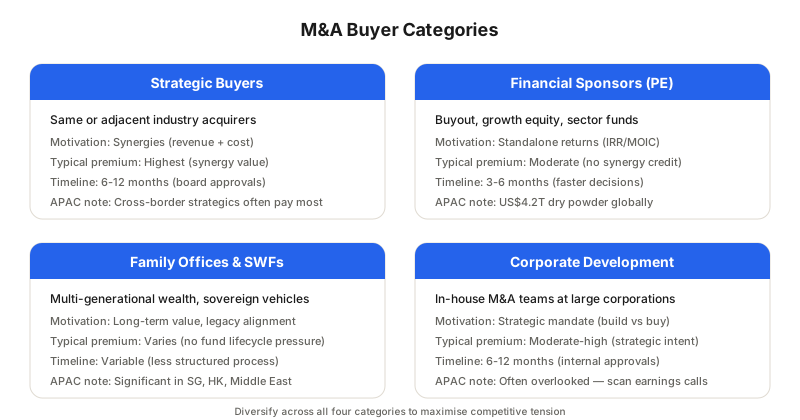
Every AI company buyer list must include parties from all three buyer categories. The categories are not interchangeable — they have different motivations, valuation frameworks, and deal structure preferences.
Category 1: Strategic Acquirers with AI Transformation Mandates
Strategic buyers are the most diverse and often most aggressive buyer type for AI companies. They are corporates outside the AI sector that have decided to acquire AI capability rather than build it — a decision driven by competitive pressure, board mandates, or digital transformation programmes. Their valuation logic is “build vs. buy”: what would it cost us, and how long would it take, to build this capability in-house? An AI company that would take three years and $30M to replicate may be worth $40M+ to a strategic acquirer who needs the capability in 12 months.
In APAC AI M&A, strategic acquirers are concentrated in several industries and geographies:
- Japanese conglomerates across manufacturing, finance, insurance, and healthcare: Companies like Hitachi, Fujitsu, NTT, Mitsubishi, and their affiliates are executing AI transformation programmes under board mandate. They are acquiring AI companies — particularly those with vertical applications in their core sectors — at valuations that reflect the capability gap they are closing, not just the revenue being acquired.
- Korean chaebols and their affiliates: Samsung, SK Group, LG, Kakao, Naver, and the M&A arms of their affiliates are building AI capability across consumer electronics, semiconductor design, enterprise software, and financial services. Korean acquirers move faster than Japanese ones but require multiple layers of internal approval.
- Singapore government-linked corporations and financial institutions: DBS, OCBC, UOB, Temasek portfolio companies, and Singapore state agencies are acquiring AI capabilities with APAC market applicability — particularly in financial services, healthcare, and urban infrastructure.
- Australian corporates in finance, resources, and healthcare: Australian financial institutions and large corporates with digital transformation programmes are increasingly pursuing AI capability acquisitions, particularly in document processing, customer service automation, and predictive analytics.
- US corporates with APAC AI strategies: Large US companies expanding their AI capabilities for APAC market applications — often through acquisition of locally-trained models and APAC-specialised teams.
Identifying the right strategic buyers requires researching corporate AI strategies beyond the obvious names. The value is in identifying non-obvious strategic acquirers: companies in adjacent verticals expanding into the AI company’s sector, international players seeking APAC AI talent, or companies whose core products become significantly more valuable when combined with the AI capability being acquired.
Category 2: PE Firms and Growth Equity Funds with AI Sector Theses
Financial sponsors are increasingly active in AI M&A. The PE buyer landscape for AI companies includes:
- Buyout funds building AI-sector platforms through roll-up acquisition strategies, acquiring multiple AI companies in the same vertical to build scale and cross-sell leverage
- Growth equity funds targeting minority or majority stakes in high-growth AI companies with strong ARR metrics and expansion potential
- Sector-specialist funds with explicit AI mandates — funds that have declared AI as a primary investment thesis and are actively building positions across the sector
- PE firms with existing portfolio companies that can deploy the AI capability — a PE-backed financial services business, for example, that would benefit from acquiring an AI-powered document processing company
Financial sponsors evaluate AI companies on standalone returns within their fund horizon. The best PE buyers for AI company transactions are those whose investment thesis explicitly covers AI sector expansion — these buyers have done the sector work, understand AI company valuation frameworks, and can move quickly.
Category 3: Technology Companies and AI Companies Seeking Specific Capabilities
The technology company buyer category includes some of the most aggressive buyers in AI M&A:
- Cloud hyperscalers (Microsoft, Google, Amazon, Alibaba, Tencent) acquiring AI companies for model capabilities, specialised datasets, or APAC AI talent
- Enterprise software platforms acquiring AI capabilities to embed in their existing products — CRM, ERP, and productivity software companies that need AI features to remain competitive
- Established AI companies acquiring smaller AI companies for specific model capabilities, vertical expertise, or geographic expansion
- Large technology companies in APAC — Samsung, Sony, NTT, Baidu, and others — acquiring AI companies as part of their AI product development strategies
Technology company buyers impose the most rigorous IP diligence of any buyer type. They will conduct detailed reviews of model architecture, training data provenance, and IP ownership. But they also bring the highest per-dollar valuations for AI capabilities they cannot build within their required timeframe.
Family Offices and Sovereign Wealth Funds
Family offices and sovereign wealth funds — particularly active in Singapore, the Middle East, and Greater China — are increasingly direct investors in AI companies. Unlike PE firms, they are not constrained by fund lifecycles and can hold investments indefinitely. Singapore’s Temasek, GIC, and their affiliated investment vehicles are among the most active in this category for APAC AI transactions.
Strategic Acquirers Specifically Seeking AI Capability
For AI company sell-side processes, building the strategic buyer list requires a systematic approach to identifying which corporates are actively acquiring AI — and which type of AI capability they are seeking.
How to Identify Active AI Acquirers
Published corporate AI strategies: Most large corporates publish AI investment priorities in annual reports, investor presentations, and press releases. A Japanese conglomerate announcing a ¥100 billion AI investment programme is signalling an appetite for AI company acquisitions, not just internal development. Reading these materials identifies which companies have AI acquisition mandates and what specific capabilities they are seeking.
Recent acquisition history: Transaction databases like PitchBook and Refinitiv track AI company acquisitions by strategic buyers. Searching for companies that have acquired AI startups in the past two to three years in adjacent sectors reveals active acquirers — their acquisition thesis, their valuation approach, and the types of AI capabilities they are buying.
Corporate development contacts at potential acquirers: For APAC strategic buyers specifically, the corporate development teams at Japanese and Korean companies often have AI acquisition mandates that are not publicly discussed. Building relationships with these teams — directly or through local advisory firms — surfaces active buyer interest before it becomes visible through formal channels.
AI transformation programme announcements: Companies announcing digital transformation programmes with AI components are often simultaneously developing AI acquisition strategies. A financial institution announcing an AI transformation initiative for back-office operations is a plausible acquirer for an AI-powered document processing company.
The Build vs. Buy Framing for Strategic Buyers
The most important concept for positioning an AI company to strategic acquirers is the “build vs. buy” analysis. Strategic buyers — particularly those with corporate AI transformation mandates — evaluate acquisitions by comparing the acquisition price against:
- The estimated cost to build the same capability in-house
- The estimated timeline to build it (typically 18-36 months for a non-AI-native company)
- The competitive risk of waiting — what market position is lost if they don’t have this capability for 2+ years?
An AI company that would cost $20M and 24 months to replicate represents a much higher acquisition value to a strategic buyer than the standalone financial analysis would suggest. Advisors who frame AI company valuations using this logic — and build the buyer list with strategic acquirers who face the most acute capability gaps — consistently achieve better outcomes than those who rely on pure financial multiples.
Building the Long List: Where to Source Names
Primary Sourcing Channels for AI Company Buyer Lists
Transaction databases for AI M&A: PitchBook, Capital IQ, and Refinitiv all track AI company acquisitions. Filtering for acquirers who have completed AI company transactions in the past two to three years reveals active buyers, their valuation approaches, and their acquisition criteria. This is the foundation of any AI company buyer list.
Corporate AI strategy research: Company annual reports, investor day presentations, and earnings call transcripts are rich sources of AI acquisition intent signals. Many large corporates explicitly discuss their AI capability gaps and acquisition strategies in these materials.
AI industry publications and conference intelligence: AI industry conferences — NeurIPS, ICML, major product launches — are where corporate AI strategies are articulated in detail. The announcements made at these events often directly signal acquisition priorities.
Advisor network for PE buyers: Financial sponsor investment theses are not always public. Senior advisors maintain relationships with PE firms across their AI sector coverage, and these relationships surface fund-level AI acquisition mandates that aren’t visible through database research.
AI company buyer research: At Amafi Advisory, buyer identification is a core part of every AI company sell-side mandate, particularly for APAC transactions where strategic buyer information is fragmented across Japanese, Korean, and Chinese language sources that English-language databases systematically undercount. The research process looks for strategic buyers whose published strategies, recent acquisition histories, and capability gaps signal AI appetite, even when those buyers have not yet entered a formal acquisition process.
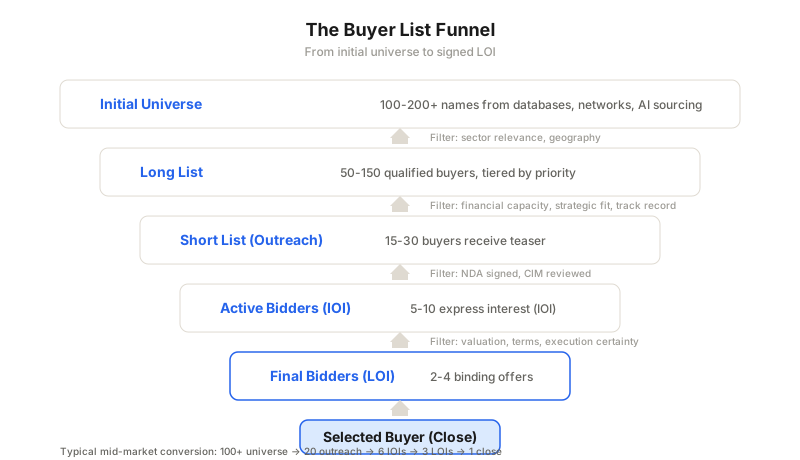
Qualifying and Prioritising: From Long List to Short List
Qualification Criteria for AI Company Buyers
| Criterion | What to Assess for AI Companies | Red Flags |
|---|---|---|
| Strategic fit | Does the AI capability fill a genuine gap in their product or operations? | Buyer has no stated AI strategy or history of AI investment |
| AI acquisition readiness | Has the buyer completed AI company acquisitions before? Do they have technical teams for IP diligence? | No prior AI acquisition experience, no technical diligence capability |
| Financial capacity | Can the buyer fund the acquisition at the expected valuation, including talent retention packages? | Fund near end of lifecycle, budget constrained by prior large acquisitions |
| IP diligence experience | Will the buyer’s IP review be proportionate, or will it create disclosure risk disproportionate to the transaction size? | History of using diligence to re-trade on price |
| Regulatory risk | Will the buyer nationality or sector trigger foreign investment review in the AI sector? | Cross-border buyers in sensitive AI sectors (defence tech, critical infrastructure) |
| Post-acquisition intent | Will the AI team be retained and the capability developed, or is this an acqui-hire followed by shutdown? | History of technology capability acquisitions without team retention |
Tiering the Short List for AI Company Auctions
Tier 1 — Lead prospects (5-8 buyers). The buyers most likely to submit competitive bids: strategic acquirers with an active AI capability mandate that directly matches the company’s offering, PE firms with explicit AI sector investment theses, and technology companies with documented gaps in the specific AI area. These buyers receive the most customised outreach and relationship management.
Tier 2 — Strong candidates (8-12 buyers). Good strategic fit but may require more education about the opportunity, are less obviously motivated, or are approaching the AI acquisition area for the first time. They provide competitive depth and occasionally outbid Tier 1 buyers when the specific AI capability resonates unexpectedly.
Tier 3 — Optionality (5-10 buyers). Cross-border buyers exploring AI acquisition in a new geography, PE firms evaluating a sector entry, or corporate development teams that may need internal approval before engaging. Worth approaching because they occasionally produce the surprise bids that drive final round valuations.
“The AI company deals where we’ve achieved the highest valuations almost always involved a strategic acquirer from Tier 2 or Tier 3 — a Japanese corporate or Korean chaebol affiliate that nobody expected to bid aggressively — and that’s driven entirely by a build-vs-buy calculation that the financial buyers couldn’t match,” says Daniel Bae, founder of Amafi.
Research-Led Buyer Identification for APAC AI Transactions
The APAC AI buyer landscape is systematically undercovered by traditional buyer list approaches. The reasons are structural:
- Japanese and Korean strategic acquirer activity is documented in non-English sources, creating blind spots for advisors relying on English-language databases
- PE firms with AI sector mandates in Southeast Asia are often less publicly visible than their US and European counterparts
- Corporate AI acquisition strategies at APAC conglomerates are less frequently covered by English-language financial media
AI-assisted research addresses these blind spots when it is embedded in a senior-led advisory process. Company databases, transaction records, investor mandates, corporate strategy documents, and news signals across multiple languages can all help identify buyers that manual research alone would take weeks to surface. The advisory judgement comes in qualifying which buyers have a real strategic reason to engage, which relationship path is credible, and which parties are likely to pay for the specific AI capability being sold.
At Amafi Advisory, we apply this research discipline on AI company sell-side mandates. The starting point is a buyer universe that is broader, more systematically qualified, and less biased toward existing English-language relationships than a purely manual approach produces.
APAC-Specific Buyer List Considerations for AI Companies
Japanese and Korean Strategic Acquirers
Japan and Korea represent the largest opportunity for AI company acquisitions in APAC that most sell-side advisors underexploit. Both countries have major corporate AI transformation programmes and limited ability to build AI capability domestically at the speed their boards require. The acquisition of well-positioned AI companies — particularly those with APAC-localised models, specific vertical applications, or strong engineering teams — fills a genuine strategic gap.
Reaching Japanese and Korean strategic buyers requires relationship infrastructure that many APAC advisory firms lack. Cold outreach to a Japanese corporate’s corporate development team is significantly less effective than an introduction through an established relationship. Building the buyer list for these markets requires noting not just the target buyer company but the relationship path — which advisory network, which intermediary, or which alumni connection provides the warm introduction.
Greater China Buyers
Chinese technology companies and conglomerates are active AI acquirers but face regulatory headwinds in acquiring APAC AI companies, particularly in Australia (FIRB foreign investment review) and potentially in the US (CFIUS). The buyer list should include Chinese buyers where regulatory clearance is feasible, but should flag the additional process complexity and timeline implications.
Language and Information Barriers
Buyer research for APAC AI acquisitions requires navigating multiple languages and information systems. A Korean chaebol’s AI acquisition history may be documented primarily in Korean-language filings. A Japanese corporate’s AI strategy is typically published in Japanese. The buyer list should not be limited to parties whose activities are well-documented in English-language sources — this systematically undercounts the most active strategic buyer types in APAC AI M&A.
Once the buyer list is built, the next step is preparing the approach for each buyer on the short list — profiling their AI acquisition strategy, identifying the right contact, and crafting an opening message that connects the AI capability to their specific mandate. For teams looking at automation around outreach workflows, see Amafi.ai’s guide to AI-automated buyer outreach.
Building a buyer list for an AI company sale? Amafi Advisory helps founders identify and prioritise strategic acquirers, PE firms with AI theses, and technology companies across Asia Pacific — including Japanese and Korean corporate buyers that generic sourcing methods often miss. Get in touch to strengthen your buyer universe.