Introduction
This guide covers the practical mechanics of structuring, executing, and closing cross-border acquisitions from the United States into Asia Pacific markets. It is written for US-based PE firms, corporate development teams, and their advisors who are evaluating or actively pursuing APAC acquisitions.
Cross-border M&A between the US and APAC has grown steadily over the past decade, driven by US companies seeking growth in Asia’s expanding economies and US PE firms deploying capital into markets that offer attractive risk-adjusted returns. Yet the structural complexity of these transactions — spanning multiple legal systems, tax regimes, regulatory frameworks, and currencies — means that deal teams must navigate significantly more variables than in domestic US transactions.
The guide covers entity structuring, tax treaty considerations, foreign investment regulatory frameworks, CFIUS implications, currency risk management, due diligence nuances, deal mechanics, and post-merger integration across APAC jurisdictions. Each section is grounded in the practical realities that deal teams encounter, not theoretical frameworks.
Entity Structuring for APAC Acquisitions
Why Structure Matters
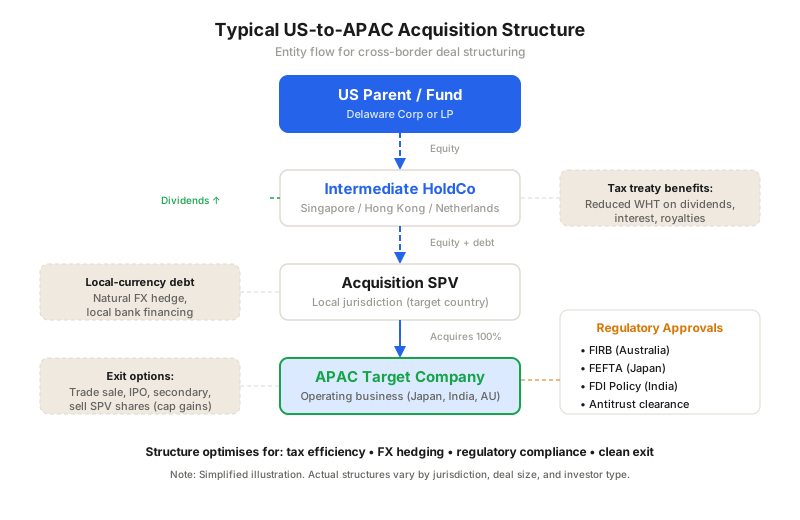
The entity structure of a cross-border acquisition determines the tax efficiency of the investment, the regulatory approvals required, the mechanics of profit repatriation, and the eventual exit pathway. Getting the structure right at the outset is essential — restructuring after closing is expensive and often triggers additional tax liabilities.
Common Structures
Direct acquisition from a US parent. The US entity directly acquires shares or assets of the APAC target. This is the simplest structure but is rarely optimal from a tax perspective. Dividends repatriated from the APAC subsidiary to the US parent are subject to US corporate income tax (with foreign tax credits) plus withholding taxes in the target country. The structure provides limited flexibility for future restructuring or exit.
Intermediate holding company. The US parent establishes a holding company in a jurisdiction with favorable tax treaty networks and no or low corporate tax on holding income. Common holding jurisdictions for US-APAC acquisitions include:
- Singapore — 0% withholding on dividends paid by Singapore companies, extensive tax treaty network across APAC, territorial tax system, robust IP protection
- Hong Kong — 0% withholding on dividends, no capital gains tax, but a more limited tax treaty network than Singapore
- Netherlands/Luxembourg — historically popular for US-APAC structures due to extensive treaty networks, though OECD BEPS reforms have reduced some advantages
The intermediate holding company acquires the APAC target, and profits flow from the target to the holdco with reduced withholding taxes under relevant bilateral tax treaties. Eventual sale of the APAC business can be structured at the holdco level, potentially accessing jurisdictions with no capital gains tax.
Special purpose vehicle at target level. For private equity transactions, the acquiring fund typically establishes a SPV in the target’s jurisdiction to acquire the business. The SPV is capitalised with equity from the fund (often through the intermediate holdco) and may also raise local-currency debt to finance the acquisition. This structure isolates the investment, simplifies exit, and provides clean bankruptcy remoteness.
Practical Recommendations
For US corporate acquirers making their first APAC acquisition, a Singapore intermediate holding company is often the optimal starting point. Singapore’s tax treaty network covers virtually every major APAC market, its corporate governance requirements are manageable, and the jurisdiction provides a natural base for expanding across ASEAN.
For US PE funds, the structure is typically dictated by the fund’s existing offshore feeder structure (often Cayman Islands or Delaware LP) flowing through a jurisdictional holdco into the target-level SPV.
In all cases, engage transfer pricing advisors early. Intercompany transactions between the US parent, the holdco, and the APAC operating entity must be structured at arm’s length to withstand scrutiny from tax authorities in multiple jurisdictions.
Tax Treaty Considerations
The Treaty Network
The United States has bilateral tax treaties with most major APAC economies. These treaties reduce or eliminate withholding taxes on cross-border payments (dividends, interest, royalties) and provide mechanisms for resolving double taxation.
| Target Country | Dividend WHT (Treaty Rate) | Interest WHT (Treaty Rate) | Royalty WHT (Treaty Rate) | Treaty Status |
|---|---|---|---|---|
| Australia | 15% | 10% | 5% | Active, comprehensive |
| Japan | 10% (0% for 50%+ ownership) | 10% (0% for certain) | 0% | Updated 2019, very favorable |
| India | 15-25% (varies by ownership) | 10-15% | 10-15% | Active, complex |
| South Korea | 10-15% | 12% | 10-15% | Active |
| Singapore | No treaty (but 0% domestic WHT on dividends) | 0% | 0% | No comprehensive treaty needed |
| Hong Kong | No treaty (but 0% domestic WHT) | 0% | 4.95% | Limited |
Japan has one of the most favorable US treaty arrangements in APAC. The 2019 protocol reduced the dividend withholding rate to 0% for US corporate shareholders owning 50% or more of the Japanese company — a significant incentive for US acquirers pursuing majority control.
Australia’s treaty provides a 15% dividend withholding rate, which is higher than some APAC jurisdictions but partially offset by Australia’s franking credit system on corporate profits.
India’s treaty is more complex, with varying rates depending on ownership percentage and the type of payment. The India-US treaty also contains a Limitation on Benefits (LOB) article that restricts treaty access to qualified residents — an important consideration when structuring through intermediate jurisdictions.
Transfer Pricing and BEPS
The OECD’s Base Erosion and Profit Shifting (BEPS) framework has tightened the rules around cross-border intercompany transactions. US acquirers must ensure that management fees, IP licensing payments, intercompany loans, and service charges between the US parent and APAC entities are priced at arm’s length and supported by contemporaneous transfer pricing documentation.
APAC tax authorities — particularly in Australia, India, Japan, and Korea — have become significantly more aggressive in challenging transfer pricing arrangements. The cost of a transfer pricing adjustment can be material, including penalties, interest, and potential double taxation if the adjustment is not matched in the US.
Foreign Investment Regulatory Frameworks
Country-by-Country Guide
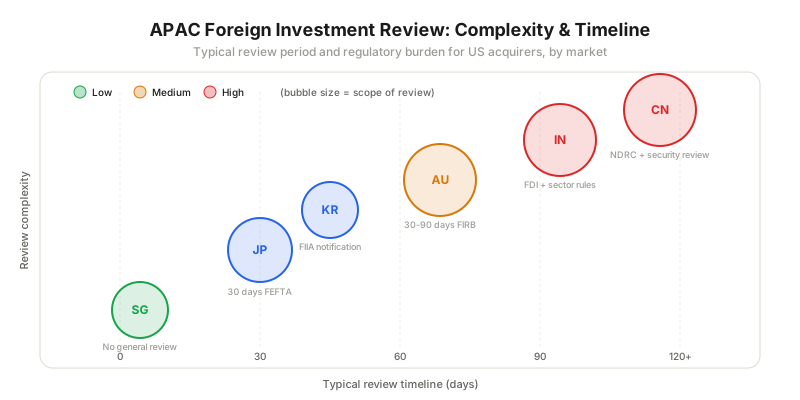
Each APAC jurisdiction has its own foreign investment review framework. Understanding the applicable regime is essential for deal timing and structuring.
Australia (FIRB)
The Foreign Investment Review Board screens acquisitions by “foreign persons” above certain monetary thresholds or in sensitive sectors. Key points for US acquirers:
- Thresholds. Under the Australia-US Free Trade Agreement, the monetary threshold for US investors in non-sensitive sectors is AUD 1.339 billion (2024) — significantly higher than for investors from non-FTA countries
- Sensitive sectors. Zero-dollar thresholds apply to media, telecommunications, defence, critical minerals, and agricultural land regardless of investor nationality
- Timeline. Standard review is 30 days, extendable to 90 days for complex transactions. National security reviews can extend to 90+ days
- Conditions. FIRB may approve acquisitions subject to conditions (employment guarantees, investment commitments, data residency requirements). US acquirers should anticipate and plan for potential conditions rather than being surprised by them
Japan (FEFTA)
- Prior notification required for foreign investment in designated sectors (defence, critical infrastructure, certain technology, agriculture, broadcasting)
- Standard review period is 30 days, which can be shortened for lower-risk transactions
- Most sectors are open to foreign investment without notification requirements
- Practical note. Japan’s foreign investment rules are less restrictive than many APAC jurisdictions. The primary barrier to US acquisitions in Japan is cultural, not regulatory
India (FDI Policy)
- Automatic route (no prior approval) covers most sectors: manufacturing, technology, healthcare, real estate, and financial services up to specified caps
- Government route (prior approval required) covers defence, media, retail, mining, and certain sensitive sectors
- Press Notes. India’s FDI policy is updated through “Press Notes” that can change sector rules at relatively short notice. Always verify current policy at transaction time
- Investment from countries sharing a land border with India (China, Pakistan, Bangladesh, Nepal, Myanmar, Bhutan, Afghanistan) requires mandatory government approval regardless of sector — this affects US entities with Chinese beneficial owners
South Korea (FIIA)
- Notification-based system for most sectors — notify the Ministry of Trade, Industry and Energy before or within 60 days of investment
- Restricted sectors include broadcasting, telecommunications, and nuclear energy
- National security review applies to investments in critical technology sectors, with review periods up to 60 days
- Practical note. Korea’s regulatory environment is more permissive than its reputation suggests, though navigating Korean business customs and the chaebol-influenced market requires cultural sophistication
Singapore
- No general foreign investment approval requirement. Singapore is one of the most open investment environments globally
- Competition review. The Competition and Consumer Commission of Singapore (CCCS) reviews mergers that may substantially lessen competition, but filing is voluntary and thresholds are high
- Sector-specific rules apply in banking, insurance, and media, requiring approval from relevant regulators
CFIUS Considerations for Reverse-Flow Transactions
While this guide focuses on US outbound acquisitions into APAC, deal teams should be aware that reverse-flow implications exist. If the US acquirer is itself partially owned by APAC-headquartered investors (common in PE fund structures with non-US LPs), or if the APAC target has US operations or US customer data, CFIUS considerations may arise.
The Committee on Foreign Investment in the United States (CFIUS) reviews transactions that could result in control of a US business by a foreign person, or that grant foreign persons access to critical technology, critical infrastructure, or sensitive personal data.
When CFIUS is relevant for US outbound deals:
- The APAC target has existing US subsidiaries or operations
- The transaction involves transfer of US-origin technology to a foreign entity
- The US acquirer’s fund structure includes significant LP commitments from APAC government-linked entities
According to the US Treasury’s annual report on CFIUS, 285 notices were filed in 2023, with the committee clearing the majority of transactions — but the review process adds 45-90 days and creates uncertainty that must be factored into deal timelines and closing conditions.
Currency Risk Management
The FX Challenge
Every US outbound APAC acquisition creates currency exposure. The US acquirer invests USD, the target generates revenue in local currency (JPY, AUD, INR, KRW, SGD, THB, VND), and the eventual exit or dividend repatriation must be converted back to USD. Currency movements over a 3-7 year hold period can materially impact returns — positively or negatively.
Hedging Strategies
Natural hedging. The most cost-effective approach is to match the currency of the acquisition financing with the currency of the target’s revenue. If a US PE fund acquires a Japanese company, financing the acquisition with JPY-denominated debt creates a natural hedge: JPY revenue services JPY debt, and the equity portion is the residual exposure. This approach is standard in Japan and Australia, where deep local debt markets exist.
Forward contracts. For PE firms with a defined exit strategy and timeline, forward contracts can lock in the conversion rate for a future date. The cost of the forward is determined by the interest rate differential between the two currencies. This approach works best when the exit timing is relatively predictable.
Options-based hedging. FX options provide the right (but not the obligation) to convert at a predetermined rate. More expensive than forwards, but they preserve upside if the currency moves favourably. Appropriate for larger transactions where the downside risk justifies the premium.
No hedging. Some investors, particularly those with long APAC track records, choose not to hedge currency exposure. Their view: over long hold periods, the operational improvements and earnings growth of the portfolio company dominate the currency effect. Hedging costs erode returns, and timing currency movements is unreliable.
Practical Guidance
For corporate acquirers making a long-term strategic entry into APAC, natural hedging through local-currency financing is typically optimal. The acquisition becomes a permanent part of the company’s operating footprint, and local-currency debt servicing reduces ongoing FX exposure.
For PE firms with defined hold periods, a combination of natural hedging (for the debt component) and selective forward contracts (for a portion of the equity return) provides reasonable downside protection without excessive cost.
Due Diligence Nuances in APAC
Cross-border due diligence in APAC requires adaptations to the standard US playbook.
Financial DD
- Accounting standards. Most APAC targets report under local GAAP (JGAAP, Indian GAAP) or IFRS. Reconciliation to US GAAP or a common baseline is essential for accurate valuation. Key areas of divergence include revenue recognition, lease accounting, goodwill treatment, and employee benefits provisioning.
- Quality of earnings analysis. Particularly important in India and Southeast Asia, where related-party transactions, owner personal expenses running through the business, and aggressive revenue recognition practices can distort reported earnings.
- Tax DD. Prior tax positions, ongoing tax disputes, and the risk of historical tax exposures should be thoroughly assessed. APAC tax authorities are increasingly conducting retrospective audits of acquired companies.
Legal DD
- Employment law varies dramatically across APAC. Japan’s employment protections make workforce reductions extremely difficult. India’s labour codes are currently being reformed but remain complex. Australian employment law includes modern award provisions and unfair dismissal protections that US acquirers must understand.
- Reps and warranties. The scope and enforceability of representations and warranties vary by jurisdiction. In some APAC markets (India, parts of Southeast Asia), the practical enforceability of contractual indemnities is less reliable than in the US. W&I insurance has become a standard mechanism for bridging this gap.
- IP protection. The strength of IP protection varies significantly across APAC. Japan, Singapore, and Australia have robust IP frameworks. India’s IP enforcement is improving but uneven. Southeast Asian markets outside Singapore present higher IP risk.
Commercial and Market DD
- Customer concentration risk is often higher in APAC targets than in comparable US businesses, particularly in Japan and Korea where large corporate buyers dominate customer portfolios.
- Market data. Reliable third-party market data is less available for many APAC sectors than for US sectors. Deal teams should budget for primary research (expert interviews, customer diligence) rather than relying solely on published market reports.
Deal Mechanics
Purchase Price and Consideration
Cross-border APAC transactions use the same consideration structures as domestic deals — cash, stock, or a combination — but with additional complexity.
Cash consideration in local currency. Most APAC sellers prefer cash, denominated in their local currency. The buyer bears the FX conversion risk between signing and closing. To manage this, the SPA should specify the currency of the purchase price and the exchange rate mechanism (typically a fixing rate on or near the closing date).
Earnouts. Common in transactions where the seller remains involved post-close. Cross-border earnouts require careful drafting to account for currency effects on milestones, potential changes in accounting standards, and the buyer’s post-close operating decisions that may affect the target’s ability to meet earnout thresholds.
Escrow and holdback mechanisms. Standard in APAC transactions, with holdback amounts typically ranging from 5-15% of the purchase price held for 12-24 months to cover post-close adjustments and warranty claims.
Closing Conditions
Closing conditions in cross-border APAC transactions typically include:
- Foreign investment regulatory approval (FIRB, FEFTA notification, FDI approval)
- Antitrust clearance in relevant jurisdictions
- Third-party consents (key customer contracts, licences, landlord consents)
- MAC clause — material adverse change provisions
- Completion of specified pre-closing reorganisation steps (common when the target has a complex group structure)
The gap between signing and closing in cross-border APAC transactions is typically 60-120 days — longer than domestic US deals — reflecting the time required for multi-jurisdictional regulatory approvals.
Definitive Agreement Considerations
The definitive agreement for a cross-border APAC acquisition should address several elements that are less prominent in domestic deals:
- Governing law and dispute resolution. Neutral jurisdictions (Singapore, Hong Kong) are common for governing law. Arbitration (SIAC or HKIAC) is generally preferred over litigation, as arbitral awards are more reliably enforceable across APAC jurisdictions under the New York Convention.
- Language. The agreement should specify the controlling language version (usually English, even when the target operates in Japanese, Korean, or another local language).
- Currency and exchange rate mechanics. As noted above, the agreement must specify how the purchase price is denominated and converted.
- Non-compete enforceability. Non-compete clauses in employment agreements and SPAs are enforceable in most APAC jurisdictions but the scope and duration allowed vary. Japanese courts enforce reasonable non-competes; Indian courts are more restrictive.
Post-Merger Integration Across Borders
Integration is where cross-border APAC transactions succeed or fail. According to Harvard Business Review, 70-90% of M&A failures are attributed to poor post-merger integration — and the failure rate is higher for cross-border deals where cultural misalignment compounds operational challenges.
Integration Principles for US-APAC Deals
Preserve local management autonomy. Unless the acquisition thesis specifically requires management change, the acquired company’s local team should retain significant operational autonomy during the first 12-18 months. Imposing US management practices on day one signals distrust and drives talent attrition.
Invest in cultural integration. Assign dedicated integration managers who understand both US and local business cultures. Cross-cultural training for the US headquarters team is as important as orientation for the acquired company’s employees. Budget for regular in-person interactions — video calls cannot build the trust required for effective cross-border collaboration.
Align on financial reporting early. Harmonising financial reporting between the APAC entity and the US parent is a practical priority. This includes agreeing on the chart of accounts, management reporting cadence, KPI definitions, and the level of detail required in monthly/quarterly reports.
Protect key relationships. In relationship-driven APAC markets, key customer and supplier relationships are often held by specific individuals. Identify these relationship holders during diligence and ensure retention plans are in place before closing.
“Successful cross-border integration requires the acquiring team to lead with curiosity, not certainty,” says Daniel Bae, founder of Amafi and former M&A advisor with over US$30 billion in transaction experience. “The acquirer bought the business because it works. The integration plan should start with understanding why it works before changing anything.”
Sourcing APAC Targets as a US Acquirer
One of the most persistent challenges for US acquirers is identifying quality targets in APAC’s fragmented mid-market. Unlike the US, where databases like PitchBook, CapIQ, and Grata provide extensive private company coverage, APAC’s mid-market information landscape is distributed across languages, disclosure regimes, and local data sources.
Traditional approaches — engaging local investment banks, attending industry conferences, and leveraging personal networks — remain important but are inherently limited in coverage. A US corporate development team or PE deal team cannot maintain on-the-ground relationships across Japan, India, Australia, Singapore, Vietnam, and Korea simultaneously.
AI-powered deal sourcing platforms are filling this gap. By screening structured and unstructured data across APAC markets — company registries, financial filings, news, industry databases, and social media — AI can identify companies matching specific acquisition criteria that manual processes would miss.
Amafi was built specifically for this use case — an AI-native platform that screens, matches, and surfaces cross-border APAC deal opportunities. For US acquirers, the platform provides systematic coverage of fragmented APAC markets, intelligent matching against specific investment criteria, and curated deal flow that reduces the time from target identification to initial engagement.
Conclusion
Cross-border M&A from the US into Asia Pacific is structurally complex but commercially compelling. The region offers growth, diversification, and valuation arbitrage opportunities that domestic US deals increasingly cannot match.
Success requires more than financial ambition. It demands structural sophistication (entity design, tax planning, currency management), regulatory fluency (FIRB, FEFTA, FDI, CFIUS), cultural intelligence (negotiation styles, management dynamics, relationship norms), and operational discipline (integration planning, local autonomy, reporting alignment).
The firms and companies that build these capabilities — or partner with advisors who have them — will be well-positioned to capture value in APAC’s expanding M&A market for decades to come.
Ready to explore APAC acquisition opportunities? Amafi helps US PE firms and corporate acquirers source, screen, and match targets across Asia Pacific — from AI-powered deal identification to curated opportunity flow. Get in touch to discuss your APAC M&A strategy.

About the Author
Daniel Bae
Co-founder & CEO, Amafi
Daniel is an investment banker with 15+ years of experience in M&A, having advised on deals worth over US$30 billion. His career spans Citi, Moelis, Nomura, and ANZ across London, Hong Kong, and Sydney. He holds a combined Commerce/Law degree from the University of New South Wales. Daniel founded Amafi to solve the pain points in M&A, enabling bankers to focus on what matters most — delivering trusted advice to clients.
About Amafi
Amafi is an M&A advisory firm built for Asia Pacific. We help business owners sell their companies and corporate teams make strategic acquisitions — with bulge bracket execution quality at lower fees, powered by AI and a network of senior dealmakers.
Book a valuation meeting