M&A advisory fees are one of the largest transaction costs in selling a business, yet many sellers enter the process without understanding what they will pay. The standard model — a monthly retainer plus a percentage-based success fee — is straightforward in concept but highly variable in practice. The difference between a well-negotiated and poorly-negotiated fee arrangement can run into hundreds of thousands of dollars on a mid-market transaction.
The advisory relationship is formalised in an engagement letter, which defines the scope of work, fee structure, duration, and termination rights. Before signing, sellers should understand what each fee component covers and how the total cost varies with deal size, advisor type, and market.
This guide breaks down what sellers actually pay — based on current APAC mid-market practice, not theoretical fee schedules.
The Four Components of Advisory Fees
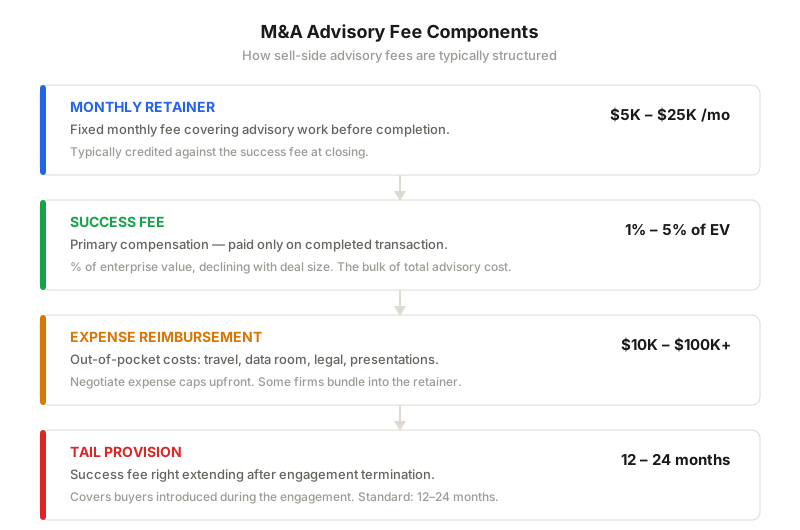
Advisory fees are not a single number. They consist of four distinct components, each of which is negotiable.
Monthly Retainer
The retainer is a fixed payment — typically USD 5,000 to USD 25,000 per month for mid-market transactions — that compensates the advisor for work performed before any transaction closes. This covers initial preparation: building the CIM, preparing the teaser, identifying buyers through deal sourcing, and running the outreach process.
The retainer serves a dual purpose. It provides cash-flow cover for the advisor’s upfront investment, and it demonstrates the seller’s commitment to proceeding with the sale. Advisors are wary of mandates where the seller has no financial stake in the process.
Key point: The retainer should be credited against the success fee upon completion. This is standard practice — if the deal closes, the retainer payments reduce the total success fee, meaning the seller does not pay twice for the same work. Insist on this provision.
Success Fee
The success fee is the primary advisory compensation and is paid only when a transaction completes. It is calculated as a percentage of enterprise value — or occasionally equity value — and represents the bulk of the total advisory cost.
Success fee percentages decline as deal size increases. According to the Association for Corporate Growth, mid-market transactions (USD 10 million to USD 250 million) typically command success fees between 1.5% and 5% of enterprise value. Smaller transactions carry higher percentages to ensure the advisor is adequately compensated for the time invested.
Fee basis matters. Whether the success fee is calculated on enterprise value or equity value can make a material difference for leveraged businesses. A company with USD 50 million in enterprise value but USD 15 million in debt has an equity value of USD 35 million — a 3% fee on enterprise value is USD 1.5 million, versus USD 1.05 million on equity value. Clarify this in the engagement letter before signing.
Expense Reimbursement
Advisory engagements generate out-of-pocket costs: travel for management meetings and site visits, data room setup and hosting, third-party research, printing and presentation materials, and legal review costs. These are typically passed through to the seller at cost.
Negotiate an expense cap upfront. Without one, expenses on a cross-border APAC transaction — where the buyer universe spans multiple countries — can escalate beyond expectations. A cap of USD 25,000 to USD 50,000 is reasonable for most mid-market transactions.
Tail Provision
The tail provision entitles the advisor to a success fee if the business is sold to a buyer the advisor introduced during the engagement — even after the engagement ends. Standard tail periods run 12 to 24 months.
Tail provisions exist for a legitimate reason: without them, a seller could terminate the engagement just before closing and complete the transaction without paying the fee. However, broadly worded tail clauses create problems — particularly if the seller changes advisors or sells the business years later to a buyer who was on a long list the first advisor compiled.
Negotiate for a tail that covers only buyers with whom the advisor had substantive contact (not just a name on a list), and cap the period at 12 months unless the advisor can justify a longer window.
The Lehman Formula and Its Variants
The most widely referenced fee structure in M&A is the Lehman formula, originally developed by Lehman Brothers. The original formula has been adapted repeatedly to reflect modern deal sizes.
Original Lehman Formula
| Transaction Value Tier | Fee Percentage |
|---|---|
| First USD 1 million | 5% |
| Second USD 1 million | 4% |
| Third USD 1 million | 3% |
| Fourth USD 1 million | 2% |
| Everything above USD 4 million | 1% |
Worked example: On a USD 10 million transaction, the original Lehman formula yields: (1M × 5%) + (1M × 4%) + (1M × 3%) + (1M × 2%) + (6M × 1%) = USD 200,000 — a 2.0% effective rate.
The original Lehman formula was designed when a USD 10 million deal was considered large. At current deal sizes, it produces fees that are often too low to compensate a sell-side advisor adequately.
Modified Lehman (Mid-Market Standard)
The modified Lehman applies the same tiered logic but scales each bracket to USD 10 million increments:
| Transaction Value Tier | Fee Percentage |
|---|---|
| First USD 10 million | 5% |
| USD 10–20 million | 4% |
| USD 20–30 million | 3% |
| USD 30–40 million | 2% |
| Everything above USD 40 million | 1% |
Worked example: On a USD 50 million transaction: (10M × 5%) + (10M × 4%) + (10M × 3%) + (10M × 2%) + (10M × 1%) = USD 1.5 million — a 3.0% effective rate.
The modified Lehman is the most common fee structure for mid-market sell-side mandates in the USD 15 million to USD 100 million range, according to Corporate Finance Institute.
Double Lehman
The double Lehman doubles each tier’s percentage from the original formula:
| Transaction Value Tier | Fee Percentage |
|---|---|
| First USD 1 million | 10% |
| Second USD 1 million | 8% |
| Third USD 1 million | 6% |
| Fourth USD 1 million | 4% |
| Everything above USD 4 million | 2% |
Worked example: On a USD 10 million transaction: (1M × 10%) + (1M × 8%) + (1M × 6%) + (1M × 4%) + (6M × 2%) = USD 400,000 — a 4.0% effective rate.
Double Lehman is typical for lower mid-market transactions (under USD 15 million) where the work required is comparable to a larger deal but the absolute fee at standard rates would not justify the advisor’s time.
Most sellers are better off comparing total fee as a percentage of expected deal value rather than fixating on formula mechanics. A 3% flat fee and a modified Lehman that works out to 3% are economically identical.
Fee Benchmarks by Deal Size
Market practice varies, but these ranges reflect current mid-market norms across APAC and globally:
| Enterprise Value | Monthly Retainer | Success Fee | Minimum Fee |
|---|---|---|---|
| Under USD 10M | USD 0–5,000 | 4–6% | USD 150,000–250,000 |
| USD 10–25M | USD 5,000–10,000 | 3–5% | USD 250,000–400,000 |
| USD 25–100M | USD 10,000–20,000 | 2–4% | USD 400,000–750,000 |
| USD 100–500M | USD 15,000–25,000 | 1–2.5% | Rarely applies |
| Above USD 500M | USD 20,000–50,000 | 0.5–1.5% | Rarely applies |
These are starting points, not fixed rates. Complexity (regulatory approvals, carve-out structures), sector specialisation, and competitive dynamics all influence where a given engagement falls within these ranges.
The minimum fee is a floor below which the success fee cannot fall, regardless of the formula. This protects the advisor on smaller transactions where a straight percentage might produce an inadequate fee relative to the work required. Minimum fees typically range from USD 150,000 to USD 500,000.
How Advisory Fees Differ Across Asia Pacific
Fee structures in APAC broadly mirror global conventions, but regional nuances are worth understanding.
Hong Kong and Singapore — advisory fees in these markets are closest to US and European practice. Success fees in the 2–4% range for mid-market transactions (USD 25–100 million) are standard. The advisory community is mature and competitive, which provides sellers with genuine negotiating leverage.
Japan — advisory mandates in Japan often involve longer pre-transaction advisory periods, reflecting the relationship-driven business culture and the time required to build consensus among stakeholders. Retainers may be higher relative to the success fee component, compensating advisors for the extended timeline. Cross-border transactions involving Japanese targets or acquirers may carry fee premiums of 10–20% due to language, regulatory, and cultural complexity.
“Advisory fees in APAC need to reflect the actual work required — and in markets like Japan, the pre-deal advisory period can be twice as long as a comparable US transaction,” says Daniel Bae, founder of Amafi and former M&A advisor with over US$30 billion in transaction experience. “Sellers should evaluate total value delivered, not just the headline fee percentage.”
Australia — the Australian mid-market is well-served by both global and domestic advisory firms. Fees are competitive. The Foreign Investment Review Board (FIRB) approval process for foreign acquirers can add complexity and cost, which may be reflected in advisory fees for transactions likely to attract foreign interest.
India — advisory fees in the Indian market tend to be lower in absolute terms, reflecting domestic deal sizes and competitive dynamics. Fees for cross-border transactions involving Indian targets — particularly outbound acquisitions by Indian corporates — are closer to global benchmarks.
At Amafi, we took a different approach entirely — no retainers, no monthly charges, success fee only. Our rates start at 3% for transactions under $25 million and step down from there, which runs roughly 50% below what traditional advisors charge at comparable deal sizes. We can do this because AI-powered deal sourcing and buyer matching reduce the operational cost of running a sell-side process — savings we pass directly to sellers.
Negotiating Advisory Fees: What Actually Works
The best time to negotiate fees is before signing the engagement letter — not after. Once the engagement is underway, the advisor’s leverage increases and the seller’s willingness to switch diminishes.
Engage multiple advisors. Request proposals from two or three advisors before committing. This is not about playing firms against each other — it is about understanding market rates and identifying which advisor’s approach and fee structure best fit your situation.
Negotiate the fee basis, not just the percentage. A 3% success fee on enterprise value is very different from 3% on equity value if your business carries debt. Clarify the basis in writing and ensure it aligns with how value will be measured — typically enterprise value on a cash-free, debt-free basis with a working capital adjustment.
Insist on retainer credit. The retainer should be fully credited against the success fee at closing. Any advisor who resists this is prioritising upfront revenue over alignment with your outcome.
Cap expenses. Agree on a maximum expense reimbursement — particularly for cross-border mandates where travel and multi-jurisdictional costs accumulate. USD 25,000 to USD 50,000 is reasonable for most mid-market transactions.
Narrow the tail. Push for a 12-month tail (rather than 24) covering only buyers with whom the advisor had direct, substantive engagement — not every name on a screening list. The tail should explicitly exclude buyers the seller independently identifies.
Consider incentive alignment. Some fee structures include a kicker — a higher success fee percentage for value above a minimum threshold. For example, 2% on the first USD 30 million and 4% on any value above USD 30 million. This rewards the advisor for negotiating a higher price and aligns incentives with the seller’s outcome.
Fee Traps That Cost Sellers Money
Certain fee provisions look standard but can be costly if sellers do not scrutinise them.
Broad transaction definitions. Some engagement letters define “transaction” broadly enough to include joint ventures, minority investments, recapitalisations, and other structures that the seller may not intend to compensate at the same rate as a full sale. Narrow the definition to the specific transaction type being pursued.
Uncapped tail clauses. A tail provision that covers “any buyer contacted during the engagement” — without specifying substantive contact — can entitle the advisor to a fee on a transaction with a buyer the advisor merely emailed once. The tail should cover buyers who progressed to a meaningful stage: signed an NDA, received the CIM, or submitted an indication of interest.
No retainer credit. If the retainer is not credited against the success fee, the seller pays both — the monthly retainers throughout the process plus the full success fee at closing. On a 12-month engagement with USD 15,000 monthly retainers, that is USD 180,000 in additional cost.
Ambiguous fee triggers. The engagement letter should be clear about what constitutes “completion” for success fee purposes — typically the closing of the transaction, not the signing of a definitive agreement. If the deal signs but never closes due to closing conditions failure, the success fee should not be payable.
Hidden additional fees. Some advisors charge separately for fairness opinions, valuations, or due diligence coordination. These may be reasonable, but they should be disclosed upfront — not presented as add-ons after the engagement is underway.
Want simpler, lower fees? Amafi charges a success fee only — no retainers, no monthly charges, no hidden costs. Our rates are up to 50% below traditional advisory fees because AI-powered processes let us deliver the same quality at lower cost. See our fee structure or book a valuation meeting to discuss your business.

About the Author
Daniel Bae
Co-founder & CEO, Amafi
Daniel is an investment banker with 15+ years of experience in M&A, having advised on deals worth over US$30 billion. His career spans Citi, Moelis, Nomura, and ANZ across London, Hong Kong, and Sydney. He holds a combined Commerce/Law degree from the University of New South Wales. Daniel founded Amafi to solve the pain points in M&A, enabling bankers to focus on what matters most — delivering trusted advice to clients.
About Amafi
Amafi is an M&A advisory firm built for Asia Pacific. We help business owners sell their companies and corporate teams make strategic acquisitions — with bulge bracket execution quality at lower fees, powered by AI and a network of senior dealmakers.
Learn about selling your businessGet M&A insights delivered
AI-powered deal sourcing strategies, market analysis, and Asia Pacific insights — straight to your inbox.