The AI Copilot Era Is Already Ending
For most of 2024 and 2025, M&A teams adopted AI the same way every other industry did: as a copilot. An analyst asks an LLM to draft a teaser. A VP uses ChatGPT to summarize a due diligence report. An associate pastes a target’s financials into a model and asks for a narrative. One question in, one answer out.
That copilot model is already being superseded. According to Gartner’s 2026 Strategic Technology Trends, agentic AI — systems that autonomously plan, decide, and act to achieve defined goals — will be embedded in 33% of enterprise software applications by 2028, up from less than 1% in 2024. In M&A, where deal workflows involve dozens of sequential steps across multiple parties, the shift from copilots to agents is particularly consequential.
The distinction matters: a copilot helps you do a task. An agent does the task — and the five tasks after it — while you focus on the decisions that actually require your judgment.
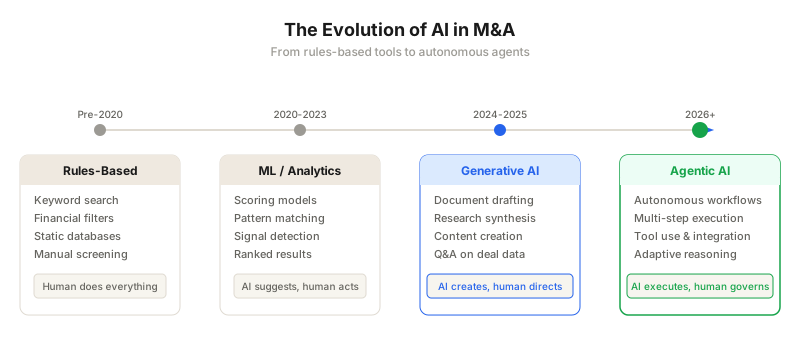
What Makes AI “Agentic” in M&A
The term “agentic” gets applied loosely. In the context of M&A workflows, an AI system is genuinely agentic when it exhibits four characteristics:
Goal-directed autonomy. The agent receives a high-level objective — “identify acquisition targets in APAC healthcare with US$5-20 million EBITDA and founder succession risk” — and independently determines the steps needed to achieve it. It decides which databases to search, what screening criteria to apply, what supplementary research to conduct, and how to rank and present results.
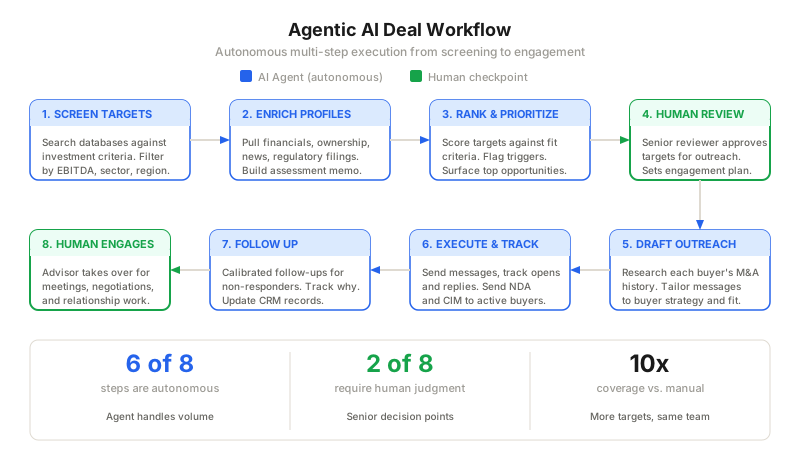
Multi-step execution. Unlike a single-turn copilot interaction, an agentic system chains actions together. It screens a target, pulls financial data, checks regulatory filings, drafts a preliminary assessment, identifies the right contact, personalizes outreach, sends the email, monitors for responses, and triggers follow-up sequences — all without waiting for human direction at each step.
Tool use and integration. Agentic AI systems use external tools: company databases, financial APIs, CRM platforms, email systems, virtual data rooms. They do not simply generate text — they take actions in real systems. An agent might create a new opportunity in your deal flow CRM, populate it with financial data, attach a screening memo, and assign it to the appropriate deal team member.
Adaptive reasoning. When an agent encounters unexpected information — a target company turns out to have been acquired last month, or a contact’s email bounces — it adapts. It finds an alternative contact, updates its records, adjusts the target list, and continues the workflow without requiring a human to troubleshoot.
Agentic AI Across the Deal Lifecycle
The deal stages where agentic AI delivers the most value share a common pattern: high volume, structured decision-making, and multiple sequential steps that currently consume analyst and associate time.
Deal Origination and Screening
This is where agentic AI has the largest immediate impact. Traditional deal sourcing involves an analyst manually searching databases, filtering spreadsheets, reading news, and building target lists — a process that takes days or weeks and covers only a fraction of the addressable market.
An agentic system monitors thousands of companies continuously, ingesting data from financial databases, news feeds, regulatory filings, social media, and industry publications. When a trigger event occurs — a founder reaches retirement age, a company’s growth inflects, a competitor exits the market — the agent evaluates it against predefined investment criteria, enriches the profile with financial and operational data, and surfaces it to the deal team with a preliminary assessment.
“We built Amafi around this exact principle,” says Daniel Bae, founder of Amafi and former M&A advisor with over US$30 billion in transaction experience. “The question was never whether AI could screen targets — it was whether AI could autonomously identify the right targets, at the right time, with enough context for a senior professional to make a decision in minutes instead of days.”
Buyer Outreach and Engagement
Outreach is the most labor-intensive stage of sell-side M&A. For a typical mid-market mandate, an advisor might contact 100-200 potential buyers — each requiring a personalized approach, NDA execution, CIM distribution, and follow-up sequences. Manually, this consumes weeks of associate time.
An agentic outreach system transforms this into a managed workflow:
- Research — the agent pulls each buyer’s acquisition history, sector focus, fund size, and recent activity
- Personalize — it drafts outreach tailored to the specific buyer’s strategy and the target’s fit
- Execute — it sends messages through the appropriate channels, tracks opens and responses
- Adapt — interested buyers receive the NDA and CIM automatically; non-responders receive calibrated follow-ups; rejections are logged with reason codes for future reference
- Escalate — when a buyer requests a meeting or asks a substantive question, the agent routes it to the human deal team
The result is not just speed but coverage. According to McKinsey’s 2025 State of AI survey, organizations using AI for customer outreach and engagement report a 20-30% increase in qualified response rates — not because the AI is more persuasive, but because it ensures every qualified buyer actually gets contacted, followed up with, and tracked.
This is how we run buyer outreach at Amafi — agentic systems handle the volume and sequencing of buyer engagement, while our senior advisors focus on the high-judgment interactions that close deals. Our clients benefit from systematic coverage without sacrificing the personal touch.
Due Diligence Triage
Due diligence generates thousands of documents — contracts, financial statements, regulatory filings, employment agreements, IP registrations. An agentic system does not just summarize individual documents (that is copilot behavior). It processes the entire data room, identifies patterns and anomalies across documents, flags material issues against a predefined risk framework, and produces a structured diligence memo that highlights what needs human attention.
For example, an agent reviewing a target’s contract portfolio might independently:
- Extract all change-of-control provisions across 200 customer contracts
- Flag the 12 contracts where a change of control triggers termination rights
- Calculate the revenue at risk from those provisions
- Cross-reference with the revenue concentration analysis
- Present a summary: “US$4.2 million in annual revenue (18% of total) is at risk from change-of-control provisions in customer contracts”
That synthesis — across documents, with quantified impact — is what makes the system agentic rather than just generative.
Deal Monitoring and Market Intelligence
Agentic systems excel at continuous monitoring tasks that humans cannot sustain. An agent tasked with tracking M&A activity in APAC financial services can simultaneously monitor regulatory filings across twelve jurisdictions, news feeds in multiple languages, company registry changes, job postings that signal expansion or restructuring, and financial data releases — surfacing only the signals that meet predefined relevance thresholds.
Risks and Guardrails
Agentic AI introduces risks that copilot-style tools do not. When an AI takes autonomous actions — sending emails, creating records, sharing documents — the blast radius of errors is larger.
Confidentiality
M&A is built on confidentiality. An agentic system with access to deal data and external communication channels must have strict boundaries on what information it can share, with whom, and under what conditions. A misconfigured outreach agent that includes deal-specific details in a buyer communication before NDA execution is not a minor error — it is a breach of the advisor’s fiduciary obligation.
Accuracy and Hallucination
Agentic systems make decisions based on data they retrieve and process. If an agent pulls incorrect financial data, misinterprets a regulatory filing, or hallucinates a company’s acquisition history, the downstream actions — outreach to the wrong buyers, incorrect screening assessments — compound the error. Human validation checkpoints at critical decision nodes are non-negotiable.
Regulatory and Compliance
Financial regulators are watching. The EU AI Act classifies AI systems used in credit and financial decisions as “high-risk,” requiring human oversight, documentation, and auditability. While M&A advisory is not yet explicitly regulated under AI-specific frameworks, the trajectory is clear. Firms deploying agentic AI should build auditability into their systems from the start: every agent decision logged, every action traceable, every escalation documented.
The Human-Agent Interface
The most effective implementations define clear escalation points. The agent handles volume and velocity; humans handle judgment and relationships. A well-designed system does not ask the managing director to review every screening memo — it asks them to review the three targets that passed all automated filters and warrant a senior conversation.
What This Means for M&A Professionals
The shift to agentic AI does not eliminate M&A jobs. It eliminates M&A tasks — the ones that consume 60-70% of junior professionals’ time and add limited intellectual value. Deal sourcing, target screening, outreach sequencing, document review, data entry, status tracking — these are the workflows being absorbed by agents.
What remains — and becomes more valuable — is judgment: which targets to pursue, how to position a company to buyers, when to push on price, how to navigate regulatory complexity in cross-border transactions, and how to manage the human dynamics of a deal that changes the trajectory of a company and the lives of its people.
For advisors and investors, the practical question is not whether to adopt agentic AI, but how quickly you can deploy it without compromising the confidentiality, accuracy, and relationship quality that define great dealmaking.
The firms that get this right will not just work faster — they will cover more of the market, identify better opportunities, and spend more of their senior professionals’ time on the activities that clients actually pay for. The firms that wait will find themselves competing against teams that can do in hours what used to take weeks.
According to Deloitte’s 2025 M&A Trends report, 72% of corporate development leaders plan to increase their AI investment in deal processes over the next 12 months. The agentic wave is not a prediction — it is a deployment already underway.
This is what separates Amafi from traditional advisors. Autonomous AI agents handle deal sourcing, buyer matching, and outreach sequencing — so our advisors spend their time on the relationships and judgement that close deals. The result for sellers: broader buyer coverage, faster processes, and better offers. Learn about selling your business or book a valuation meeting.

About the Author
Daniel Bae
Co-founder & CEO, Amafi
Daniel is an investment banker with 15+ years of experience in M&A, having advised on deals worth over US$30 billion. His career spans Citi, Moelis, Nomura, and ANZ across London, Hong Kong, and Sydney. He holds a combined Commerce/Law degree from the University of New South Wales. Daniel founded Amafi to solve the pain points in M&A, enabling bankers to focus on what matters most — delivering trusted advice to clients.
About Amafi
Amafi is an M&A advisory firm built for Asia Pacific. We help business owners sell their companies and corporate teams make strategic acquisitions — with bulge bracket execution quality at lower fees, powered by AI and a network of senior dealmakers.
Book a valuation meetingGet M&A insights delivered
AI-powered deal sourcing strategies, market analysis, and Asia Pacific insights — straight to your inbox.