Contract Review Is the Bottleneck in M&A Legal Diligence
A typical mid-market M&A transaction involves 300 to 500 contracts sitting in a virtual data room: customer agreements, supplier contracts, employment arrangements, real estate leases, IP licenses, partnership agreements, and regulatory filings. Each contract contains dozens of provisions, any one of which could affect deal value, structure, or risk allocation.
Traditionally, a team of lawyers reviews these contracts manually — reading every page, extracting key terms into a spreadsheet, and flagging issues for the deal team. For a mid-market deal, this process takes two to four weeks and costs US$200,000 to US$500,000 in legal fees. Even then, time pressure forces teams to prioritize: reviewing the top 50 contracts in detail, sampling another 50, and accepting the risk that the remaining 200 go unreviewed.
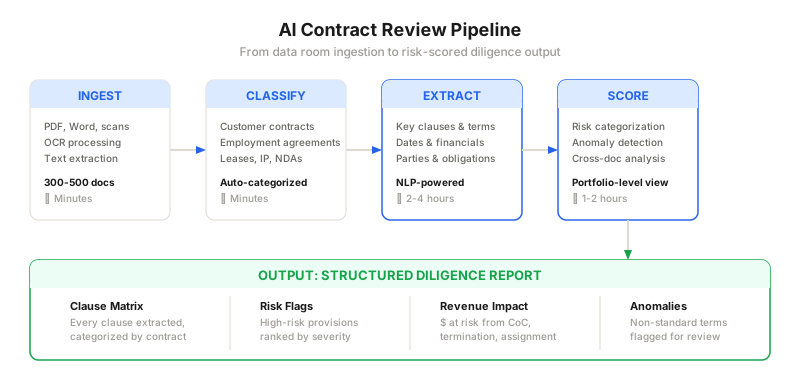
According to Thomson Reuters’ 2025 Legal Technology report, AI-powered contract review tools can now process that same 500-contract data room in four to eight hours — extracting key clauses, categorizing provisions against a risk framework, and producing structured outputs that let lawyers focus their time on the 15-20 contracts that actually contain material issues.
This is not about replacing lawyers. It is about changing what lawyers spend their time on — from reading every page of a supply agreement to evaluating the commercial impact of a change of control provision that the AI flagged in 30 seconds.
How AI Contract Review Works
AI contract review tools follow a structured pipeline. Understanding each stage helps deal teams set realistic expectations and configure systems for maximum accuracy.
Document Ingestion and Classification
The system ingests documents from the data room — PDFs, Word documents, scanned images. Native text documents (Word, searchable PDF) are processed directly. Scanned documents require optical character recognition (OCR), which introduces a layer of potential error, particularly for older documents, handwritten annotations, or non-Latin scripts.
The AI then classifies each document by type: customer contract, employment agreement, real estate lease, NDA, intellectual property license, shareholder agreement. This classification determines which extraction rules to apply — the provisions that matter in an employment contract (non-compete scope, severance triggers, change-of-control bonuses) are fundamentally different from those in a customer agreement (termination rights, pricing commitments, exclusivity).
Clause Extraction and Categorization
This is the core of the system. The AI reads each contract and extracts specific provisions into structured fields:
- Parties and counterparty information — who the contract is with, jurisdiction, entity type
- Term and renewal — start date, end date, automatic renewal provisions, notice periods
- Termination rights — termination for convenience, termination for cause, change-of-control triggers
- Financial terms — pricing, payment terms, minimum commitments, most-favored-nation clauses
- Liability and indemnification — indemnification obligations, limitation of liability caps, insurance requirements
- Assignment and consent — whether the contract can be assigned in a transaction, whether counterparty consent is required
- Restrictive covenants — non-compete and non-solicitation restrictions, exclusivity commitments
- Governing law and dispute resolution — jurisdiction, arbitration vs. litigation, choice of law
Modern NLP models do not rely on keyword matching. They understand contractual language semantically — recognizing that “upon a change in the controlling ownership of the Company” and “in the event of a sale of all or substantially all of the assets” both describe change-of-control scenarios, even though the language differs completely.
Risk Scoring and Anomaly Detection
Extracted clauses are scored against a configurable risk framework. A change-of-control provision that allows the counterparty to terminate a contract worth US$5 million annually is scored differently from the same provision in a US$50,000 contract.
The system also flags anomalies — provisions that deviate from standard market terms or from the other contracts in the same data room. An indemnification obligation with no cap in a single supplier contract, when all other supplier contracts have a 12-month cap, is flagged as an outlier that warrants human review.
Cross-Document Analysis
This is where AI contract review moves beyond what manual review can achieve at scale. The system analyzes patterns across the entire contract portfolio:
- Revenue at risk from change-of-control triggers — summing the annual revenue from every customer contract that allows termination upon a sale
- Total indemnification exposure — aggregating uncapped or unusually broad indemnification obligations across all contracts
- Non-compete landscape — mapping all restrictive covenants affecting the business to identify geographic or sector limitations that could affect the buyer’s plans
- Consent requirements — identifying every contract that requires counterparty consent for assignment, and the revenue associated with each
This portfolio-level synthesis is often the most valuable output of AI contract review. A lawyer reviewing contracts one at a time builds understanding incrementally. The AI system delivers the cross-contract picture immediately.
The Clauses That Matter Most in M&A
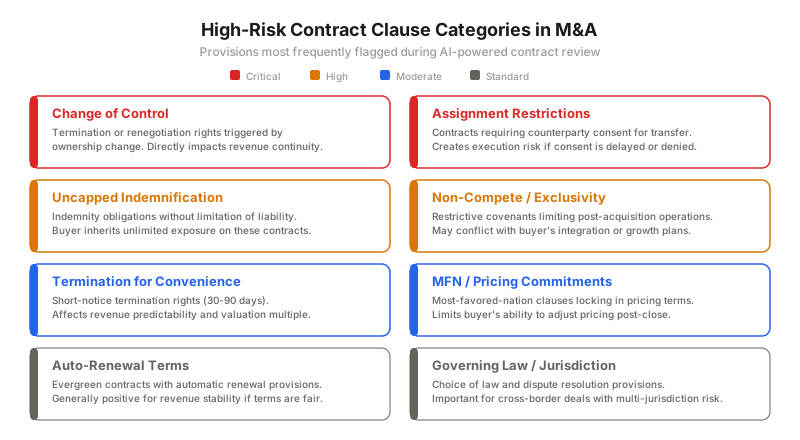
Not all contract provisions carry equal weight in a transaction. Based on practitioner experience, these are the clause categories that most frequently affect deal value, structure, or negotiations:
Change-of-Control Provisions
The single most consequential clause category. Customer and supplier contracts that allow termination, renegotiation, or automatic expiry upon a change of control directly affect the continuity of revenue and operations post-close. Buyers will quantify the revenue at risk and may require an earnout or price reduction to account for it.
In APAC markets, change-of-control provisions are particularly common in government contracts, regulated industry agreements, and joint venture arrangements where partner identity matters.
Assignment and Consent Requirements
Contracts that cannot be freely assigned — or that require counterparty consent before assignment — create execution risk. If a key customer must consent to the transaction and refuses or extracts concessions, the deal timeline and economics change. AI tools flag every assignment restriction and the associated contract value, giving the deal team a complete picture before negotiations begin.
Indemnification and Liability
The reps and warranties package in the SPA is shaped by what the contract portfolio reveals. Uncapped indemnification obligations, unusually broad liability provisions, or warranty and indemnity gaps in the target’s contracts directly inform how the buyer prices risk and structures protections.
Termination and Renewal
Understanding the termination landscape — which contracts can be terminated on short notice, which auto-renew, which require cause — helps buyers model revenue stability. A customer base with 80% of revenue under multi-year contracts with automatic renewal is fundamentally more valuable than one with 80% on annual terms with 30-day termination rights.
Restrictive Covenants
Non-compete, non-solicitation, and exclusivity provisions can constrain the buyer’s ability to operate or grow the business post-acquisition. An exclusive distribution agreement that prevents the target from selling through other channels in a key market might conflict with the buyer’s integration plan. AI extracts and maps these restrictions across the full contract set.
Multi-Language Contract Review in APAC
Cross-border M&A in Asia Pacific introduces a challenge that domestic deals rarely face: contracts in multiple languages and legal traditions.
A Singapore-based target with operations across ASEAN might have customer contracts in English, Bahasa Indonesia, Thai, and Vietnamese — each governed by different law and drafted under different contractual conventions. A Japanese acquisition target will have the majority of its contracts in Japanese, with statutory provisions implied by the Civil Code that may not appear explicitly in the contract text.
According to Deloitte’s APAC M&A legal trends analysis, cross-border transactions in Asia Pacific take 30-40% longer to close than domestic deals, with legal due diligence complexity cited as a primary driver. Multi-language contract review is a major contributor to that delay.
AI contract review tools handle multi-language processing with varying degrees of maturity:
| Language | AI Extraction Accuracy | Maturity |
|---|---|---|
| English | 90-95% | High |
| Simplified Chinese | 85-92% | High |
| Japanese | 80-88% | Medium |
| Korean | 78-85% | Medium |
| Bahasa (MY/ID) | 75-82% | Developing |
| Thai | 70-78% | Developing |
| Vietnamese | 68-75% | Developing |
“For cross-border APAC deals, the practical approach is a hybrid model,” says Daniel Bae, founder of Amafi and former M&A advisor with over US$30 billion in transaction experience. “AI handles the volume — extracting and classifying clauses across languages — while native-language lawyers validate the flagged provisions. You get 80% of the time savings with near-100% of the accuracy.”
The best APAC-focused implementations pair AI extraction with local legal expertise: the AI processes the full data room and produces structured outputs with risk flags, and jurisdiction-specific lawyers review the flagged provisions in their native language and legal context.
Accuracy, Limitations, and the Human-AI Workflow
What AI Gets Right
AI contract review excels at:
- Volume processing — reviewing every contract, not just a sample
- Consistency — applying the same extraction rules to contract 1 and contract 500 with equal attention
- Speed — reducing a three-week workstream to days
- Cross-document pattern recognition — identifying portfolio-level risks that sequential human review often misses
- Structured output — producing clause matrices and risk summaries that are immediately usable by the deal team
Where AI Struggles
AI contract review is not infallible:
- Heavily negotiated bespoke agreements — contracts with unusual structures, nested amendments, or side letters that modify standard terms can confuse extraction models
- Implied terms and statutory provisions — in civil law jurisdictions across Asia, important obligations may not appear in the contract text because they are implied by statute. AI trained on common law contracts will miss these
- Commercial context — the AI can flag that a customer contract allows termination on 30 days’ notice, but it cannot assess the likelihood that the customer would actually exercise that right or the relationship dynamics that make it unlikely
- Handwritten annotations and poor-quality scans — OCR limitations persist, particularly for older documents or those with marginal notes
The Optimal Workflow
The highest-value implementation is not full automation — it is intelligent triage:
- AI processes the entire data room — every contract, every page
- Structured output — clause matrices organized by risk category with severity scores
- Senior lawyer reviews flagged issues — focusing on the 15-20 contracts with material risk provisions, not the 300 standard-form agreements
- Deal team quantifies impact — translating legal findings into commercial terms: revenue at risk, indemnification exposure, closing conditions requirements
- Findings feed into the definitive agreement — informing the reps and warranties package, indemnification structure, and MAC clause negotiation
This workflow cuts legal due diligence time by 50-70% while improving coverage from sampling-based review to comprehensive analysis.
This is how we work at Amafi — AI handles the structured, high-volume analysis across the deal lifecycle, so our advisors focus on the judgment calls that determine deal outcomes. For our clients, it means faster processes and fewer surprises.
Implementing AI Contract Review: A Practical Roadmap
For deal teams considering AI contract review, the implementation path matters as much as the technology choice.
Start With Data Room Organization
AI extraction quality depends directly on input quality. Before running any AI tool, ensure your virtual data room is organized with clear folder taxonomy, consistent file naming, and documents in searchable format. Scanned documents should be OCR-processed before ingestion. A poorly organized data room produces noisy AI output that creates more work, not less.
Define Your Risk Framework Before You Start
Configure extraction priorities around the specific risks that matter for your deal. A PE bolt-on acquisition in healthcare has different risk priorities (regulatory compliance, physician non-competes, payer contract terms) than a tech acquisition (IP assignment, open-source license obligations, customer SaaS terms). Generic out-of-the-box extraction frameworks miss deal-specific nuances.
Pilot on a Single Deal Before Scaling
Run AI contract review alongside your traditional process on one deal. Compare the outputs — what the AI caught that humans missed, what humans caught that the AI missed, and where the AI produced false positives. This calibration builds confidence and informs how you adjust the workflow for subsequent deals.
Measure the Right Metrics
The value of AI contract review is not just speed. Track:
- Coverage — percentage of contracts reviewed (target: 100%, vs. 30-50% in manual sampling)
- Issue detection rate — material issues identified per deal
- False positive rate — flagged issues that turn out to be immaterial after human review
- Time to legal diligence memo — total days from data room access to final memo
- Cost per deal — legal fees for AI-assisted review vs. traditional review
This is part of how Amafi delivers faster, more thorough M&A advisory. AI-powered analysis across the deal lifecycle — from buyer matching through contract review — means our clients close deals faster without surprises. Learn about selling your business or book a valuation meeting.

About the Author
Daniel Bae
Co-founder & CEO, Amafi
Daniel is an investment banker with 15+ years of experience in M&A, having advised on deals worth over US$30 billion. His career spans Citi, Moelis, Nomura, and ANZ across London, Hong Kong, and Sydney. He holds a combined Commerce/Law degree from the University of New South Wales. Daniel founded Amafi to solve the pain points in M&A, enabling bankers to focus on what matters most — delivering trusted advice to clients.
About Amafi
Amafi is an M&A advisory firm built for Asia Pacific. We help business owners sell their companies and corporate teams make strategic acquisitions — with bulge bracket execution quality at lower fees, powered by AI and a network of senior dealmakers.
Book a valuation meetingGet M&A insights delivered
AI-powered deal sourcing strategies, market analysis, and Asia Pacific insights — straight to your inbox.