Why Advisor Selection Matters More Than Most Sellers Realise
The M&A advisor you choose will shape every aspect of your transaction — the buyers who see your business, the price you receive, the terms you accept, and whether the deal closes at all. According to Harvard Business Review, between 70% and 90% of acquisitions fail to create value for the acquirer, and a significant share of failed sell-side processes can be traced back to poor advisor selection: wrong buyer targeting, weak process management, or misaligned incentives.
Despite these stakes, most business owners spend more time choosing an accountant than selecting their M&A advisor. They hire based on a referral from their lawyer, a persuasive pitch meeting, or simple proximity. The result is a six-to-twelve month engagement with a firm that may lack the sector expertise, buyer network, or process discipline the transaction demands.
This guide provides a structured framework for evaluating and selecting an M&A advisor — applicable whether you are a business owner selling for the first time, a corporate development team engaging external advisors, or a PE-backed company preparing for exit.
The Four Types of M&A Advisors
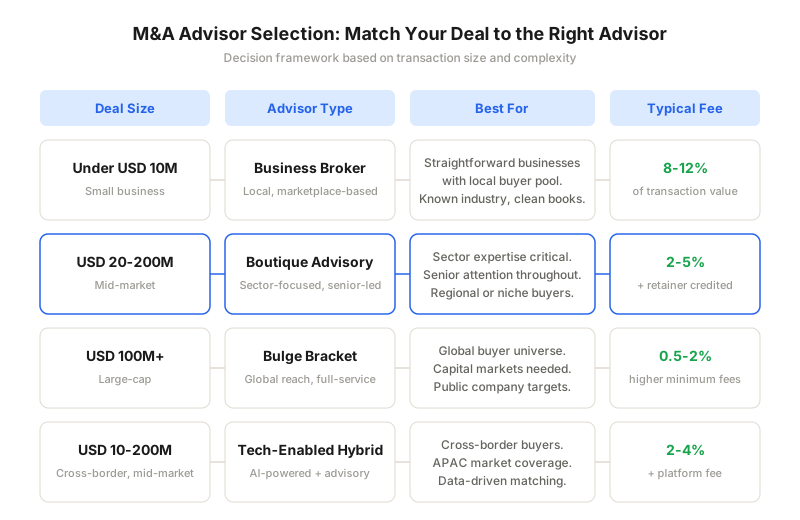
Not all advisors serve the same market. The M&A advisory landscape spans four distinct categories, and choosing the wrong type is a common and expensive mistake.
Bulge-bracket investment banks — Goldman Sachs, Morgan Stanley, JPMorgan, and their APAC counterparts like Nomura and Macquarie — dominate transactions above USD 100 million. They bring global buyer networks, capital markets capabilities, and brand credibility. The trade-off: high minimum deal sizes, senior banker attention that can be inconsistent on smaller mandates, and the highest fee structures in the market.
Boutique advisory firms focus on the mid-market (typically USD 20 million to USD 200 million in enterprise value). These firms are led by senior practitioners who remain involved throughout the engagement. Many specialise by sector or geography, giving them deeper relationships within a specific buyer universe. In Asia Pacific, boutiques often have stronger cross-border capabilities within their focus region than large banks have in the mid-market.
Business brokers serve transactions below USD 10 million, typically involving owner-operated businesses with straightforward structures. They list businesses on marketplaces and work with individual buyers. The distinction from M&A advisors is not about quality — it is about the buyer universe and process sophistication each model is designed for.
Technology-enabled hybrid models combine traditional advisory judgement with AI-powered buyer identification, outreach automation, and data-driven matching. These platforms extend mid-market firms’ reach across geographies without requiring a physical presence in every market — particularly valuable for cross-border M&A in fragmented APAC markets. This is the model Amafi is built on: AI-driven deal sourcing and buyer matching layered onto advisory expertise.
Five Criteria That Actually Matter
Advisor pitches are polished, credentials are carefully curated, and every firm claims deep sector expertise. The challenge is distinguishing genuine capability from effective marketing. These five criteria, evaluated rigorously, separate advisors who will add value from those who will not.
1. Recent, Relevant Deal Experience
Track record is the most reliable predictor of future performance — but only if it is genuinely relevant. Ask for completed transactions in your sector and size range from the past two years. Markets shift, buyer appetites change, and an advisor’s decade-old deal list tells you nothing about their current capability.
“The most important thing to evaluate is whether the advisor has actually closed deals like yours recently,” says Daniel Bae, founder of Amafi and former M&A advisor with over US$30 billion in transaction experience. “A firm that closed three healthcare deals last year in your size range is far more valuable than one that closed a headline deal in a different sector five years ago.”
According to Deloitte’s 2024 M&A Trends Survey, 63% of corporate executives cited “sector-specific deal experience” as the most important factor when selecting an external M&A advisor — ahead of brand recognition, fee structure, or geographic presence.
2. Buyer Network Quality
The advisor’s buyer relationships determine the competitive dynamics of your process. The right advisor does not just send emails to a list — they have relationships with the specific acquirers, private equity firms, and strategic buyers active in your sector.
Ask specifically: Which buyers in my space have you transacted with? Which PE firms have you completed deals with recently? How many of the buyers on your target list have you personally introduced deals to before?
A broad but shallow buyer list matters less than a focused network of qualified, active acquirers. In Asia Pacific, where many markets are relationship-dependent, an advisor’s personal connections to decision-makers can be the difference between a buyer engaging seriously or passing on the opportunity.
3. Senior Team Continuity
This is the single most common source of advisor disappointment. A managing director pitches the engagement, wins the mandate, and then hands execution to a junior associate. The seller expected senior-level attention and strategic counsel; they got a coordinator.
Before engaging, confirm: Who will lead my process day-to-day? Will the senior person I am meeting be involved through closing? How many active mandates does the lead banker currently have? An advisor running six engagements simultaneously cannot give any of them the attention they need.
4. Process Design and Discipline
A credible advisor should articulate a clear process before you sign the engagement letter — timeline, buyer targeting strategy, marketing approach, milestone checkpoints, and contingency plans. If the advisor cannot describe how they will run your process with specificity, they are improvising.
Ask about their typical timeline from engagement to close. Ask what happens when a lead buyer drops out at the LOI stage. Ask how they maintain competitive tension with two bidders versus four. Process discipline separates experienced advisors from those who are still learning at your expense.
5. Fee Structure Alignment
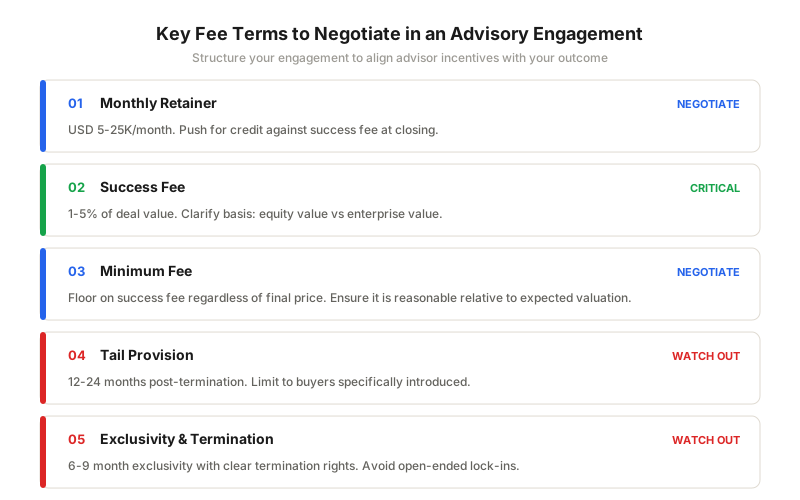
Advisory fees are negotiable, but the structure matters more than the headline number. The standard model — monthly retainer plus success fee on completion — creates reasonable alignment, but the details can shift incentives significantly.
Key terms to negotiate in the definitive agreement:
| Term | What to Push For | Why It Matters |
|---|---|---|
| Retainer credit | Retainer credited against success fee | Prevents double-paying if the deal closes |
| Success fee basis | Clear definition (equity value vs enterprise value) | Can differ by millions on leveraged businesses |
| Minimum fee | Reasonable floor relative to expected deal value | Avoid paying an outsized percentage on a smaller-than-expected outcome |
| Tail provision | 12 months, limited to specifically introduced buyers | Prevents the advisor from claiming a fee on buyers they did not meaningfully engage |
| Exclusivity period | 6-9 months with clear termination rights | Protects you from being locked into an underperforming engagement |
The Interview: Questions That Reveal the Truth
Pitch meetings are rehearsed. The real evaluation happens when you ask questions the advisor has not prepared for. These ten questions, asked directly, will reveal more than any credentials deck.
- How many deals in my sector and size range have you closed in the past 24 months? Not “worked on” — closed. Failed processes do not count.
- Can I speak with your two most recent clients? Not hand-picked references from five years ago. Recent clients. If they hesitate, that tells you something.
- Who exactly will run my deal day-to-day, and how many other mandates will they be managing? Get names, not titles. Get commitments, not reassurances.
- What is your buyer list methodology? How do they build the target list? Do they start from a database, or from relationships? How do they identify non-obvious buyers?
- Walk me through a deal that did not close. Every experienced advisor has had deals fail. Their analysis of why — and how they managed the client through it — reveals their judgement and integrity.
- What is your process when the lead bidder drops out after due diligence? This tests whether they have real contingency planning or just optimism.
- How do you handle cross-border buyers? Particularly relevant in Asia Pacific. Do they have local presence, partnerships, or AI-powered tools to reach buyers across jurisdictions?
- What is the most common reason deals at my size fail to close? Their answer tells you what they worry about — and whether those concerns are relevant to your situation.
- What do you think my business is worth, and how did you arrive at that range? A credible advisor gives a range with clear methodology. An advisor who quotes a high number to win the mandate is a red flag. Expect references to EBITDA multiples, comparable company analysis, and precedent transactions — not vague assurances.
- What would make you decline this engagement? An advisor willing to turn down work has standards. An advisor who takes every mandate regardless of fit is volume-driven, not outcome-driven.
Red Flags That Should Disqualify an Advisor
Some warning signs should end the evaluation immediately. These patterns, observed across hundreds of advisory engagements, reliably predict poor outcomes.
Guaranteed valuations. No honest advisor promises a specific price before running a process. Markets set prices, not advisors. A firm that quotes an aggressive number to win the mandate is likely to manage your expectations downward once the engagement is signed.
Reluctance to provide references. If an advisor will not connect you with recent clients, assume the worst. Satisfied clients are happy to talk. Dissatisfied ones are the reason the advisor is deflecting.
The “bait and switch.” The senior partner dominates the pitch meeting, then you never see them again. The actual team running your deal is junior, overworked, and learning on the job. Confirm team continuity in writing before signing.
Excessive retainer focus. An advisor who spends more time negotiating the retainer than discussing the success fee structure has misaligned incentives. The retainer should be a cost-recovery mechanism, not a profit centre.
No clear process timeline. If the advisor cannot articulate specific milestones — buyer list completion by week 3, teaser distribution by week 5, IOIs by week 10 — they lack the operational rigour to run a competitive process.
Conflicts of interest. Ask directly whether they represent any potential buyers for your business. Dual representation — advising both buyer and seller — is less regulated in some APAC markets than in the US, and the conflict can be devastating to seller outcomes.
APAC Considerations: What Is Different in Asia Pacific
Advisor selection in Asia Pacific carries nuances that do not apply in Western markets, and ignoring them leads to process failures that could have been avoided.
Market fragmentation. APAC is not one market — it is a dozen distinct markets with different languages, regulatory regimes, buyer pools, and deal norms. An advisor with a strong network in Singapore may have zero reach into Japan or South Korea. For sellers with a cross-border buyer universe, advisor reach across multiple APAC markets is not a nice-to-have — it is essential.
Relationship dependency. In markets like Japan, South Korea, and parts of Southeast Asia, cold outreach to potential acquirers is far less effective than in the US or UK. Buyers respond to advisors they know and trust. This makes the advisor’s personal relationship network more important than their firm’s brand or database.
Regulatory complexity. Cross-border M&A in APAC involves navigating foreign investment reviews (FIRB in Australia, similar regimes across the region), exchange controls, and sector-specific restrictions. An advisor experienced in cross-border transactions understands which regulatory hurdles to anticipate and how to structure around them.
Succession-driven dealmaking. Across Japan and parts of Southeast Asia, a growing share of M&A activity is driven by ageing business owners without successors. According to Japan’s Ministry of Economy, Trade and Industry (METI), over 600,000 profitable SMEs in Japan risk closure by 2025 due to succession planning failures. Advisors in these markets need cultural sensitivity and patience that transaction-focused bankers from other regions may lack.
Looking for an M&A advisor with cross-border reach across Asia Pacific? Amafi is an M&A advisory firm that combines senior dealmaker expertise with AI-powered buyer identification — covering sectors and geographies that traditional networks miss. No retainers, success fee only. Book a valuation meeting to discuss your situation.

About the Author
Daniel Bae
Co-founder & CEO, Amafi
Daniel is an investment banker with 15+ years of experience in M&A, having advised on deals worth over US$30 billion. His career spans Citi, Moelis, Nomura, and ANZ across London, Hong Kong, and Sydney. He holds a combined Commerce/Law degree from the University of New South Wales. Daniel founded Amafi to solve the pain points in M&A, enabling bankers to focus on what matters most — delivering trusted advice to clients.
About Amafi
Amafi is an M&A advisory firm built for Asia Pacific. We help business owners sell their companies and corporate teams make strategic acquisitions — with bulge bracket execution quality at lower fees, powered by AI and a network of senior dealmakers.
Learn about selling your businessGet M&A insights delivered
AI-powered deal sourcing strategies, market analysis, and Asia Pacific insights — straight to your inbox.