Every M&A advisor has a version of the same story: a business owner who built something valuable over 20 years, then left millions on the table in the final transaction because of avoidable mistakes when selling their business.
Selling a company is, for most founders, a once-in-a-lifetime event. The information asymmetry is brutal — buyers and their advisors do this every week. Sellers are learning the playbook in real time, under pressure, with their life’s work on the line.
After advising on over US$30 billion in transactions, these are the seven mistakes we see most often — and each one is entirely preventable.
1. Going to Market with Messy Financials
This is the single most expensive mistake a seller can make. Buyers don’t pay for what your business earns — they pay for what they can verify your business earns.
When a buyer’s team runs a quality of earnings analysis and finds undocumented add-backs, personal expenses mixed with business costs, or inconsistent revenue recognition, one of two things happens: they discount your EBITDA significantly, or they walk away.
The gap between “owner-reported EBITDA” and “adjusted EBITDA after QofE” averages 10-30% for privately held businesses, according to GF Data’s mid-market M&A report. For a business expecting a 6x multiple, that’s the difference between a $12 million and an $8.4 million enterprise value.
What to do instead: Commission a sell-side quality of earnings report 6-9 months before going to market. Clean up your books. Document every add-back with supporting evidence. A $50,000-$100,000 QofE investment routinely protects millions in deal value.
2. Anchoring on a Headline Number
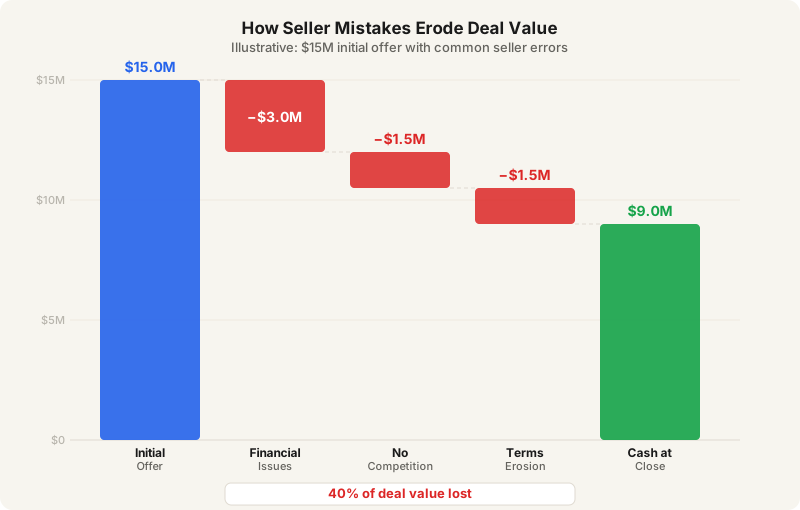
A buyer offers $15 million. The seller celebrates. Then the LOI arrives and the real number looks very different.
Between earnouts (20-30% of total consideration tied to future performance), holdbacks (typically 10-15% held in escrow for 12-18 months), working capital adjustments, and reps and warranties exposure, the cash-at-close on a “$15 million deal” might be $9-10 million.
According to SRS Acquiom’s 2024 M&A Deal Terms Study, earnouts were present in 63% of private-target acquisitions, with a median earnout representing 25% of total deal value. Sellers who don’t understand this going in negotiate from a position of weakness.
“The headline number is the beginning of the negotiation, not the end,” says Daniel Bae, founder of Amafi and former M&A advisor with over US$30 billion in transaction experience. “Every dollar of deal structure that shifts risk to the seller is a dollar that may never arrive.”
What to do instead: Evaluate every offer on cash-at-close, not enterprise value. Model the worst-case scenario on every contingent component. Your advisor should build a “sources and uses” table showing exactly what you receive at closing versus what’s deferred or at risk.
3. Breaking Confidentiality
Sellers who tell employees, customers, or suppliers that the company is for sale before a deal is signed create a self-inflicted wound that buyers exploit mercilessly.
When employees learn the company is being sold, the best ones start interviewing elsewhere. When customers learn, they begin diversifying to backup suppliers. When competitors learn, they poach your team and undercut your pricing. Each of these dynamics shows up in the numbers — and buyers reprice accordingly.
Maintaining confidentiality is why the M&A process uses NDAs, anonymous teasers, and controlled information flows through a data room. These aren’t bureaucratic overhead — they’re seller protection.
“I’ve seen deals where the seller mentioned the sale to three key customers ‘just to see how they’d react,’ and within six weeks two of those customers had signed backup contracts with competitors,” notes Bae. “The buyer used that customer concentration risk to negotiate a 20% price reduction.”
What to do instead: Operate on a strict need-to-know basis. Use a professional CIM distributed only to NDA-signed, pre-qualified buyers. Prepare a communication plan for employees and customers that deploys only after signing — not before.
4. Running a Single-Buyer Process
Many sellers receive an unsolicited offer from a strategic buyer or a PE firm and decide to negotiate exclusively with that one party. This is almost always a mistake.
Without competitive tension from an auction process, the buyer has no incentive to offer premium pricing or favorable terms. They know you have no alternative. Every negotiation point tilts in their favor — price, structure, timeline, representations, transition requirements.
Research from Houlihan Lokey consistently shows that competitive processes generate 15-30% higher valuations than negotiated single-buyer deals, even when the winner is the same party who would have been the sole bidder.
This doesn’t mean you need a full public auction. Even a limited, targeted process with 5-10 qualified buyers creates enough competitive dynamics to protect the seller’s position. The goal isn’t to maximize the number of bidders — it’s to ensure no single buyer has monopoly negotiating power.
What to do instead: Even if you have a preferred buyer, market the opportunity to multiple qualified parties simultaneously. Use an exclusivity period as a negotiation chip — grant it only after receiving a strong LOI that reflects genuine competitive pricing.
5. Neglecting the Business During the Process
A typical M&A sale takes 6-12 months. That’s half a year to a full year where the owner spends 20-30 hours per week on deal-related activities: management presentations, buyer meetings, data room requests, legal negotiations.
The business suffers. Revenue growth stalls. Key initiatives get delayed. Customer relationships go unattended. Then the buyer looks at trailing-three-month performance, sees the dip, and either retrades the price or walks away.
According to Bain & Company’s 2024 Global M&A Report, “business performance degradation during the sale process” is one of the top reasons private equity buyers cite for post-LOI price reductions.
What to do instead: Before going to market, identify a trusted lieutenant who can run daily operations during the process. Delegate ruthlessly. If you don’t have a strong number-two, consider promoting or hiring one 6-12 months before launching the sale. The cost of a COO hire is trivial compared to a 15% valuation haircut.
6. Being Unprepared for Due Diligence
Due diligence is where deals go to die. Not because the business has fatal flaws, but because the seller’s inability to respond quickly and completely creates doubt in the buyer’s mind. Doubt gets priced in.
When a buyer sends a 300-item DD request list and the seller takes three weeks to produce basic documents, the buyer assumes the worst. Slow responses signal disorganization, hidden problems, or both. Professional buyers use DD as a second negotiation round — every issue they uncover becomes a reason to reduce the price.
A well-prepared seller has a virtual data room populated before the process begins: three years of audited financials, customer contracts, employment agreements, IP documentation, lease abstracts, insurance policies, regulatory filings. The buyer’s DD team gets what they need within 48 hours of requesting it.
What to do instead: Build your data room 3-6 months before going to market. Anticipate the standard DD request list — your advisor will have one — and pre-load every document. Run a vendor due diligence process that identifies and resolves issues before buyers find them. For a detailed preparation framework, see our guide on how to prepare your company for an M&A exit.
7. Not Hiring an Advisor — or Hiring the Wrong One
Some business owners, especially those who are successful negotiators in their own industry, believe they can sell their business without professional representation. This rarely works out.
Selling a company isn’t a negotiation over price. It’s a multi-month, multi-party process involving legal, financial, operational, and strategic dimensions that require specialized expertise. An owner who negotiates their own sale is like a surgeon who operates on themselves — technically possible, but inadvisable.
The data supports this. According to IBBA/M&A Source research, advisor-represented sellers achieve 10-25% higher transaction values compared to unrepresented sellers. The advisor’s success fee (typically 3-7% of enterprise value for mid-market deals) is more than offset by the value they create through competitive process management, professional marketing, and negotiation expertise.
The inverse mistake is equally dangerous: hiring the wrong advisor. An advisor without relevant sector expertise, geographic reach, or buyer relationships will run a process that looks professional but delivers mediocre results. The wrong advisor costs more than no advisor, because they consume your time, erode buyer interest through poor execution, and create a market impression that’s hard to overcome in a re-launch. For a detailed evaluation framework, see our guide on how to choose the right M&A advisor.
Avoiding These Mistakes When Selling Your Business
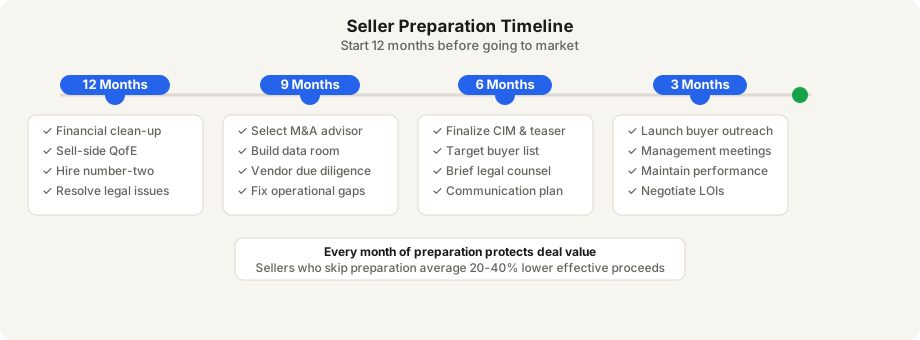
Every mistake on this list traces back to the same root cause — insufficient preparation. Sellers who invest 6-12 months in pre-sale readiness consistently achieve better outcomes than those who rush to market.
The preparation checklist is straightforward:
- 12 months out: Hire a strong number-two. Begin financial clean-up. Commission a sell-side QofE.
- 9 months out: Interview and select an advisor. Build the data room. Identify and resolve any operational or legal issues.
- 6 months out: Finalize marketing materials (teaser, CIM). Develop the target buyer list. Brief your legal team.
- 3 months out: Launch the process. Begin buyer outreach. Maintain business performance with religious discipline.
This is what Amafi advises business owners on every day — from understanding your valuation and preparing for due diligence to running a competitive process that attracts the right buyers. The goal is ensuring that when you go to market, you’re positioned to capture the full value of what you’ve built.
The best time to start preparing was a year ago. The second best time is now.
Ready to sell your business the right way? Amafi is an M&A advisory firm that helps owners avoid these mistakes — with thorough preparation, AI-powered buyer identification, and a process designed to maximise value. No retainers, success fee only. Book a valuation meeting to start the conversation.

About the Author
Daniel Bae
Co-founder & CEO, Amafi
Daniel is an investment banker with 15+ years of experience in M&A, having advised on deals worth over US$30 billion. His career spans Citi, Moelis, Nomura, and ANZ across London, Hong Kong, and Sydney. He holds a combined Commerce/Law degree from the University of New South Wales. Daniel founded Amafi to solve the pain points in M&A, enabling bankers to focus on what matters most — delivering trusted advice to clients.
About Amafi
Amafi is an M&A advisory firm built for Asia Pacific. We help business owners sell their companies and corporate teams make strategic acquisitions — with bulge bracket execution quality at lower fees, powered by AI and a network of senior dealmakers.
Learn about selling your businessGet M&A insights delivered
AI-powered deal sourcing strategies, market analysis, and Asia Pacific insights — straight to your inbox.