The Question Every Corporate Acquirer Faces
Every corporate development team eventually confronts the same question: should we build this capability ourselves, buy it through an acquisition, or partner with someone who already has it?
The build vs buy vs partner decision is the most consequential framework in corporate M&A strategy. Get it right, and you accelerate growth while preserving capital. Get it wrong, and you either waste years building something the market already offers, overpay for an acquisition you struggle to integrate, or lock into a partnership that constrains your strategic freedom.
The stakes are higher than most corporate teams acknowledge. McKinsey’s research on corporate M&A shows that programmatic acquirers — companies with a clear, repeatable M&A strategy — generate significantly higher total shareholder returns than companies that pursue large, one-off deals. The framework you use to decide between build, buy, and partner is the foundation of that strategy.
In Asia Pacific, the decision carries additional complexity. Foreign ownership restrictions, family business dynamics, regulatory approval timelines, and cross-border cultural nuances all shape which path is viable — and which is optimal.
The Three Paths Defined
Before applying any framework, the three options need clear definitions. In practice, they are more nuanced than corporate strategy textbooks suggest.
Build means developing a capability organically — hiring talent, investing in R&D, launching a new product line or business unit from scratch. The advantage is full control and deep institutional knowledge. The cost is time: organic capability development typically takes two to five years before it reaches competitive scale.
Buy means acquiring the capability through M&A — purchasing a company, business unit, or asset that already possesses what you need. This could be a full acquisition, a bolt-on to an existing business unit, or a carve-out from a larger company. The advantage is speed and proven capability. The cost is capital, integration risk, and the premium you pay for certainty.
Partner covers a spectrum of arrangements: joint ventures, strategic alliances, licensing agreements, minority investments, and distribution partnerships. The advantage is shared risk and access to capabilities without full ownership. The cost is shared economics, potential misalignment, and limited control.
These are not mutually exclusive. The most effective corporate development teams use all three — sometimes sequentially. A partnership can be a prelude to acquisition. An acquisition can fill a gap while you build adjacent capabilities organically. The framework helps you choose the right starting point.
A Seven-Dimension Scoring Framework
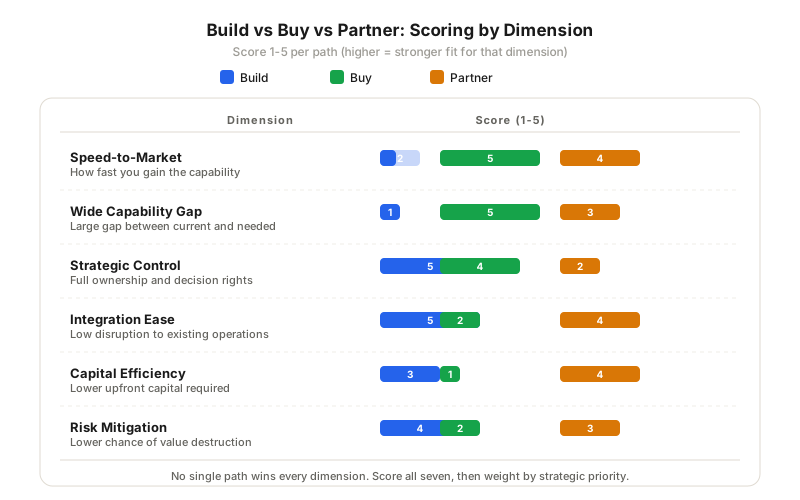
We use a seven-dimension scoring model to evaluate build, buy, and partner for any given strategic initiative. Score each dimension from 1 (low) to 5 (high) for each path. The highest aggregate score points to the preferred approach — but judgment still matters.
1. Speed-to-Market
How urgently do you need this capability? If the market window closes in 12 months, building organically is not viable. Acquisition delivers capability in months (post-closing). Partnerships can be structured in weeks but may take longer to operationalise.
2. Capability Gap Size
How far is your current capability from where it needs to be? A narrow gap (you have 70% of what’s needed) favours building. A wide gap (you would need to hire an entirely new team and develop new IP) favours buying.
3. Strategic Importance
Is this capability core to your competitive advantage, or adjacent? Core capabilities — the things that define why customers choose you — deserve the control that comes with building or buying. Adjacent capabilities can often be accessed through partnerships without the overhead of full ownership.
4. Integration Complexity
How difficult will it be to absorb? Some acquisitions are straightforward (a bolt-on that operates semi-independently). Others are deeply complex (a target with incompatible technology, different culture, and overlapping customers). High integration complexity tilts the framework toward partnership or building, where you avoid the integration problem entirely.
“The integration question is where most corporate development teams get burned,” says Daniel Bae, founder of Amafi and former M&A advisor with over US$30 billion in transaction experience. “They model the acquisition cost and the revenue synergies but underweight the cost — both financial and organisational — of actually combining two companies. A partnership can deliver 70% of the value at 20% of the integration pain.”
5. Capital Requirements
What does each path cost? Building requires sustained investment over years with uncertain returns. Buying requires upfront capital (often at a control premium of 20-40% above market value). Partnering typically requires the least capital but shares the upside.
According to Bain & Company’s 2025 M&A report, global M&A deal multiples have remained elevated through 2024-2025, with median EBITDA multiples for mid-market deals ranging from 10-14x depending on sector. That premium makes the “buy” option expensive — and makes the “build” or “partner” paths comparatively more attractive when the capability gap is manageable.
6. Risk Profile
What are the failure modes for each path? Building risks include talent shortages, slow execution, and market shifts during the development period. Buying risks include overpayment, culture clash, and integration failure. Partnering risks include misaligned incentives, IP leakage, and partner dependency.
Research from Harvard Business Review has consistently shown that 70-90% of acquisitions fail to create the value projected in their deal thesis. Most failures trace back not to bad targets but to poor integration execution and cultural misalignment — risks that the “partner” path avoids entirely.
7. Control Requirements
How much control do you need over the capability? If regulatory compliance, data privacy, or brand standards require full control, building or buying is necessary. If the capability can operate at arm’s length, partnership works.
When to Build
Build is the right answer when:
The capability is core to your competitive moat. If this is what differentiates you, you need to own it completely. No partnership or acquisition gives you the same depth of institutional knowledge that organic development creates.
The talent already exists internally (or is recruitable). Building requires people. If your industry has a deep talent pool and you can attract the right hires, the organic path is viable. If the talent is scarce and concentrated in a few companies, acquisition may be the only way to access it.
The time horizon is acceptable. If your board and shareholders can tolerate a two-to-four-year runway before the capability reaches competitive scale, building preserves capital and avoids integration risk.
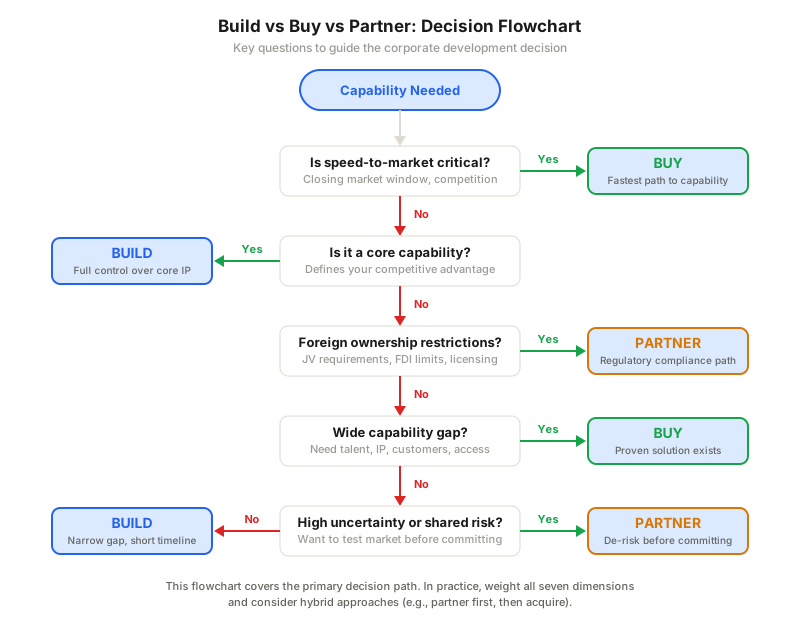
Regulatory barriers block acquisition. In some APAC markets, foreign ownership restrictions make acquisition impossible in certain sectors. Building locally — hiring a team, establishing an entity, developing the capability from within the market — may be the only path.
A global logistics company expanding into Southeast Asia, for example, might build its cold-chain infrastructure organically because the capability is core (temperature-controlled distribution defines their value proposition), the regulatory environment in Indonesia and Vietnam favours local entity establishment, and a three-year timeline aligns with their market entry strategy.
When to Buy
Buy is the right answer when:
Speed is non-negotiable. The market window is closing, a competitor is about to lock up the opportunity, or a regulatory change creates a time-limited advantage. Acquisition is the fastest way to acquire proven capability.
The target brings more than capability. The best acquisitions deliver not just technology or talent but customers, revenue, market position, regulatory licenses, or distribution channels that cannot be replicated organically. This is why platform acquisitions in new markets are so common — you are buying a beachhead, not just a product.
Consolidation creates competitive advantage. In fragmented industries, roll-up strategies create value through scale. Accounting firms, staffing agencies, healthcare clinics, and IT services businesses across APAC are being consolidated by PE-backed platforms that use acquisition as their primary growth engine.
The capability gap is too wide to bridge organically. If it would take five years and US$50 million to build what you could acquire for US$80 million today — and the acquired version comes with customers and revenue — the math often favours buying even at a premium.
Due diligence is what separates good acquisitions from expensive mistakes. The decision to buy should never be driven by speed alone. A thorough assessment of the target’s financials, customer concentration, technology stack, cultural fit, and integration complexity is the minimum standard before committing capital.
This is where platforms like Amafi add value for corporate acquirers — using AI-powered screening to evaluate targets against strategic criteria across fragmented APAC markets, where manual target identification is slow and incomplete.
When to Partner
Partner is the right answer when:
Regulatory requirements mandate it. Several APAC markets require local partners for foreign investors. Indonesia’s negative investment list restricts foreign ownership in dozens of sectors. Vietnam requires JV partners for certain financial services. India’s FDI framework limits foreign ownership in insurance, defence, and media. In these markets, partnership is not a choice — it is a regulatory prerequisite.
You want to test before you commit. Partnerships are a lower-risk way to evaluate a market, a partner, or a capability before making a full acquisition. Many of the most successful cross-border acquisitions in Asia Pacific started as joint ventures or distribution partnerships. The partnership phase de-risks the eventual acquisition by building relationships, operational knowledge, and trust.
Shared economics make sense. If the opportunity requires capabilities from both parties that neither possesses alone, a joint venture preserves each party’s strengths while sharing the investment. This is particularly common in infrastructure, resources, and real estate across APAC, where deals are too capital-intensive for a single acquirer.
You need local knowledge without full integration burden. A strategic alliance with a local player gives you market access, regulatory navigation, and cultural fluency without the complexity of integrating a foreign acquisition. For companies entering Japan, South Korea, or China for the first time, this approach is often more pragmatic than a direct acquisition.
One common pattern in APAC: a Western company partners with a family-owned business through a minority stake, operates jointly for two to three years, and then negotiates a full acquisition once trust is established and the business is better understood. The earnout structure in the eventual acquisition is often more favourable because the partnership phase reduced information asymmetry on both sides.
APAC-Specific Factors
The build vs buy vs partner framework operates differently in Asia Pacific than in North America or Europe. Several structural factors shift the scoring.
Foreign ownership restrictions. Indonesia, Vietnam, the Philippines, Thailand, and India all maintain sector-specific foreign ownership limits. These constraints don’t just affect the “buy” option — they reshape the entire framework. A company that cannot acquire outright must decide between building a wholly-owned subsidiary (where permitted) or partnering with a local entity.
Family business dynamics. Over 85% of companies in APAC are family-controlled, according to the Asian Development Bank. Many family owners prefer partnerships or phased transactions over outright sales. Understanding this preference is not just cultural sensitivity — it is deal strategy. A corp dev team that leads with an acquisition offer may lose the opportunity to one that proposes a joint venture first.
Regulatory approval timelines. APAC M&A transactions routinely face 6-12 month regulatory approval processes, particularly for cross-border deals involving sensitive sectors. These timelines affect the speed-to-market dimension: if regulatory approval takes a year, the speed advantage of “buy” over “build” narrows significantly.
Relationship-driven markets. In Japan, South Korea, and much of Southeast Asia, business relationships precede transactions. Cold approaches rarely work. Corporate development teams that invest in relationship-building — through partnerships, advisory mandates, or introductions via trusted intermediaries — consistently outperform those that rely on transactional approaches.
Common Decision Traps
Acquisition Bias
The most common trap. Corporate development teams are, by nature, deal-doers. Their KPIs often reward completed transactions. This creates an institutional bias toward “buy” even when “build” or “partner” would create more value. The antidote is to require every acquisition proposal to include a formal comparison against the build and partner alternatives — with honest cost and timeline estimates for each.
Underestimating Integration Costs
Integration is where deals succeed or fail, yet most deal models underweight it. The direct costs (systems migration, redundancy, rebranding) are quantifiable. The indirect costs (cultural disruption, key talent departure, customer confusion, management distraction) are harder to model but often more damaging. If integration complexity scores high, the “partner” path deserves serious consideration.
Dismissing Partnerships
Some corporate cultures view partnerships as half-measures — the choice for companies that cannot afford to acquire. This is wrong. Partnerships are structurally superior in specific conditions: regulatory-constrained markets, high-uncertainty environments, and situations where both parties bring non-replicable capabilities. In APAC, the partnership path is often the sophisticated choice, not the fallback.
Speed-Over-Fit
The urgency to move quickly leads to acquiring targets that are available rather than targets that fit. A mediocre acquisition completed fast creates less value than a well-matched acquisition completed six months later. The framework’s speed dimension should be weighted against strategic fit — never evaluated in isolation.
Applying the Framework
The build vs buy vs partner decision is not a one-time exercise. Effective corporate development teams re-evaluate as conditions change. A capability that made sense to partner on two years ago may now be ready for acquisition. A market you planned to enter through acquisition may have become more attractive for organic entry as regulations eased.
The framework works best when it is embedded in the corporate development process — not applied ad hoc when a deal lands on the table. Teams that score every strategic initiative across all three paths, with discipline and honesty, consistently make better capital allocation decisions than those that default to their institutional bias.
Evaluating build, buy, or partner for your next strategic initiative? Amafi helps corporate development teams identify acquisition targets, evaluate partnership opportunities, and map market entry strategies across Asia Pacific — with AI-powered screening and cross-border intelligence. Get in touch to discuss your strategic priorities.

About the Author
Daniel Bae
Co-founder & CEO, Amafi
Daniel is an investment banker with 15+ years of experience in M&A, having advised on deals worth over US$30 billion. His career spans Citi, Moelis, Nomura, and ANZ across London, Hong Kong, and Sydney. He holds a combined Commerce/Law degree from the University of New South Wales. Daniel founded Amafi to solve the pain points in M&A, enabling bankers to focus on what matters most — delivering trusted advice to clients.
About Amafi
Amafi is an M&A advisory firm built for Asia Pacific. We help business owners sell their companies and corporate teams make strategic acquisitions — with bulge bracket execution quality at lower fees, powered by AI and a network of senior dealmakers.
Book a valuation meetingGet M&A insights delivered
AI-powered deal sourcing strategies, market analysis, and Asia Pacific insights — straight to your inbox.