What Is an Earnout?
An earnout is a deal structure where part of the acquisition price depends on the target company’s performance after closing. Instead of paying the full enterprise value upfront, the buyer pays a base amount at closing and agrees to make additional payments — the earnout — if the business hits specified milestones over a defined period, typically one to three years.
Earnouts exist because buyers and sellers often disagree on what a company is worth. The seller believes future growth justifies a higher price. The buyer sees execution risk and wants to pay for results, not projections. The earnout bridges this gap — the seller earns the higher valuation if their projections materialise, and the buyer avoids overpaying if they do not.
According to the American Bar Association’s Private Target M&A Deal Points Study (2023), earnouts appeared in approximately 28% of private transactions surveyed. In founder-led and growth-stage businesses, the figure is higher — SRS Acquiom’s 2024 M&A Deal Terms Study found that earnouts featured in roughly one-third of transactions where the target had less than three years of stable earnings history.
How an Earnout-Based Deal Is Structured
The purchase price in an earnout deal has two components: the upfront consideration paid at closing, and the contingent consideration — the earnout — payable over the measurement period if performance targets are met.
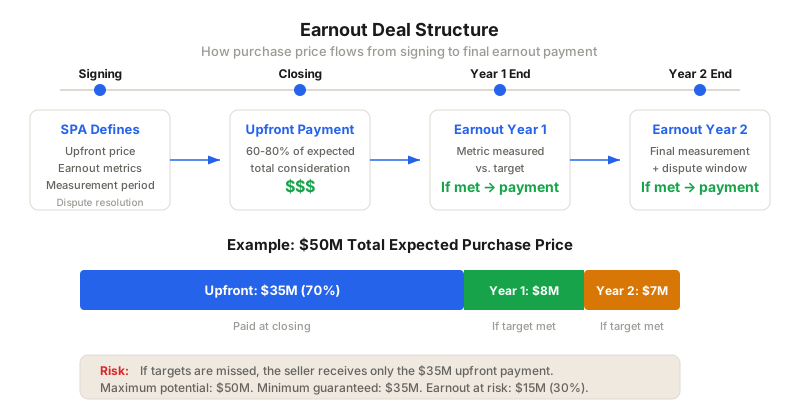
Here is how a typical earnout transaction flows:
At signing, the definitive agreement (usually a share purchase agreement) specifies the upfront amount, the earnout metrics, the measurement period, the calculation methodology, payment mechanics, and dispute resolution procedures. The earnout provisions are among the most heavily negotiated sections of the SPA.
At closing, the buyer pays the upfront consideration — typically 60-80% of the expected total purchase price. Part of the remaining consideration may be placed in escrow as a general indemnity holdback, separate from the earnout.
During the measurement period, the buyer operates the business and the seller (if retained) continues in a defined role. At each measurement date — usually annually — the buyer calculates the earnout metric and reports the result to the seller.
At payment, if the metric meets or exceeds the target, the buyer pays the corresponding earnout amount. Payment is typically due 90-120 days after the end of the measurement period, allowing time for calculation and any dispute process.
If there is a dispute, most SPAs provide for an independent accounting firm to resolve disagreements over the earnout calculation, with the costs shared or allocated to the losing party.
Common Earnout Metrics
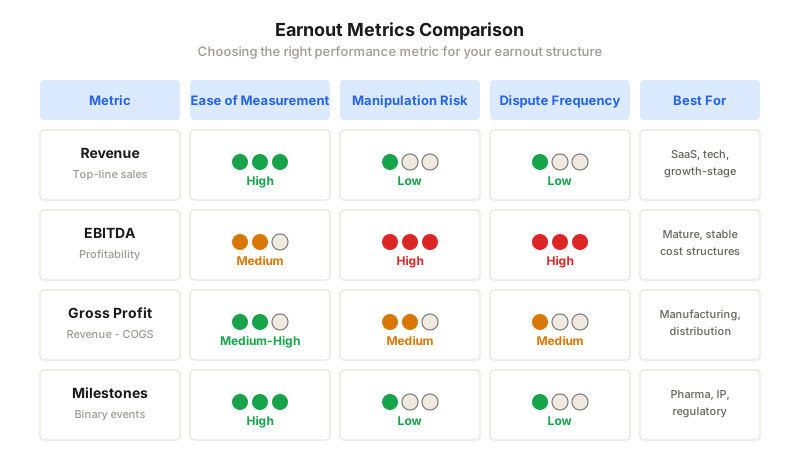
The choice of metric is the most consequential decision in structuring an earnout. It determines what the seller is incentivised to achieve, what the buyer can (and cannot) influence, and how likely disputes are.
Revenue
Revenue is the most common earnout metric in the mid-market. It is straightforward to measure, difficult for the buyer to manipulate through accounting decisions, and directly reflects the business’s commercial momentum.
The downside: revenue does not capture profitability. A seller incentivised solely on revenue may push for growth at any cost — discounting prices, extending payment terms, or entering unprofitable contracts — all of which grow revenue while destroying value for the buyer.
When to use revenue: businesses where the buyer’s primary concern is commercial traction, customer adoption, or top-line growth. Common in SaaS, technology, and early-stage businesses.
EBITDA
EBITDA-based earnouts capture profitability and are favoured by PE buyers and financially oriented acquirers. They align the seller’s incentives with the buyer’s return expectations.
The problem: EBITDA is vulnerable to buyer manipulation. Post-closing, the buyer controls operating decisions — headcount, overhead allocation, capital expenditure, marketing spend. A buyer who shifts corporate overhead onto the acquired entity, reallocates shared revenue, or underinvests in growth can suppress EBITDA without technically violating the SPA.
“Earnout disputes disproportionately involve EBITDA-based structures,” notes Robert Looney, a partner at Hogan Lovells who has handled numerous post-acquisition disputes. “The metric is inherently more subjective than revenue, and post-closing operational decisions create asymmetric information between buyer and seller.”
When to use EBITDA: mature businesses with stable cost structures, where both parties agree on the baseline and the buyer commits to operating the business as a standalone unit during the measurement period.
Gross Profit
Gross profit offers a middle ground. It captures margin quality (unlike revenue) but is less susceptible to overhead allocation games (unlike EBITDA). Gross profit-based earnouts work well for manufacturing, distribution, and services businesses where the seller’s value proposition is margin, not just volume.
Non-Financial Milestones
Some earnouts are tied to specific events rather than financial metrics: regulatory approvals, key customer contract renewals, product launches, clinical trial results, or employee retention targets.
Milestone-based earnouts are binary — the event either happens or it does not. This eliminates the accounting disputes that plague financial earnouts but introduces a different risk: the buyer may have limited incentive to pursue the milestone if the earnout payment exceeds the perceived benefit.
When Earnouts Make Sense
Earnouts are not appropriate for every transaction. They add complexity, create post-closing friction, and frequently lead to disputes. Sellers should generally prefer a clean break — full payment at closing with no contingencies.
However, an earnout is often the only way to get a deal done in these situations:
Valuation gap. The buyer’s offer at closing falls short of what the seller believes the business is worth. Rather than walking away, the earnout lets the seller prove the higher valuation through results. This is by far the most common scenario.
Growth-stage businesses. Companies with strong recent growth but limited track records. The buyer cannot justify paying a multiple on projected earnings that the business has not yet demonstrated. The earnout shifts the proof burden to the seller.
Key person dependency. When the founder or key executives are critical to the business’s revenue and relationships, the earnout incentivises their continued involvement post-closing. It is often paired with a non-compete agreement and an employment contract.
Cyclical or seasonal businesses. Companies whose recent results may not reflect normalised performance. The earnout allows for a measurement period that captures a full business cycle.
Regulatory or market uncertainty. Pending approvals, untested markets, or pipeline opportunities that could materially affect value but have not yet been realised.
Negotiating the Earnout: Key Terms for Both Sides
The earnout provisions in the SPA are among the most heavily negotiated terms in any transaction. Sellers and buyers have directly opposing interests, and the language matters.
Seller Protections
Accounting methodology. Define the accounting standards and specific policies that apply to the earnout calculation within the SPA itself, not by reference to “GAAP as applied by the buyer.” Every ambiguity is a potential dispute.
Ordinary course covenants. Require the buyer to operate the business in the ordinary course during the measurement period — maintaining staffing levels, marketing spend, customer pricing, and product development at levels consistent with the pre-closing business plan.
Standalone operation. The most protective provision for sellers: require the buyer to maintain the business as a separate entity during the earnout period, preventing revenue reallocation, overhead loading, or integration decisions that suppress earnout metrics.
Information rights. Sellers need regular access to financial information — monthly or quarterly — to monitor performance against earnout targets. Without these rights, the seller has no visibility until the buyer delivers the earnout calculation months after the period ends.
Dispute resolution. An independent accounting firm (typically a Big Four firm not engaged by either party) should resolve calculation disputes, with expedited timelines and binding decisions.
Acceleration on change of control. If the buyer resells the business or experiences a change of control during the earnout period, the earnout should accelerate at the maximum amount. Without this, the seller risks losing their contingent consideration entirely.
Buyer Protections
Operational flexibility. The buyer needs room to integrate and manage the business. Overly restrictive earnout covenants — such as requiring standalone operation indefinitely — can prevent the buyer from realising the synergies that justified the acquisition.
Anti-sandbagging. Prevent the seller from artificially inflating earnout metrics by pulling forward revenue, deferring expenses, or making unsustainable commitments to customers.
Reasonable targets. Base the earnout on the seller’s own projections. If the seller claimed during due diligence that the business would generate USD 20 million in revenue, that figure — not an easier target — should be the earnout benchmark.
Cap and floor. Set a maximum earnout payment (the cap) and consider whether a minimum threshold is needed before any earnout is payable. Tiered structures with partial credit for partial achievement balance both parties’ interests.
Set-off rights. Allow the buyer to offset earnout payments against indemnification claims arising from breaches of reps and warranties. Without this, the buyer may owe earnout payments while simultaneously pursuing indemnity claims.
Earnout Disputes: The Biggest Risk
Earnouts are among the most litigated provisions in M&A. A Shareholder Representative Services (SRS Acquiom) study found that earnout-related claims accounted for a significant share of post-closing disputes in private transactions. The inherent tension is structural: once the deal closes, the buyer controls the business, and the seller’s economic outcome depends on decisions the buyer makes.
Common Sources of Disputes
| Dispute Type | Description | Frequency |
|---|---|---|
| Accounting methodology | Disagreements over how revenue or EBITDA is calculated | Very common |
| Buyer’s conduct | Allegations the buyer deliberately suppressed earnout metrics | Common |
| Integration decisions | Whether the buyer’s operational changes affected earnout results | Common |
| Good faith / ordinary course | Whether the buyer operated the business consistently with pre-closing practice | Moderate |
| Metric interpretation | Disputes over what counts as “revenue” or which entities are included | Moderate |
Reducing Dispute Risk
The best protection is precise drafting. Every term in the earnout provision — “revenue,” “EBITDA,” “ordinary course,” “good faith” — should be defined specifically in the SPA, not left to general interpretation.
Parties should also consider including a sample calculation as an exhibit to the SPA, showing exactly how the earnout would be computed using recent historical financials. This eliminates many post-hoc disagreements over methodology.
For transactions with material earnout components, both parties should engage quality of earnings advisors to stress-test the metrics and agree on baseline assumptions before signing.
Earnouts in Asia Pacific Transactions
Cross-border M&A transactions in Asia Pacific introduce additional earnout considerations that do not arise in purely domestic deals.
Legal enforcement. Earnout provisions must be enforceable in the governing jurisdiction of the SPA. In markets like Japan, Korea, and Southeast Asia, the legal framework for contingent payment obligations may differ from US or UK precedent. Sellers should ensure the SPA’s governing law and dispute resolution mechanism (typically Singapore or Hong Kong arbitration for APAC cross-border deals) provide effective remedies.
Currency denomination. Whether the earnout is denominated in local currency or USD matters significantly over a multi-year measurement period. APAC currency volatility — the Japanese yen moved over 15% against the USD in 2024 alone — can meaningfully affect earnout economics. Smart structures specify the denomination currency and may include FX adjustment mechanisms.
Accounting standards. IFRS, local GAAP, and US GAAP can produce different revenue and EBITDA figures for the same business. The SPA must specify which standard applies to the earnout calculation and how adjustments are handled if the buyer converts the target’s accounting post-closing.
Cultural factors. In relationship-driven markets — particularly Japan, Korea, and much of Southeast Asia — earnout disputes can destroy the post-closing working relationship between buyer and seller management. This is especially damaging when the seller’s continued involvement is critical to the earnout itself. Parties should consider mediation as a first step before formal dispute mechanisms.
This is where tools like Amafi add value — helping dealmakers model earnout structures against APAC-specific variables including currency exposure, local GAAP adjustments, and comparable transaction benchmarks across fragmented regional markets where data is otherwise difficult to aggregate.
Getting the Earnout Right
Earnouts are neither inherently good nor bad. They are a tool — useful when applied to the right transaction, dangerous when used as a lazy compromise to avoid difficult valuation conversations.
For sellers, the priority is precision: define every term, protect against buyer manipulation, and ensure enforcement mechanisms work in your jurisdiction. For buyers, the priority is alignment: structure the earnout so the seller’s incentives match the buyer’s post-closing business plan.
The transactions where earnouts work best share a common trait: both parties genuinely believe the targets are achievable and have aligned incentives to achieve them. When an earnout is used to paper over fundamental disagreement about a business’s prospects, it simply converts a pre-closing negotiation into a post-closing dispute.
Navigating earnout terms in your deal? Amafi advises business owners on deal structure, valuation, and negotiation — including earnout terms that protect your interests. No retainers, success fee only. Book a valuation meeting to discuss your situation.

About the Author
Daniel Bae
Co-founder & CEO, Amafi
Daniel is an investment banker with 15+ years of experience in M&A, having advised on deals worth over US$30 billion. His career spans Citi, Moelis, Nomura, and ANZ across London, Hong Kong, and Sydney. He holds a combined Commerce/Law degree from the University of New South Wales. Daniel founded Amafi to solve the pain points in M&A, enabling bankers to focus on what matters most — delivering trusted advice to clients.
About Amafi
Amafi is an M&A advisory firm built for Asia Pacific. We help business owners sell their companies and corporate teams make strategic acquisitions — with bulge bracket execution quality at lower fees, powered by AI and a network of senior dealmakers.
Learn about selling your businessGet M&A insights delivered
AI-powered deal sourcing strategies, market analysis, and Asia Pacific insights — straight to your inbox.