Why Exit Preparation Matters More Than the Sale Process
Most M&A literature focuses on what happens after you engage an advisor — the CIM, the buyer outreach, the bid rounds, the closing. But by that point, 80% of the value drivers are already locked in. The work that determines whether you sell at 5x EBITDA or 8x EBITDA happens 12 to 24 months before a buyer ever sees your company.
According to Bain & Company’s 2025 Global M&A Report, deal completion rates remain below 60% for mid-market transactions — and the most common reasons for failure are issues that surface during due diligence that could have been resolved before going to market. Unprepared sellers lose deals, accept lower valuations, or face painful renegotiations at the worst possible moment.
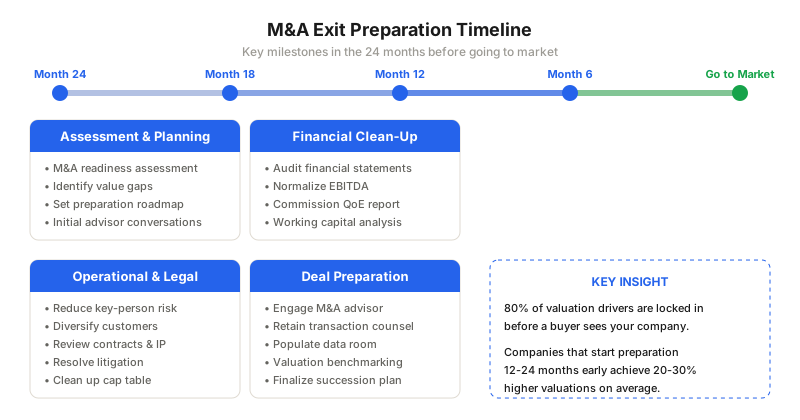
This guide covers the pre-process preparation work — what to do in the 12 to 24 months before you engage an advisor and start a formal sell-side M&A process.
Financial Readiness: The Foundation of Valuation
Buyers price businesses on adjusted EBITDA — and they will challenge every adjustment you present. The difference between a well-prepared seller and an unprepared one often comes down to financial credibility.
Audit and Review Your Statements
At minimum, you need two to three years of audited financial statements from a reputable accounting firm. If a full audit is cost-prohibitive, reviewed financials are acceptable, but they carry less weight with institutional buyers and lenders. Companies with reviewed or unaudited financials typically face a longer diligence process and more invasive information requests.
Normalize Your EBITDA
Build a clear EBITDA bridge that shows every adjustment from reported net income to normalized EBITDA. Common add-backs include:
- Owner compensation above market rate — the single largest and most scrutinized adjustment
- One-time expenses — litigation costs, non-recurring consulting projects, COVID-era restructuring
- Related-party transactions — rent above market for owner-held real estate, payments to family members not employed in the business
- Discretionary spending — personal travel, non-business vehicles, club memberships
Every add-back must be documented and defensible. Buyers’ advisors will challenge aggressive normalizations, and losing credibility on EBITDA adjustments creates a trust deficit that infects the entire deal.
Commission a Quality of Earnings
A quality of earnings report — prepared by an independent accounting firm — validates your adjusted EBITDA and gives buyers confidence in your numbers. It typically costs US$50,000 to US$150,000 for a mid-market company, but it is one of the highest-ROI investments in the pre-sale process.
A sell-side QoE does three things: it identifies issues before a buyer does (giving you time to fix them), it reduces the scope and duration of buyer diligence, and it signals to the market that you are a serious, prepared seller.
Operational Clean-Up: Reducing Buyer Risk
Buyers pay premiums for businesses that can operate without the founder and survive the loss of any single customer, supplier, or employee. Every concentration risk depresses your enterprise value.
Reduce Key-Person Dependency
If you are the primary relationship holder for your top clients, the lead on product development, and the final decision-maker on everything from pricing to hiring, buyers see a business that cannot survive your departure. Start delegating:
- Transition client relationships to a second-level manager who can maintain continuity post-close
- Document institutional knowledge — processes, pricing logic, supplier terms, key vendor relationships
- Build a management layer that can present credibly in a management presentation and give buyers confidence in post-acquisition continuity
“The businesses that command the highest multiples are the ones where the founder could take a six-month sabbatical and the company wouldn’t miss a beat,” says Daniel Bae, founder of Amafi and former M&A advisor with over US$30 billion in transaction experience. “Buyers are acquiring the business, not the founder — and the exit preparation period is when you prove that.”
Diversify Customer Concentration
If your top customer represents more than 20% of revenue, most institutional buyers will either discount the valuation or require an earnout tied to that customer’s retention. If the top three customers represent more than 50%, it is a material deal risk.
During the preparation period:
- Pursue new customer acquisition to dilute concentration ratios
- Lock in multi-year contracts with key customers (ideally with automatic renewal provisions)
- Ensure no customer contract has a change of control clause that would allow termination upon a sale
Clean Up Contracts and Agreements
Review every material contract for assignability, change-of-control triggers, and termination provisions. Buyers will examine these during diligence, and unfavorable provisions can become deal-breakers or price chips:
- Employment agreements — ensure key employees have non-compete agreements and appropriate notice periods
- Supplier agreements — confirm they are assignable and do not require consent for ownership changes
- Lease agreements — understand transfer requirements and remaining terms
- IP assignments — verify all intellectual property is properly assigned to the company, not held personally by founders or contractors
Legal and Compliance Housekeeping
Legal surprises during due diligence are among the most common deal-killers. The preparation period is your window to resolve them without the pressure of a live transaction.
Corporate Records and Cap Table
Ensure your corporate records are current and complete — articles of incorporation, board minutes, shareholder resolutions, and stock ledger. A messy cap table with undocumented equity grants, informal side agreements, or disputes between founders will slow or kill a deal.
Regulatory and Compliance
Confirm compliance with all relevant regulations — industry licensing, data privacy (GDPR, APAC equivalents), employment law, environmental obligations, and tax filings. For businesses operating across APAC, this is particularly critical: cross-border transactions involve regulatory review in multiple jurisdictions, and gaps discovered post-signing can trigger price adjustments or allow buyers to invoke MAC clauses.
Pending Litigation
Resolve any ongoing disputes before going to market. Even meritless litigation creates contingent liability that buyers will price in — typically by requiring an indemnification holdback or discounting the purchase price. If resolution is not possible, prepare a clear litigation summary with counsel’s assessment of exposure so your advisor can address it proactively.
Valuation Optimization: What Moves the Multiple
The preparation period is your last opportunity to influence the metrics that drive your valuation multiple. According to McKinsey’s valuation analysis, the spread between the highest and lowest multiples within the same industry can be 3-4x — meaning a well-positioned business in a “6x industry” can trade at 8-9x while a poorly positioned peer trades at 4-5x.
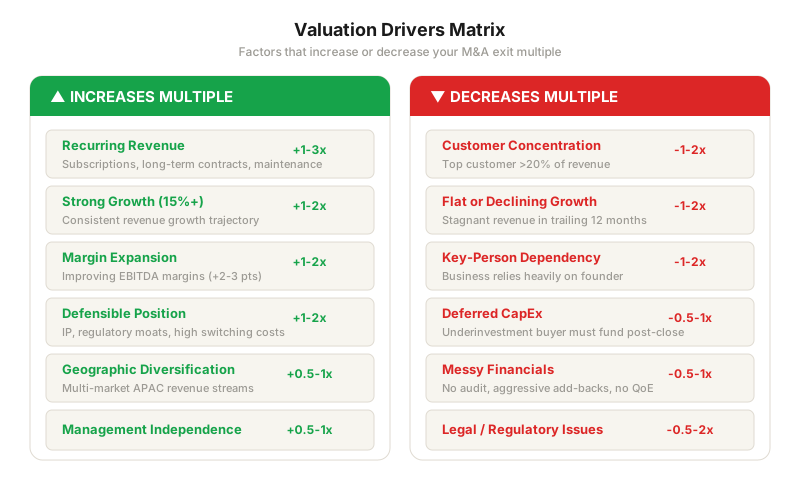
The key drivers that move multiples upward:
- Recurring revenue — subscription models, long-term contracts, maintenance agreements. Even shifting 20-30% of revenue to a recurring model can meaningfully improve your multiple
- Revenue growth trajectory — a business growing at 15%+ commands a materially higher multiple than one growing at 5%. The trailing twelve months before going to market matters most
- Margin expansion — improving EBITDA margins by 2-3 points through operational efficiency or pricing discipline can add 1-2x to your multiple
- Defensible market position — proprietary technology, regulatory moats, switching costs, brand strength
- Geographic diversification — APAC businesses with revenue across multiple markets trade at premiums to single-country operators, according to Deloitte’s Asia-Pacific M&A Insights
This is the approach we’ve taken at Amafi — helping business owners and their advisors understand how AI-powered market intelligence can identify the buyers most likely to pay a control premium for a well-prepared company, particularly across APAC’s fragmented markets.
What Depresses Multiples
Conversely, these factors reliably reduce your multiple:
- Customer concentration above 20% in a single account
- Declining or flat growth in the trailing twelve months
- Key-person dependency on the founder
- Deferred capital expenditure — underinvestment that a buyer will need to fund post-close
- Messy financials without clear EBITDA normalization
- Pending legal or regulatory issues
Assembling Your Advisory Team
The best outcomes come from building the right team before you need them. Engaging advisors under time pressure leads to suboptimal selection and weaker negotiating positions.
M&A Advisor Selection
Choose an advisor based on three criteria: sector expertise, buyer relationships, and cultural fit. The ideal advisor has closed deals in your industry, maintains active relationships with the buyers most likely to value your business, and will represent your interests with the credibility and professionalism that reflects on your company.
For APAC businesses, cross-border capability is essential. A deal involving a Singaporean business and a Japanese buyer requires an advisor who understands both markets, speaks the language (literally and figuratively), and has navigated the regulatory requirements of both jurisdictions.
Key questions to ask prospective advisors:
- How many deals have you closed in my industry in the past 24 months?
- What is your buyer database in this sector and geography?
- What fee structure do you propose — retainer, success fee, or hybrid?
- What is your average timeline from engagement to close?
Legal Counsel
Retain M&A-experienced transaction counsel early — not your general corporate attorney. The SPA negotiation, reps and warranties package, and indemnification framework require specialists who negotiate these provisions regularly.
Tax and Accounting
Engage a tax advisor to structure the transaction optimally — asset vs. share sale, purchase price allocation, rollover equity structures, and cross-border tax implications. Poor tax structuring can cost sellers millions that could have been avoided with early planning.
Timing the Market
While you cannot control macroeconomic conditions, you can control when you go to market relative to your own business trajectory.
The ideal window is when:
- Revenue is growing — not flat or declining
- EBITDA margins are stable or expanding — not contracting
- The industry outlook is positive — sector tailwinds attract more buyers and higher multiples
- You have optionality — you do not need to sell, which gives you leverage to walk away from a bad deal
Selling in a downturn, immediately after losing a major customer, or when the founder is visibly fatigued sends distress signals that sophisticated buyers will exploit. Sellers who are perceived as motivated to exit typically receive 10-15% lower valuations than those who are perceived as selling from a position of strength (Harvard Business Review).
The M&A Exit Readiness Checklist
Use this checklist to track your preparation progress. Each item should be resolved before you engage an advisor and begin the formal exit strategy process.
Financial
- Two to three years of audited financial statements
- Normalized EBITDA bridge with documented add-backs
- Sell-side quality of earnings report completed
- Working capital analysis and trends documented
- Revenue and margin trends showing positive trajectory
- Tax structure reviewed and optimized for transaction
Operational
- Management team can operate independently of founder
- Top customer concentration below 20%
- Key employee agreements include non-competes and retention terms
- All critical processes documented
- Deferred capital expenditure addressed
Legal and Compliance
- Corporate records current and complete
- IP properly assigned to the company
- Regulatory compliance confirmed across all jurisdictions
- Pending litigation resolved or clearly documented
- Material contracts reviewed for change-of-control provisions
- Cap table clean with no disputes
Deal Readiness
- Virtual data room populated with material documents
- M&A advisor selected and engaged
- Transaction counsel retained
- Tax advisor engaged on deal structuring
- Preliminary valuation benchmarking completed
- Succession plan in place for post-close leadership
Preparing your business for an M&A exit? Amafi is an M&A advisory firm that helps business owners across Asia Pacific prepare, value, and sell their companies — with AI-powered buyer matching and a success-fee-only model. Book a confidential valuation meeting to start the conversation.

About the Author
Daniel Bae
Co-founder & CEO, Amafi
Daniel is an investment banker with 15+ years of experience in M&A, having advised on deals worth over US$30 billion. His career spans Citi, Moelis, Nomura, and ANZ across London, Hong Kong, and Sydney. He holds a combined Commerce/Law degree from the University of New South Wales. Daniel founded Amafi to solve the pain points in M&A, enabling bankers to focus on what matters most — delivering trusted advice to clients.
About Amafi
Amafi is an M&A advisory firm built for Asia Pacific. We help business owners sell their companies and corporate teams make strategic acquisitions — with bulge bracket execution quality at lower fees, powered by AI and a network of senior dealmakers.
Learn about selling your businessGet M&A insights delivered
AI-powered deal sourcing strategies, market analysis, and Asia Pacific insights — straight to your inbox.