Why the First 100 Days Define Deal Success
The deal thesis is set during due diligence. Whether that thesis becomes reality is determined in the first 100 days after close.
Research from McKinsey consistently shows that roughly 70% of acquisitions fail to deliver their projected synergies. But the failure rarely starts with a bad thesis. It starts with the integration that follows — organisations that move too slowly, communicate too poorly, or underestimate the operational complexity of combining two businesses.
The 100-day mark matters because it represents the window where integration momentum is either built or lost. Employees decide whether to stay or start looking. Customers decide whether the new ownership changes anything for them. Competitors decide whether to poach accounts during the transition. Every week of uncertainty erodes value.
This playbook lays out what effective integration teams actually do, phase by phase, from 30 days before close through Day 100.
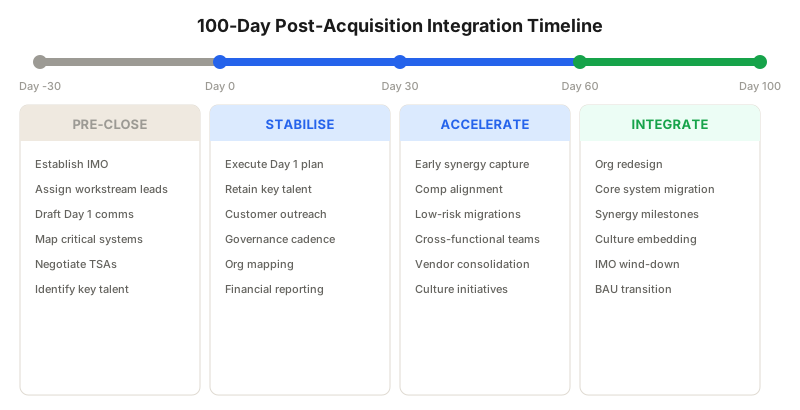
Pre-Close: Building the Integration Blueprint (Days -30 to 0)
Integration planning starts before the deal closes. The best acquirers begin building their integration blueprint as soon as closing conditions are substantially agreed — typically 30 days before close, sometimes earlier.
Establish the Integration Management Office (IMO). The IMO is the nerve centre of every integration. Appoint an integration lead with dedicated bandwidth — not someone doing this alongside their day job. This person reports directly to the deal sponsor (CEO, Head of Corp Dev, or the PE operating partner).
Assign workstream leads. Break the integration into functional workstreams: People & Organisation, Finance, IT & Systems, Operations, and Commercial/Customers. Each workstream needs an owner from the acquiring side and a counterpart from the target. These pairs will co-own integration execution.
Draft Day 1 communications. You need separate communications for employees (both sides), customers, suppliers, regulators, and the market. Each message has a different tone, level of detail, and set of commitments. In cross-border deals, these need translation and cultural adaptation — the messaging that works for an Australian team won’t land the same way in Japan or Thailand.
Map critical systems and contracts. Identify every system, contract, and process that must function on Day 1: payroll, email, financial reporting, key customer contracts with change of control clauses, supplier agreements, insurance policies, and IT access controls.
Identify transition services agreements. If the target is being carved out of a larger entity, TSAs govern which services the seller continues providing post-close. Understand what’s covered, for how long, and at what cost — TSAs that expire before you’ve migrated the underlying capability are one of the most common integration failures.
Day 1: The Tone-Setting Moment
Day 1 isn’t about completing the integration. It’s about setting the tone for everything that follows. Get Day 1 right and you buy goodwill that carries the team through harder decisions later. Get it wrong and you spend months recovering trust.
Leadership visibility. The CEO or deal sponsor should be present — physically, not via email. If it’s a cross-border deal, the most senior leader available should be at the target’s main office. Town halls, floor walks, and small-group meetings matter more than polished presentations.
Employee communications. Every employee at both organisations should receive a communication within the first two hours. The message: what happened, why, what it means for them, what’s changing immediately, and what isn’t changing. Be specific — “nothing is changing yet” is not reassuring, it’s ambiguous.
Customer outreach. Key accounts should hear from their relationship owner on Day 1, not from a press release. Prepare a customer communication plan ranked by revenue and strategic importance. Top 20 accounts get personal calls. The next tier gets personalised emails. Everyone else gets a professional notification.
IT continuity. Email works. Payroll works. Access badges work. VPN works. Financial systems are accessible. These are non-negotiable Day 1 requirements. If any of these fail, the integration starts with a credibility deficit.
Phase 1: Stabilise the Business (Days 1-30)
The first month is about stabilisation — making sure the business continues to operate while integration planning progresses.
Retain key talent. Identify the 20-50 employees most critical to the target’s value — the people whose departure would destroy the acquisition thesis. Meet with them individually in the first two weeks. Understand their concerns. Where earnouts or non-compete agreements create retention incentives, make sure they’re clearly communicated. Where they don’t, consider retention bonuses tied to specific milestones.
According to Bain & Company’s Global M&A Report, talent retention is the single strongest predictor of whether an integration achieves its value targets — yet fewer than half of acquirers have a structured retention programme in place before close.
Maintain customer relationships. Track customer engagement signals weekly: order volumes, support ticket tone, contract renewal conversations, NPS shifts. If a major customer starts pulling back, you need to know in week 2, not month 3.
Establish governance cadence. Set a weekly integration steering committee and workstream check-ins. Use a simple red/amber/green status for each workstream. The IMO lead should produce a one-page integration dashboard weekly — not a 50-page report that nobody reads.
Complete organisational mapping. Map every role in the combined organisation. Identify overlaps, gaps, and reporting line questions. Don’t announce org changes yet — you need a complete picture first. But start the analysis now so you can act in Month 2.
Integrate financial reporting. The board and investors need consolidated financials. Establish a combined management reporting cadence, even if the underlying systems haven’t been integrated yet. Manual reconciliation is fine for Month 1 — automation comes later.
Phase 2: Execute Quick Wins (Days 31-60)
Month 2 is about demonstrating progress. The organisation is watching to see whether this integration is real or theoretical.
Capture early synergies. Identify procurement savings that can be realised without system integration: insurance consolidation, software license rationalisation, office lease negotiations, professional services vendor consolidation. These aren’t the headline synergies, but they’re visible and they build credibility.
Align compensation and benefits. Disparities in compensation, bonus structures, or benefits between the two organisations create resentment fast. You don’t need full harmonisation by Day 60, but you need a clear plan with a timeline — and communication to both sides about what’s coming.
Begin system consolidation. Start with low-risk systems: communication tools, expense management, travel booking, HR information systems. Defer high-risk migrations (ERP, CRM, core operational systems) until Month 3 or beyond. Every system migration that fails in Month 2 undermines confidence in the integration team.
“The biggest mistake I see in mid-market integrations is trying to do everything at once,” says Daniel Bae, founder of Amafi and former M&A advisor with over US$30 billion in transaction experience. “The teams that succeed treat the first 60 days as stabilise-and-prove. The hard restructuring comes in Month 3, once you’ve earned the organisation’s trust.”
Launch cross-functional teams. By Day 45, people from both legacy organisations should be working together on specific projects. This is how integration happens in practice — not through org charts and town halls, but through shared work. Assign cross-entity project teams for the integration’s highest-priority deliverables.
Phase 3: Integrate (Days 61-100)
The final phase is where strategic integration begins in earnest. You’ve stabilised the business, proven the integration team’s competence, and built enough trust to make harder decisions.
Implement organisational redesign. If the combined organisation requires restructuring — leadership changes, team consolidations, or role eliminations — this is when it happens. Don’t delay beyond Day 100. Prolonged uncertainty about “who stays and who goes” is the single most corrosive force in any integration.
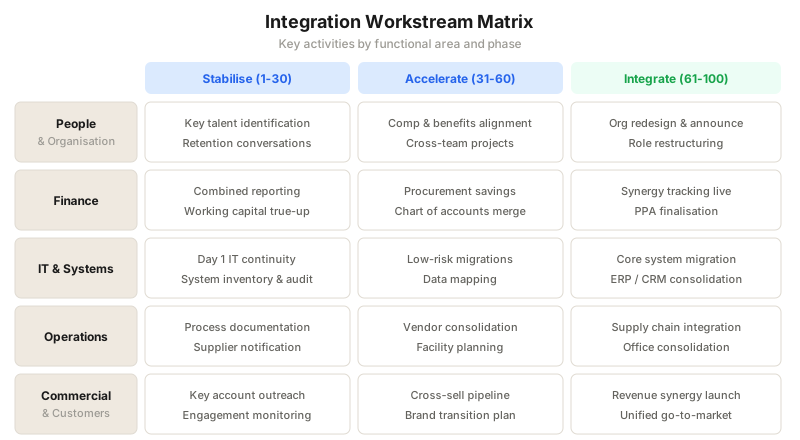
Migrate core systems. Begin the ERP, CRM, and operational system migrations that were planned in Month 1 and scoped in Month 2. These are the highest-risk, highest-impact workstreams. Each migration needs its own project plan, testing protocol, and rollback contingency.
Deliver first synergy milestones. By Day 100, the integration should have delivered measurable progress against the synergy targets set in the deal model. Not full realisation — that takes 12-24 months — but directional evidence that the thesis is on track. Purchase price allocation and goodwill assumptions should be validated against what you’re seeing in practice.
Embed the combined culture. Culture isn’t declared; it’s demonstrated. By Day 100, the leadership team should be modelling the behaviours and decision-making norms they want the combined organisation to adopt. If the integration’s cultural aspiration exists only in a PowerPoint deck, it doesn’t exist.
Transition from IMO to business-as-usual. The IMO is a temporary structure. By Day 100, the most critical integration workstreams should be transitioning to business-as-usual ownership. The IMO continues to oversee longer-term projects (system migrations, facility consolidations) but the day-to-day business should be running without integration scaffolding.
The Integration Management Office
The IMO deserves its own discussion because it’s where integrations succeed or fail.
Structure. The IMO lead reports to the deal sponsor and has authority to convene any workstream, request resources, and escalate blockers. Below the lead sit the workstream owners, each co-led by an acquirer and target representative. A small PMO team (2-3 people for mid-market, 5-10 for large-cap) handles tracking, reporting, and meeting coordination.
Cadence. Weekly workstream reviews. Biweekly steering committee with C-suite or deal sponsor. Monthly board updates. The cadence should be rigid — never skip a check-in because “there’s nothing to report.” In integration, silence is never good news.
Tracking. Track three things per workstream: milestones (on/off track), synergy capture (actual vs. plan), and risks (new issues surfaced). Keep reporting simple and visual. The goal is pattern recognition across workstreams, not comprehensive documentation.
According to McKinsey’s research on M&A integration, companies that establish a dedicated IMO within the first week of close are 2.5 times more likely to capture targeted synergies than those that rely on existing management structures.
Cross-Border Integration in Asia Pacific
APAC transactions add integration complexity that domestic acquirers rarely anticipate.
Employment law variation. Restructuring timelines vary dramatically across APAC jurisdictions. Terminating employees in Japan or South Korea involves significantly longer notice periods, regulatory consultations, and social obligations than in Australia or Singapore. Integration timelines must account for these differences — a 100-day restructuring plan designed for common-law jurisdictions will fail in civil-law markets.
Language and communication. A regional integration spanning Australia, Japan, and Indonesia requires operating in at least three languages. Every policy document, training module, and leadership communication needs local language versions. Translation is the easy part — cultural adaptation of tone, formality level, and messaging hierarchy is where most acquirers stumble.
Working capital and financial integration. Working capital peg calculations and completion accounts mechanisms vary by jurisdiction. Multi-country targets may have different fiscal year-ends, tax reporting requirements, and audit standards. Finance integration in APAC typically takes 50% longer than domestic equivalents.
This complexity is why Amafi’s platform emphasises compatibility assessment during the deal sourcing phase — acquisitions that account for operational and cultural alignment from the start face materially smoother integrations than deals sourced purely on financial metrics. For a broader view of how AI tools can accelerate integration workstreams, see our article on AI-powered post-merger integration.
Common Integration Failures
After observing hundreds of transactions, the same failure patterns recur.
Delayed decisions. The most expensive integration mistake is indecision. Organisations can absorb bad decisions faster than they can absorb no decisions. If the combined leadership structure isn’t announced by Day 60, the best people leave.
Under-resourcing the IMO. Integration is a full-time job. Assigning integration leadership to executives who are simultaneously running their day jobs guarantees that integration becomes everyone’s second priority.
Ignoring the target’s customers. Acquirers focus on the target’s employees and systems while assuming customers will remain loyal. Customer attrition during integration — especially when relationships were founder-dependent — destroys deal value faster than any failed system migration.
Over-engineering the communication. When leadership spends weeks perfecting the change narrative, the organisation fills the silence with speculation. Speed matters more than polish. A good-enough message delivered on Day 1 beats a perfect message delivered in Week 3.
Treating post-merger integration as a project, not a capability. Organisations that integrate well don’t view PMI as a one-time project. They build integration as an institutional capability — with playbooks, trained integration leads, and lessons-learned processes that improve with every transaction.
Planning an acquisition in Asia Pacific? Amafi helps PE firms and corporate development teams source, match, and evaluate acquisition targets across the region — with AI that assesses strategic and operational compatibility from the start, setting up smoother integrations. Get in touch to discuss how better sourcing leads to better outcomes.

About the Author
Daniel Bae
Co-founder & CEO, Amafi
Daniel is an investment banker with 15+ years of experience in M&A, having advised on deals worth over US$30 billion. His career spans Citi, Moelis, Nomura, and ANZ across London, Hong Kong, and Sydney. He holds a combined Commerce/Law degree from the University of New South Wales. Daniel founded Amafi to solve the pain points in M&A, enabling bankers to focus on what matters most — delivering trusted advice to clients.
About Amafi
Amafi is an M&A advisory firm built for Asia Pacific. We help business owners sell their companies and corporate teams make strategic acquisitions — with bulge bracket execution quality at lower fees, powered by AI and a network of senior dealmakers.
Book a valuation meetingGet M&A insights delivered
AI-powered deal sourcing strategies, market analysis, and Asia Pacific insights — straight to your inbox.