If you have spent 20 or 30 years building a business, selling it is probably the biggest financial decision of your life. It is also something most people only do once. You would not wing it on a decision this significant — so why do so many business owners rush into the sale without proper preparation?
The short answer: they do not know what preparation looks like. Nobody teaches you how to sell a business. And by the time you start talking to advisors, the clock is already ticking.
This guide is written for business owners who are thinking about selling in the next one to three years. No jargon. No investment banking terminology. Just practical steps you can start taking today to make sure you get the best possible outcome when the time comes.
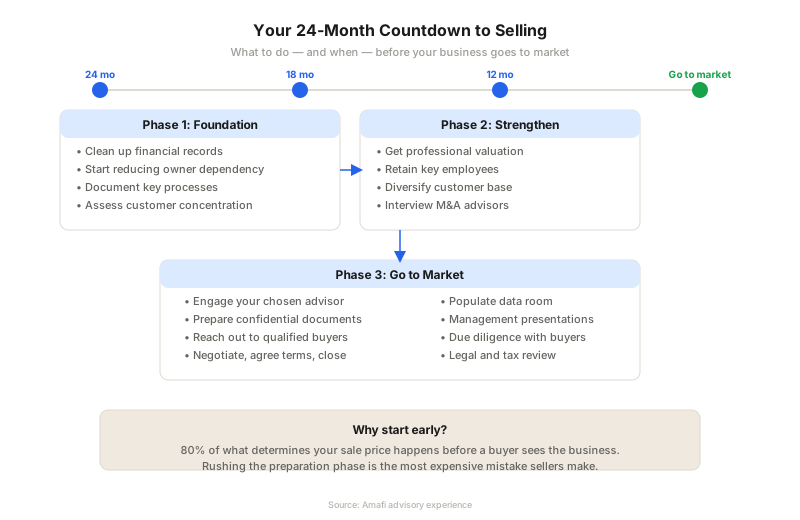
Start Preparing at Least Two Years Early
The single biggest mistake sellers make is waiting too long to prepare. According to the International Business Brokers Association (IBBA), the average business sale takes 8 to 12 months from the day you formally go to market — but the preparation work that happens before that determines whether you sell at a good price, an average price, or not at all.
Two years before a planned sale is the ideal starting point. That gives you enough time to:
- Clean up your financial records so they withstand scrutiny
- Reduce your personal involvement in the day-to-day running of the business
- Diversify your customer base if you are too dependent on one or two accounts
- Lock in your best employees so they stay through the transition
- Get a professional valuation so you know what your business is actually worth
- Interview and select the right advisor to run the sale process
If you are thinking “I want to sell next year,” you can still do a lot of this work — but you will be making trade-offs. Buyers can tell when a seller is rushing, and it almost always costs you money.
Clean Up Your Financials
This is where most business owners underestimate the work involved. Your accountant may have your tax returns in order, but tax returns are not what buyers look at. Buyers want to see the true earning power of your business — and that means clean, transparent financial statements.
Here is what “clean financials” means in practice:
Separate personal and business expenses. If you run personal travel, a family member’s salary, or your car through the business, you need to identify and document every one of these items. Buyers will subtract anything that looks personal — and if your numbers are tangled, they will assume the worst.
Produce two to three years of accurate financial statements. At minimum, you want profit-and-loss statements and balance sheets that a qualified accountant has reviewed. If your revenue is above $5 million, consider getting a formal audit — it costs more, but it dramatically increases buyer confidence.
Calculate your adjusted EBITDA. This is the number buyers use to value your business. EBITDA stands for Earnings Before Interest, Taxes, Depreciation, and Amortisation — but what buyers really care about is the adjusted version, which removes one-off expenses and owner perks to show what the business truly earns. If your accountant is not familiar with this, find one who is.
Document every adjustment. If you add back your above-market salary or a one-time legal expense, you need to show the maths. Buyers’ advisors will challenge every single adjustment, and losing credibility on financials creates a trust deficit that poisons the rest of the deal.
According to a PwC study on mid-market M&A transactions, financial quality is the single most cited reason for deals failing during due diligence — ahead of regulatory issues, management concerns, or market conditions.
Reduce Owner Dependency
Here is a hard truth: if your business cannot run without you, it is worth less than you think. Buyers are buying the business, not hiring you. If every key relationship, every pricing decision, and every operational judgment flows through you, a buyer sees a business that could fall apart the day you leave.
Ask yourself honestly:
- If you took a two-month holiday tomorrow, would the business run smoothly?
- Are your top customers loyal to the company, or loyal to you personally?
- Can someone else on your team make the decisions you make every day?
If the answer to any of these is “no,” you have work to do.
Build a management layer. Identify one or two people who can take over day-to-day decision-making. Give them authority, visibility, and accountability. If you do not have the right people, you may need to hire someone senior in the next 12 months.
Transition key relationships. If your top customers deal only with you, start introducing a second contact. Ideally, by the time you sell, your customers will have an established relationship with someone who is staying on after the sale.
Step back gradually. Start taking regular time away from the business — a week at first, then two weeks, then a month. This is not just good preparation; it is a test. If things fall apart while you are away, you will learn exactly what needs to be fixed before a buyer gets involved.
“The businesses that command the highest multiples are the ones where the founder could take a six-month sabbatical and the company wouldn’t miss a beat,” says Daniel Bae, founder of Amafi and former M&A advisor with over US$30 billion in transaction experience. “Buyers are acquiring the business, not the founder — and the preparation period is when you prove that.”
Document Your Processes
You know how your business works. Your team probably knows too — at least the parts they handle. But if those processes live in people’s heads rather than on paper, a buyer sees risk.
Documented processes do two things for you. First, they show a buyer that the business is transferable — that it does not depend on institutional knowledge locked inside a few key people. Second, the act of documenting forces you to find inefficiencies and gaps you may not have noticed.
Focus on the critical processes first:
- How you win customers — from first contact through to signed contract
- How you deliver your product or service — the step-by-step workflow
- How you invoice and collect payment — including who approves what
- How you hire, onboard, and manage staff — including any compliance requirements
- How you handle complaints and problems — your escalation process
You do not need a 200-page operations manual. Clear, concise documentation of how each major process works is enough. Think of it as writing instructions that would let a competent stranger run the business for a month.
Address Customer Concentration Risk
If one customer accounts for more than 20% of your revenue, most buyers will either lower the price or attach conditions to the deal. If your top three customers make up more than 50% of revenue, you have a serious problem.
Why? Because a buyer knows that if that one big customer leaves after the sale, a huge chunk of the business goes with them. That risk gets priced in — sometimes through a lower upfront price, sometimes through an earnout that ties part of your payout to whether that customer sticks around.
What you can do in the preparation period:
- Win new customers to dilute the percentage any one customer represents
- Lock in long-term contracts with your biggest accounts — ideally with automatic renewal clauses
- Check your contracts for change-of-control clauses — these are provisions that let a customer cancel if the business changes ownership. If your biggest customer has one, you need to deal with it before going to market
- Build relationships at multiple levels within key accounts — so the relationship is not dependent on your personal connection
Customer diversification takes time, which is another reason to start preparing two years out.
Retain Your Key Employees
Your best people are part of what makes the business valuable. If buyers worry that key staff will leave after the sale, they will either reduce the price or walk away.
The tricky part: you may not want to tell your team you are thinking about selling. Rumours of a sale can create anxiety, distraction, and departures — exactly the opposite of what you need.
Here are some practical steps:
Review employment agreements. Make sure your key employees have current contracts with reasonable notice periods. If they are on casual or at-will arrangements with no binding terms, a buyer will see flight risk.
Consider retention bonuses. These are payments that reward key employees for staying through and after the ownership transition. You can structure them to pay out 6 or 12 months after the sale closes — giving the buyer confidence that critical people will stick around.
Ensure you have non-compete agreements where appropriate. If a key employee leaves and takes customers or know-how to a competitor, it directly destroys value. Non-competes should be reasonable in scope and duration, and they need to be enforceable in your jurisdiction.
Invest in your people now. The two years before a sale is not the time to cut training budgets or freeze hiring. A stable, capable team is one of the strongest signals of a healthy business.
Get a Professional Valuation
You probably have a number in your head — what you think your business is worth. That number may be right, it may be too low, or it may be dangerously too high. The only way to know is to get a professional opinion.
A professional valuation does three things:
- Sets realistic expectations. Knowing your actual market value before you engage an advisor prevents disappointment and wasted time.
- Identifies where to invest. A good valuation will show you what is driving the number up and what is holding it back — giving you time to improve the business before going to market.
- Gives you negotiating credibility. When you can back up your asking price with a professional analysis, buyers take you more seriously.
Most business valuations in the mid-market are based on a multiple of EBITDA. The multiple depends on your industry, size, growth rate, and risk profile. A healthy services business might sell for 4x to 6x EBITDA, while a fast-growing technology company might sell for 8x to 12x or more.
According to BizBuySell’s annual Insight Report, the median sale price for small businesses in 2024 was 2.4x seller’s discretionary earnings — but that median hides enormous variation. Businesses that prepared properly and ran competitive processes consistently achieved multiples 30-50% above the median.
The valuation approach matters too. Depending on the type of business, a valuator might use comparable company analysis (looking at what similar businesses sold for), a discounted cash flow model (projecting future earnings), or an asset-based approach. For most SMEs, comparable transactions are the most relevant benchmark.
This is one area where Amafi can help. We work with business owners to understand their valuation before they go to market — using data from thousands of comparable transactions across the region to identify where the business sits relative to peers, and what specific actions could improve the price.
The Difference Between a Broker and an M&A Advisor
When you start looking for help selling your business, you will encounter two types of professionals: business brokers and M&A advisors. They sound similar but operate quite differently.
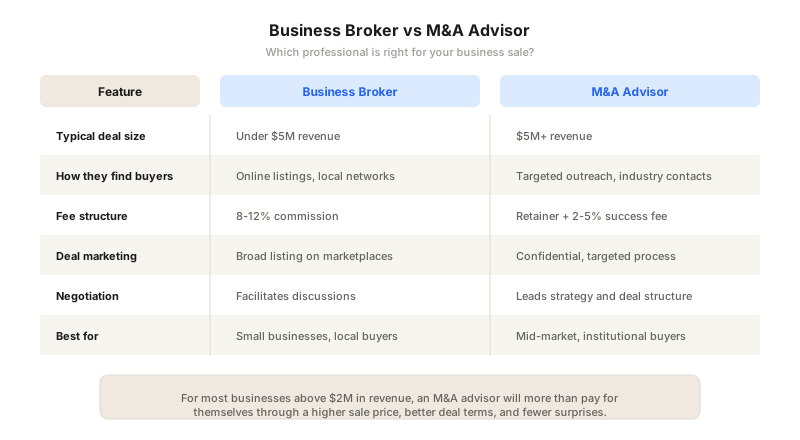
Business brokers are best suited for smaller businesses — typically under $5 million in revenue. They work a bit like real estate agents: they list your business on marketplaces, field enquiries, and help facilitate the sale. Fees are usually a straight commission, typically 8-12% of the sale price. For a small retail business or a solo-owner consultancy, a broker may be perfectly appropriate.
M&A advisors handle larger and more complex transactions. Rather than listing your business publicly, they run a confidential, targeted process — identifying the specific buyers most likely to value your business, reaching out directly, and creating competitive tension that drives up the price. They charge a retainer (a monthly fee during the process) plus a success fee (a percentage of the sale price), typically 2-5% depending on deal size.
The key difference is in how they find buyers and manage the process. A broker casts a wide net and waits for interest. An M&A advisor proactively builds a buyer list, approaches prospects confidentially under NDA, and manages a structured process designed to maximise your outcome.
For most businesses above $2 million in revenue, an M&A advisor will deliver a higher sale price that more than covers the difference in fees. Research from the Alliance of Merger & Acquisition Advisors consistently shows that advisor-represented sellers achieve 10-25% higher transaction values compared to unrepresented sellers.
Questions to Ask When Interviewing Advisors
Whether you go with a broker or an M&A advisor, ask these questions before you sign anything:
- How many businesses in my industry have you sold in the past two years?
- How do you find buyers — do you have an existing database, or do you start from scratch?
- What is your fee structure — retainer, success fee, or both?
- What is the typical timeline from engagement to closing for a business like mine?
- Can you share references from past clients in a similar situation?
- How do you handle confidentiality — will my employees, customers, or competitors know my business is for sale?
The right advisor will answer these questions confidently and specifically. Be wary of anyone who gives vague answers or makes promises about the sale price before seeing your financials.
What Happens After You Go to Market
Once you have done the preparation work and engaged an advisor, the formal sale process typically takes 6 to 12 months. Here is a simplified version of what to expect:
-
Preparation of marketing materials. Your advisor creates a confidential information memorandum — a document that presents your business to potential buyers. This is where all your preparation pays off.
-
Buyer outreach. Your advisor identifies and contacts qualified buyers — both strategic buyers (companies in your industry or adjacent sectors) and financial buyers (private equity firms or investment groups). Buyers sign an NDA before seeing any details.
-
Indications of interest. Interested buyers submit preliminary offers, usually expressed as a range. Your advisor helps you evaluate which buyers are serious, capable, and a good fit.
-
Due diligence. The buyer’s team examines your business in detail — financials, operations, legal, customers, employees. They use a data room (a secure online system) to access your documents. This is where messy financials or undisclosed problems kill deals.
-
Negotiation and closing. You negotiate the final terms — price, payment structure, transition period, any ongoing obligations — and sign the legal agreements.
Throughout this process, your job is to keep running the business as if you are not selling it. If performance dips during the sale, buyers will notice — and they will use it to negotiate a lower price.
A Final Thought: Selling From a Position of Strength
The best time to prepare is when you are not under pressure. The worst time to sell is when you need to — because buyers can sense desperation, and it always costs the seller.
If you are reading this and thinking about selling in the next few years, you are already ahead of most business owners. The preparation steps in this guide are not complicated, but they take time. Start now, work through them methodically, and you will be in the strongest possible position when the day comes.
And remember: you have spent decades building something valuable. The sale is the last chapter — make sure it reflects the quality of everything that came before.
Thinking about selling your business in the next few years? Start with a clear picture of where you stand. Book a confidential valuation meeting with Amafi to understand your business’s market value, or take the Exit Readiness Assessment to identify the preparation steps that will have the biggest impact on your sale price. If you prefer to explore on your own first, our guide to selling a business covers the full process from start to finish.

About the Author
Daniel Bae
Co-founder & CEO, Amafi
Daniel is an investment banker with 15+ years of experience in M&A, having advised on deals worth over US$30 billion. His career spans Citi, Moelis, Nomura, and ANZ across London, Hong Kong, and Sydney. He holds a combined Commerce/Law degree from the University of New South Wales. Daniel founded Amafi to solve the pain points in M&A, enabling bankers to focus on what matters most — delivering trusted advice to clients.
About Amafi
Amafi is an M&A advisory firm built for Asia Pacific. We help business owners sell their companies and corporate teams make strategic acquisitions — with bulge bracket execution quality at lower fees, powered by AI and a network of senior dealmakers.
Learn about selling your businessGet M&A insights delivered
AI-powered deal sourcing strategies, market analysis, and Asia Pacific insights — straight to your inbox.