Why Australian SME Owners Are Selling Now
Australia’s mid-market is experiencing a generational shift. Thousands of business owners who built companies during the 1990s and 2000s are reaching retirement age, and many have no clear successor within the family. At the same time, buyer demand has never been stronger — private equity buyout value in Australia rose 32% to US$30.5 billion in 2025, and mid-market transaction activity was up approximately 40% year-on-year (PwC Australia M&A Outlook 2026).
If you own a profitable SME in Australia and have been thinking about selling, the market conditions in 2026 are favourable. But favourable conditions do not guarantee a good outcome. The difference between an owner who captures full value and one who leaves money on the table almost always comes down to preparation.
This guide walks through what Australian SME owners need to know — from understanding your valuation to structuring the deal to minimise tax — so you can make informed decisions about the most significant financial transaction of your career.
Understanding Your Business Valuation
The first question every owner asks is: “What is my business worth?” The honest answer is that it depends on what a buyer is willing to pay — but there are frameworks that narrow the range.
How Buyers Value SMEs
Most mid-market acquirers in Australia value businesses as a multiple of EBITDA — earnings before interest, tax, depreciation, and amortisation. The multiple reflects the buyer’s assessment of risk, growth potential, and strategic fit.
| Sector | Typical EBITDA Multiple | Key Value Drivers |
|---|---|---|
| Healthcare services | 6–8x | Recurring revenue, regulated barriers |
| Technology / SaaS | 6–10x | Recurring revenue, scalability |
| Business services | 5–7x | Client retention, contract visibility |
| Manufacturing | 4–6x | Equipment, IP, export relationships |
| Construction / trades | 3–5x | Backlog, key relationships |
| Retail / hospitality | 3–5x | Location, brand, lease terms |
Sources: Australian mid-market transaction data from IBISWorld and Pitcher Partners.
These are indicative ranges. A well-run healthcare services business with sticky revenue and a strong management team might command 8x EBITDA. The same sector with heavy owner-dependence and a single major contract might be worth 4–5x.
What Drives Your Multiple Up — or Down
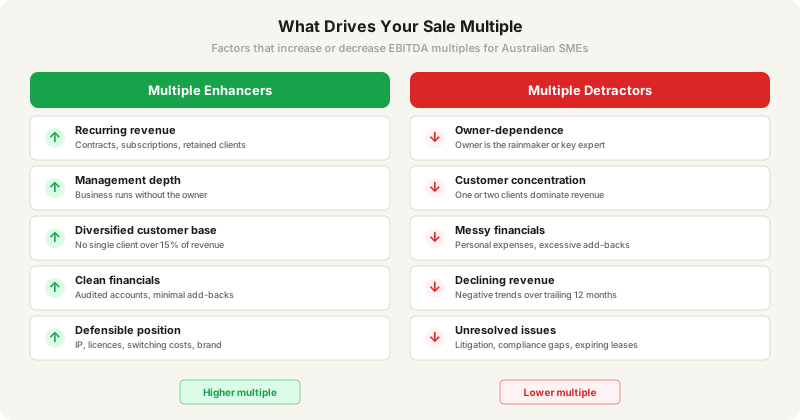
The factors that push your multiple higher are the same factors that make your business attractive to a buyer:
Multiple enhancers:
- Recurring or contracted revenue (reduces buyer risk)
- Management team that operates without the owner
- Diversified customer base (no single client >15% of revenue)
- Clean financial records with audited or reviewed statements
- Defensible competitive position (IP, licences, switching costs)
- Growth trajectory with identifiable expansion paths
Multiple detractors:
- Heavy owner-dependence (you are the rainmaker, the key relationship holder, or the technical expert)
- Customer concentration (one or two clients dominate revenue)
- Messy financials with excessive add-backs and personal expenses run through the business
- Declining revenue trends, even if the current year looks strong
- Pending litigation, regulatory issues, or unresolved compliance gaps
“The single biggest value destroyer we see in Australian mid-market deals is owner-dependence. If the business can’t function without you for three months, a buyer is going to discount that risk — and they should.”
— Daniel Bae, founder of Amafi, former M&A advisor with over US$30 billion in transaction experience
Preparing Your Business for Sale
The best exits are planned 12–24 months in advance. Owners who treat the sale as a process — not an event — consistently achieve better outcomes.
12–24 Months Before: Foundation Work
Build management depth. If you are the sole decision-maker, start delegating. Promote or hire a general manager or operations lead who can run the business day-to-day. Buyers want to see that the business functions without you — and a management team that can demonstrate this during due diligence is worth real money.
Clean up your financials. Engage an accountant to prepare normalised, EBITDA-adjusted financials for the trailing three years. Remove personal expenses, one-off items, and discretionary costs. The cleaner your numbers, the smoother the diligence process and the fewer reasons a buyer has to re-trade on price.
Address customer concentration. If one customer represents more than 20% of revenue, actively work to diversify. New client acquisition now pays dividends at sale.
Resolve outstanding issues. Settle any pending legal matters, renew expiring contracts and leases, and update employee agreements. A vendor due diligence report — where you commission your own diligence before going to market — is increasingly common in Australian mid-market sales. It costs AUD 50,000–150,000 but can accelerate the process and remove surprises that cause deals to collapse.
6–12 Months Before: Go-to-Market Preparation
Appoint an advisor. For businesses with enterprise value above AUD 5 million, engaging an M&A advisor or investment banker is standard practice. Good advisors run a competitive process that creates buyer tension and maximises value. For a detailed breakdown, see our guide to choosing an M&A advisor.
Prepare the information pack. Your advisor will prepare a teaser (anonymous summary), a CIM (detailed business profile), and a financial model. These documents are what buyers use to decide whether to pursue your business — quality here matters enormously.
Identify the right buyer universe. Australian SMEs attract several buyer types, and understanding who they are helps you position the business effectively:
- Strategic buyers — Competitors or adjacent businesses seeking capabilities, market share, or geographic expansion. They often pay premiums for synergy.
- Private equity firms — Financial buyers looking for platform acquisitions or bolt-on acquisitions for existing portfolio companies. PE is very active in Australian mid-market services, healthcare, and technology.
- International buyers — US, Japanese, and other APAC acquirers increasingly target Australian SMEs. Inbound deals represented 45% of total Australian deal value in 2025.
- Management buyouts — Your existing management team, often backed by PE or debt, buys the business. Common where the team is strong and the owner wants a clean exit.
The Sale Process: What to Expect
A typical mid-market SME sale in Australia follows a structured process that takes 6–12 months from preparation to closing.
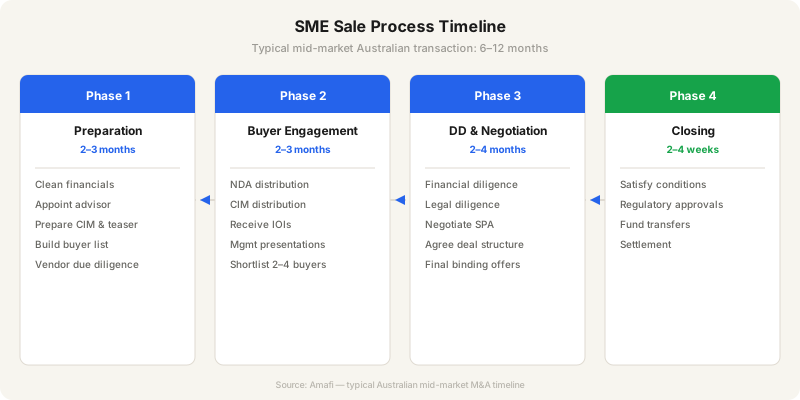
Phase 1: Preparation and Marketing (2–3 months)
Your advisor prepares marketing materials, builds a buyer list, and begins outreach. Potential buyers sign NDAs before receiving detailed information. In a well-run process, 30–60 parties are contacted, 15–25 sign NDAs, and 5–10 submit initial indications of interest.
Phase 2: Buyer Engagement (2–3 months)
Interested buyers receive the CIM and submit indications of interest (non-binding offers). The best candidates are invited to management presentations and site visits. At this stage, you shortlist 2–4 buyers to proceed to due diligence.
Running a competitive process is critical. When multiple credible buyers are at the table, each one knows the others exist — and this creates the pricing tension that drives your outcome higher. A single-buyer negotiation almost always favours the buyer.
Phase 3: Due Diligence and Negotiation (2–4 months)
Selected buyers conduct detailed due diligence — financial, legal, tax, commercial, and sometimes operational or IT diligence. Simultaneously, lawyers negotiate the purchase agreement (usually a share purchase agreement or asset purchase agreement).
Common deal structures in the Australian mid-market include:
- Cash at closing — The simplest structure. Buyer pays the full purchase price at completion.
- Earnout — A portion of the price is contingent on the business hitting agreed performance targets post-completion. Common where the buyer and seller disagree on future earnings potential.
- Seller financing — You provide a loan to the buyer for part of the price, typically 10–20%. More common in lower mid-market transactions below AUD 10 million.
- Rollover equity — You retain a minority stake in the business post-sale. Common in PE transactions where the buyer wants the owner to have “skin in the game” during the transition period.
Phase 4: Closing (2–4 weeks)
Once the purchase agreement is signed, the deal moves to closing — satisfying any remaining closing conditions, regulatory approvals, and fund transfers. In most mid-market Australian transactions, signing and closing happen simultaneously or within a few weeks.
Tax Considerations: CGT Small Business Concessions
For many Australian SME owners, the tax treatment of the sale proceeds is just as important as the headline price. The Australian Taxation Office provides four CGT small business concessions that can dramatically reduce — or eliminate — the capital gains tax on the sale of an active business.
To qualify, your business must meet the basic eligibility conditions: either an aggregated turnover of less than AUD 2 million or net assets (you plus connected entities) of less than AUD 6 million. The asset being sold must also be an active asset.
The Four Concessions
1. 15-Year Exemption. If you have owned the business for 15 continuous years and are over 55 or permanently incapacitated, the entire capital gain is exempt from CGT. This is the most powerful concession — a complete tax-free exit.
2. 50% Active Asset Reduction. Reduces the capital gain by 50% after applying the general 50% CGT discount (for assets held over 12 months). Combined, this can reduce the taxable gain to 25% of the original figure.
3. Retirement Exemption. Exempts up to AUD 500,000 of the capital gain per individual. If you are under 55, the exempted amount must be contributed to a superannuation fund. Married couples who are both shareholders can each access the full $500,000 exemption.
4. Small Business Rollover. Allows you to defer the capital gain for two years if you acquire a replacement active asset or improve an existing one. Useful if you plan to reinvest in another business.
These concessions can be combined and, when structured correctly, can result in zero or near-zero tax on the sale proceeds. Work with a specialist tax advisor early — ideally 12+ months before the sale — to ensure your ownership structure qualifies.
According to the Australian Taxation Office, these concessions are among the most valuable tax provisions available to Australian small business owners, but eligibility depends on careful structuring.
Who Is Buying Australian SMEs in 2026
Understanding the buyer landscape helps you position your business and set realistic expectations.
Private equity is the dominant force. PE firms deployed US$30.5 billion in Australian buyouts in 2025 — a 32% increase year-on-year. Firms like BGH Capital, Pacific Equity Partners, Quadrant, and Adamantem are actively pursuing mid-market platform acquisitions in healthcare, business services, technology, and education. PE buyers typically offer clean deal structures, efficient diligence, and certainty of close — but may request rollover equity or earnout components.
International strategic buyers are increasingly active. Inbound M&A represented 45% of Australian deal value in 2025. US corporates value Australia’s transparent legal system and quality assets. Japanese buyers are accelerating their Australian investment, with PwC reporting that 9% of Japanese CEOs plan to invest in Australia in the next 12 months. For SME owners in sectors like healthcare, infrastructure services, or food production, international buyers can offer premium valuations driven by synergy and market access.
Domestic consolidators are active across fragmented sectors. Many Australian industries — dental practices, accounting firms, allied health, trades services — are being consolidated by PE-backed platform companies running roll-up strategies. If you operate in a fragmented sector, there may be a well-funded consolidator already looking for businesses like yours.
This is where Amafi can help. Our AI-powered matching connects SME owners with qualified buyers across Australia and the broader Asia Pacific region — including international acquirers that traditional brokers rarely reach. For owners of mid-market businesses, access to the right pool of buyers is often the difference between a competitive process and a single lowball offer.
Common Mistakes That Destroy Value
Having advised on transactions across the region, we consistently see the same mistakes that cost business owners money:
Waiting too long to plan. Selling a business is not a decision you should make on a Monday and execute by Friday. Owners who start planning 12–24 months before they want to exit consistently achieve better multiples.
Going to market with a single buyer. A competitive auction process creates pricing tension. When there is only one buyer, you have no leverage — and the buyer knows it.
Leaving personal expenses in the financials. Buyers base their offer on normalised EBITDA. Personal expenses that inflate costs and depress reported earnings confuse the picture and erode trust.
Neglecting the transition plan. Most buyers will want you to stay involved for 6–12 months post-sale. Negotiate the transition terms, scope, and compensation before signing — not after.
Ignoring tax structuring until the last minute. CGT concessions have specific eligibility requirements. Restructuring ownership or failing to meet the net asset test at settlement can cost you hundreds of thousands of dollars in tax.
Next Steps for Business Owners
If you are considering selling your business in the next 12–24 months, start with these three actions:
- Get a realistic valuation. Engage an advisor or accountant to prepare a preliminary valuation based on normalised EBITDA. This grounds your expectations in market reality.
- Review your CGT position. Speak to a specialist tax advisor about whether your ownership structure qualifies for the small business CGT concessions — and what changes might be needed.
- Build management depth. Begin transitioning key relationships and decision-making to your team. Every month of demonstrated independence adds value.
For broader context on the Australian M&A market, see our Australia M&A 2026 outlook and our guide to selling a business.
Thinking about selling your business? Amafi helps Australian business owners connect with qualified buyers — from domestic PE firms to international acquirers across Asia Pacific. Our AI-powered matching ensures your business reaches the right buyers, not just the obvious ones. Get in touch to discuss your options.

About the Author
Daniel Bae
Co-founder & CEO, Amafi
Daniel is an investment banker with 15+ years of experience in M&A, having advised on deals worth over US$30 billion. His career spans Citi, Moelis, Nomura, and ANZ across London, Hong Kong, and Sydney. He holds a combined Commerce/Law degree from the University of New South Wales. Daniel founded Amafi to solve the pain points in M&A, enabling bankers to focus on what matters most — delivering trusted advice to clients.
About Amafi
Amafi is an M&A advisory firm built for Asia Pacific. We help business owners sell their companies and corporate teams make strategic acquisitions — with bulge bracket execution quality at lower fees, powered by AI and a network of senior dealmakers.
Learn about selling your business