Why Indonesia Demands Dedicated M&A Coverage
Indonesia is the largest economy in Southeast Asia and the 16th largest in the world, with GDP exceeding US$1 trillion in 2024, according to Global Legal Insights. For deal professionals covering APAC, it is no longer sufficient to treat Indonesia as a secondary market behind Singapore — it is a primary destination with its own regulatory architecture, sector dynamics, and deal ecosystem that require dedicated attention.
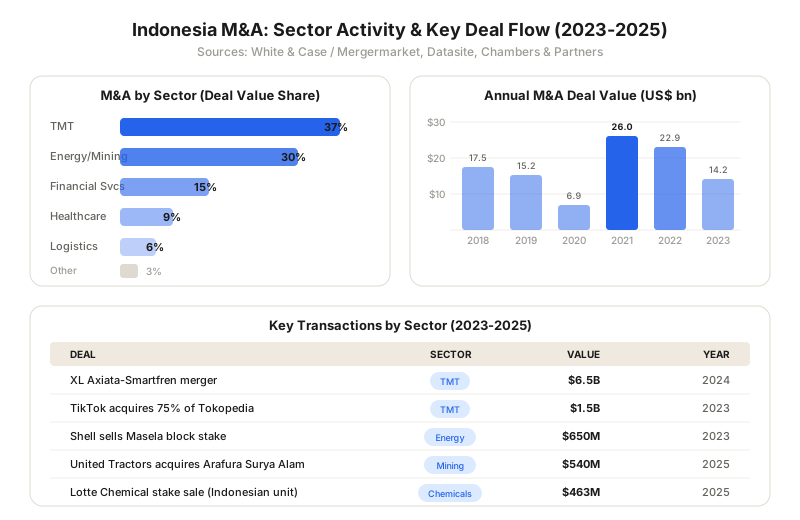
The M&A market reflects this economic weight. Indonesia recorded 150 deals valued at US$14.2 billion in 2023, according to White & Case and Mergermarket. While below the record US$26 billion posted in 2021, this represents activity that is comparable to or above pre-pandemic levels. The market is characterised by large-cap headline deals in telecoms and energy, a growing mid-market in technology and financial services, and a regulatory environment that has improved materially through the Omnibus Job Creation Law reforms.
For acquirers, Indonesia offers a combination that few ASEAN markets can match: a population of 280 million (median age 30), the region’s largest digital economy, the world’s largest nickel reserves, and valuations that remain significantly below comparable targets in Singapore or Australia. For sellers, deepening pools of both domestic conglomerate and foreign PE capital are creating exit strategy optionality that was unavailable five years ago.
This article covers what practitioners need to know to evaluate and execute M&A in Indonesia in 2026.
The Deal Landscape: Volume, Value, and Composition
Indonesia’s M&A market is structurally different from Singapore’s or Hong Kong’s. It is dominated by domestic conglomerates, state-owned enterprises, and a growing cohort of regional strategic buyers — with financial sponsors playing an increasingly important but still secondary role. Deal flow is concentrated in a handful of sectors, and the mid-market remains the most active segment for actionable transactions.
Deal Activity
According to White & Case and Mergermarket data, Indonesia’s M&A deal value trajectory over the past decade shows meaningful cyclicality:
| Year | Deal Value |
|---|---|
| 2018 | US$17.5 billion |
| 2019 | US$15.2 billion |
| 2020 | US$6.9 billion |
| 2021 | US$26.0 billion (record) |
| 2022 | US$22.9 billion |
| 2023 | US$14.2 billion |
The 2021-2022 surge was driven by mega-deals in telecoms (the US$6 billion Indosat Ooredoo Hutchison merger) and mining. The subsequent normalisation reflects softening commodity prices and global uncertainty rather than a structural decline. Year-to-date through Q3 2025, Datasite reported 62 deals totalling approximately US$3.2 billion, with activity concentrated in familiar investment themes.
Deal Composition
The market breaks down across several categories:
- Domestic conglomerate transactions: Indonesian conglomerates (Djarum Group, Lippo Group, Barito Group, Mayora) are active acquirers across consumer, healthcare, energy, and hospitality. The acquisition of Bakmi GM by Djarum Group and Sight Investment’s tender offer for Siloam Hospitals (Lippo Group) illustrate the breadth of conglomerate deal activity.
- Inbound cross-border M&A: Japan, South Korea, Singapore, and increasingly China are the most active foreign buyer origins. Japanese acquirers are particularly present in manufacturing and automotive, while Korean and Chinese companies lead in nickel and EV supply chain investments.
- State-owned enterprise (SOE) transactions: PT Mineral Industri Indonesia’s acquisition of a controlling stake in PT Vale Indonesia and PT Jasa Marga’s US$1 billion toll road equity financing demonstrate that SOE corporate actions remain a significant driver of headline deal activity.
Notable Recent Transactions
| Deal | Value | Sector | Year |
|---|---|---|---|
| XL Axiata–Smartfren merger | US$6.5 billion | Telecoms | 2024-2025 |
| TikTok acquires 75% of Tokopedia | US$1.5 billion | E-commerce | 2023 |
| Jasa Marga toll road equity financing | US$1.0 billion | Infrastructure | 2024 |
| Shell sells Masela block stake to Pertamina/Petronas | US$650 million | Energy | 2023 |
| United Tractors acquires Arafura Surya Alam | US$540 million | Mining | 2025 |
| Lotte Chemical stake sale in Indonesian subsidiary | US$463 million | Chemicals | 2025 |
| CATL acquires Antam mining subsidiaries | US$417 million | Mining/EV | 2023 |
| OCBC Indonesia acquires Bank Commonwealth Indonesia | IDR 2.2 trillion | Banking | 2024 |
| Astra International acquires Mega Manunggal Property | US$278 million | Logistics | 2025 |
Sources: Chambers and Partners, Global Legal Insights, Datasite.
Key Sectors for M&A
Indonesia’s sector mix for M&A reflects its position as a resource-rich, rapidly digitalising economy with 280 million consumers. Five sectors dominate current deal activity.
Technology, Media, and Telecommunications
TMT has been the single largest contributor to Indonesian M&A by both aggregate value and volume for four consecutive years, according to White & Case. The TikTok-Tokopedia deal (US$1.5 billion) and the XL Axiata-Smartfren merger (US$6.5 billion) are the headline transactions, but the sector’s depth extends well beyond telecoms consolidation.
Indonesia has an estimated 221.5 million internet users, and the average user spends four hours daily on mobile — twice the US average, according to McKinsey. The e-commerce market is the largest in Southeast Asia at US$62 billion, forecast to reach US$160 billion by 2030. Fintech revenue is predicted to reach US$8.6 billion by 2025, with P2P lending and e-payment platforms as dominant segments, according to Global Legal Insights.
For acquirers, the TMT opportunity is both scale (enormous addressable market) and defensibility (regulatory barriers to entry, local-language content advantages, and established payment rails). Due diligence in Indonesian tech requires attention to data protection compliance under the Personal Data Protection Law (enacted October 2024), licencing requirements from the Ministry of Communication and Digital Affairs, and the practical realities of navigating a fragmented, multi-island digital infrastructure.
Energy, Mining, and Utilities
This sector leads by deal count and is driven by two structural forces: Indonesia’s position as the world’s largest holder of nickel reserves and its role in the global EV battery supply chain.
Indonesia has set an ambitious target of producing 600,000 EVs by 2030. The downstream nickel processing industry — smelting, refining, and battery-grade material production — is attracting massive foreign investment from China (CATL, Tsingshan), South Korea (Ecopro, LG), and Japan. United Tractors’ US$540 million acquisition of Arafura Surya Alam and Ecopro’s US$142 million stake in Bahodopi Nickel Smelting illustrate the scale of capital flowing into this value chain.
Renewable energy is gaining momentum, with British Petroleum committing US$7 billion to a carbon capture and gas development project at the Tangguh facility. The government’s broader green energy initiatives — including collaboration with South Korea, China, and Japan on EV battery supply chain components — create long-term M&A tailwinds in solar, wind, and battery storage.
Financial Services
Banking M&A has accelerated as both domestic consolidation and foreign portfolio rationalisation drive transactions. OCBC Indonesia’s acquisition of Bank Commonwealth Indonesia (CBA’s Indonesian unit) for IDR 2.2 trillion reflects the ongoing trend of regional banks consolidating in-market. OJK’s new financial conglomerate regulation (OJK Regulation No. 30 of 2024) — requiring financial groups meeting certain asset thresholds to establish designated holding companies — is expected to trigger further restructuring and M&A activity in 2026.
The fintech ecosystem is separately active, with Indonesia home to several unicorns and a decacorn. The DigiAsia Bios merger with Stonebridge Acquisition Corp, valued at US$500 million and resulting in a Nasdaq listing, demonstrates the cross-border deal structures emerging from Indonesia’s fintech sector.
Healthcare and Pharmaceuticals
Healthcare M&A has grown in prominence as rising incomes, expanding insurance coverage, and demographic pressures increase demand for private healthcare services. Sight Investment Company’s acquisition of Siloam Hospitals (Lippo Group) through a voluntary tender offer was a landmark transaction. Pharmaceutical cross-border deals — including Diagnos Laboratorium’s acquisition of Singapore-based AI diagnostics company Asa Ren and Pyridam Farma’s acquisition of Australia’s Probiotec Limited — signal that Indonesian companies are also acquiring outbound.
Logistics and Industrial Infrastructure
Indonesia’s manufacturing expansion and e-commerce growth are creating demand for logistics, warehousing, and industrial real estate. Astra International’s US$278 million acquisition of Mega Manunggal Property (a warehousing platform) exemplifies how operators are building scaled logistics infrastructure through M&A. Supply chain diversification away from China continues to drive inbound acquisition of manufacturing capacity and industrial parks.
Regulatory Framework for M&A
Indonesia’s regulatory framework for M&A is more complex than Singapore’s but has improved materially through the Omnibus Job Creation Law reforms. There is no single M&A statute — the framework spans the Company Law, Investment Law, Capital Market Law, and Competition Law, with sector-specific overlays from OJK, BKPM, and the KPPU.
Core Legislation
Company Law (Law No. 40 of 2007, as amended by the Job Creation Law). Governs share acquisitions, mergers, consolidations, and spin-offs. Defines “acquisition” as any transfer resulting in a change of control. Requires specific procedures including creditor announcements and employee notifications for transactions constituting a change of control.
Investment Law (as enacted by the Job Creation Law). Regulates foreign investment through the “positive investment list” — a significant liberalisation from the previous “negative investment list.” Reduced restricted business lines from 300+ to 48. Foreign investment companies must have at least IDR 10 billion in issued and paid-up capital, with investment value (excluding land and buildings) exceeding IDR 10 billion.
Capital Market Law (Law No. 8 of 1995, as amended by the PPSK Law). Governs acquisitions of public companies through OJK Regulation No. 9/2018. A mandatory tender offer is triggered when an acquirer gains control (more than 50% of shares or the ability to determine management/policy). Must be conducted within 30 days of the announcement. Notably, Indonesian law does not provide a squeeze-out right — minority shareholders cannot be compelled to sell.
Competition Law (Law No. 5 of 1999, as amended). Enforced by the KPPU. Post-transaction antitrust review notification is mandatory within 30 business days for deals where combined assets exceed IDR 2.5 trillion or combined annual sales exceed IDR 5 trillion. The KPPU’s 2023 regulation (KPPU Regulation No. 3/2023) narrowed the scope for foreign-to-foreign transactions — notification is now required only when both parties have assets or generate sales in Indonesia.
Foreign Investment Restrictions
Indonesia’s positive investment list categories for foreign investment:
| Category | Description | Examples |
|---|---|---|
| Fully open | No foreign ownership cap | Manufacturing (most sub-sectors), insurance |
| Open with conditions | Foreign ownership caps or requirements apply | Banking, telecoms, media |
| MSME partnership required | Must partner with local MSMEs | Certain service sectors |
| Closed | No foreign investment permitted | Narcotics, gambling, chemical weapons, ozone-depleting substances |
Critical sector-specific caps include 49% for telecommunications and graduated limits in banking. Additional restrictions may apply under sector-specific regulators — OJK for financial services, the Ministry of Communication for telecoms. Foreign investors are limited to large-scale businesses with investment values exceeding IDR 10 billion (excluding land and buildings).
Regulatory Comparison
| Aspect | Indonesia | Singapore | Vietnam |
|---|---|---|---|
| Foreign ownership screening | Positive investment list + sector caps | No general screening | Sector-specific FOLs |
| Merger control | KPPU post-notification (mandatory) | CCCS (voluntary) | VCC review |
| Tender offer threshold | Control (>50% or ability to influence) | 30% of voting shares | 25% of voting shares |
| Squeeze-out right | Not available | Available (90%) | Available (90%) |
| Minimum foreign investment capital | IDR 10 billion | None | None |
| Typical regulatory timeline | 8-20 weeks | 4-8 weeks | 8-16 weeks |
Personal Data Protection
The Personal Data Protection Law (PDP Law, enacted October 2024) introduces a new compliance dimension for M&A transactions. Under Article 48, any merger, acquisition, consolidation, or dissolution involving the transfer of personal data requires notification to data subjects both before and after closing. This is a material change — due diligence must now include a thorough review of the target’s data processing practices and compliance posture.
Investment Climate and FDI Trends
Indonesia’s investment realisation reached IDR 1,714 trillion in 2024, growing 20.8% year-on-year, according to BKPM. The momentum continued into 2025, with Q1 2025 realisation reaching IDR 465.2 trillion — a 15.9% increase year-on-year, according to Global Legal Insights.
Foreign direct investment in the manufacturing sector alone reached IDR 403.3 trillion (US$24.6 billion) through Q3 2024, constituting 56.3% of total FDI. The basic metals industry was the largest contributor at IDR 167 trillion (US$10.2 billion), driven by nickel processing and downstream mineral investments.
Singapore remains the largest source of FDI into Indonesia, followed by China, Japan, Hong Kong, and South Korea. The geographic composition reflects both proximity-driven investment (Singapore as a holding jurisdiction, Japan and Korea as strategic acquirers) and resource-driven capital flows (China for nickel and EV battery supply chain).
“Indonesia’s demographic dividend, characterised by a large and youthful population, provides a robust consumer base and a dynamic workforce,” notes the Global Legal Insights 2025 analysis. “The government’s commitment to improving the business climate through regulatory reforms and investment incentives further enhances its attractiveness.”
Deal Structures Common in Indonesia
Indonesia M&A uses structures broadly consistent with international practice, with important local variations that affect deal planning and execution.
Share Acquisitions
The most common structure. Under the Company Law, share acquisitions can be either direct (purchasing from existing shareholders via a sale and purchase agreement) or indirect (subscribing to newly issued shares). For direct acquisitions that constitute a change of control, specific procedures apply — including creditor announcements, employee notifications, and notarisation requirements.
Representations and warranties insurance is used in some Indonesian transactions, typically when a US-based acquirer or seller is involved, but it remains less common than in Singapore or Australia.
Business Transfers (Asset Deals)
Used when the acquirer wants specific assets without assuming target liabilities. This structure is often tax-driven and avoids legacy issues in the target company. However, licences and permits generally cannot be transferred to a new entity — the acquirer must reapply. Asset transfers may also trigger VAT and require individual contract assignments, adding complexity. If assets transferred exceed 50% of the target’s net assets, a special shareholder resolution is required.
SOE Divestments
The Indonesian government maintains a pipeline of planned divestiture transactions from state-owned enterprises. These follow specific procedures mandated by the relevant ministries and typically involve auction process mechanisms. The pace has historically lagged announcements, but fiscal incentives to monetise state assets are growing, particularly in banking, telecoms, and industrial sectors.
Mandatory Tender Offers
For public company acquisitions resulting in a change of control, OJK Regulation 9/2018 requires a mandatory tender offer within 30 days. The absence of a squeeze-out right means that acquirers of public companies cannot compulsorily acquire remaining minority shares — making it difficult to take a listed company fully private. This is a structural difference from Singapore, Australia, or Vietnam and materially affects deal planning for public targets.
Tax Considerations
Indonesia’s tax regime is competitive in headline rates but more complex in execution than Singapore’s. Deal structuring must account for capital gains treatment, withholding taxes, and transfer pricing scrutiny.
| Tax Feature | Indonesia Treatment | Practical Impact |
|---|---|---|
| Corporate income tax | 22% standard rate | Reduced rates available for listed companies (19%) and SMEs |
| Capital gains tax | 22% on corporate gains | 0.1% final tax on listed share sales via IDX |
| Withholding tax on dividends | 0% (domestic to corporate) / 20% (foreign) | Treaty rates may reduce to 10-15% |
| Withholding tax on interest | 15% (domestic) / 20% (foreign) | Treaty rates may apply |
| VAT on asset transfers | 11% (standard) | Exempt for share transfers |
| Transfer pricing | OECD-aligned | Active enforcement; documentation required |
Double Tax Agreement Network
Indonesia has signed over 70 DTAs. Key treaty partners for M&A structuring:
- Singapore-Indonesia: The most commonly used intermediate holding structure. Singapore’s absence of capital gains tax combined with treaty benefits on dividends makes it the preferred jurisdiction for inbound investment.
- Japan-Indonesia: Reduced withholding rates, reflecting the deep bilateral investment relationship.
- Netherlands-Indonesia: Historically popular for holding structures, though treaty renegotiations have reduced some benefits.
Practical Considerations for Dealmakers
Timeline Expectations
Indonesia M&A transactions take longer to execute than in Singapore or Hong Kong. Expect the following:
- Private company acquisition (non-regulated sector): 12-20 weeks from signed term sheet to completion
- Private company acquisition (regulated sector): 16-30 weeks, depending on sector-specific approvals
- Public company mandatory tender offer: 3-6 months
- SOE divestment: 6-12 months (often longer)
Due Diligence Considerations
Due diligence standards in Indonesia are improving but require particular attention in several areas:
- Land-use rights: All land in Indonesia is owned by the state. Companies hold land-use rights with fixed terms and varying transferability. Verifying status, remaining term, and transfer restrictions is critical for any asset-heavy acquisition.
- Labour compliance: Indonesian labour law is protective. Due diligence should cover employment contracts, social insurance compliance, and mandatory severance obligations triggered by change of control. Employees who choose not to continue employment following an acquisition are entitled to severance pay, tenure awards, and compensation of rights.
- Beneficial ownership and related-party transactions: Indonesian companies — particularly family-controlled conglomerates — frequently engage in related-party transactions that may not be documented or conducted on arm’s-length terms. Identifying the true beneficial ownership structure is essential.
- Personal data compliance: The PDP Law (fully enforced October 2024) requires M&A-specific data transfer notifications. Non-compliance creates liability for the acquirer.
- Financial reporting: Indonesian companies report under Indonesian Financial Accounting Standards (SAK), which differ from IFRS in several respects. Quality of earnings analysis should account for these differences.
The Advisory Landscape
Global investment banks cover Indonesia from Singapore or Hong Kong offices for large-cap transactions. Mid-market coverage is thinner, relying on local securities firms (Mandiri Sekuritas, BCA Sekuritas, CIMB Niaga) and regional boutiques.
International law firms with strong Indonesia M&A practices include Allen & Overy (through partnership with Indonesian firms), Baker McKenzie, and Freshfields. Local firms such as TnP Law Firm, Hadiputranto Hadinoto & Partners, and ABNR (Ali Budiardjo Nugroho Reksodiputro) handle the bulk of mid-market and domestic transactions.
The gap between large-cap coverage (well-served by global banks from Singapore) and mid-market cross-border transactions (underserved) creates opportunity for platforms that can bridge information asymmetry. This is where Amafi operates — our AI-powered advisory capabilities automate deal sourcing, buyer-seller matching, and deal marketing across Indonesia and ASEAN’s fragmented mid-market, extending the reach of advisory teams covering the region from Singapore, Jakarta, or Hong Kong.
What’s Next for Indonesia M&A
Several forces are shaping the Indonesia M&A market heading into the second half of 2026:
Telecoms consolidation continues. The XL Axiata-Smartfren merger (now operating as XLSmart Telecom Sejahtera) is the most significant consolidation event, creating Indonesia’s second-largest mobile operator with over 94.3 million subscribers. Further consolidation in the broader TMT space is likely as digital infrastructure investment requirements escalate.
Nickel and EV supply chain deepening. Indonesia’s position as the world’s largest nickel producer ensures continued M&A activity in downstream processing. The commissioning of PT Freeport Indonesia’s new copper smelter in Gresik, East Java, will increase Indonesia’s refined mineral export capacity and attract further supply-chain-adjacent transactions.
Financial conglomerate restructuring. OJK Regulation No. 30 of 2024 requires financial groups meeting certain asset thresholds to restructure under designated holding companies within defined timelines. This regulatory mandate will trigger M&A activity as groups restructure, divest non-core financial services units, and consolidate operations.
Digital economy exits. Indonesia’s fintech and e-commerce ecosystem has matured to the point where VC-backed companies are reaching trade-sale or IPO-exit scale. The Nasdaq listing of DigiAsia Bios and the TikTok-Tokopedia transaction signal that liquidity events for Indonesia’s digital companies are becoming more frequent and larger.
SOE privatisation pipeline. The government has signalled continued commitment to divesting from SOEs, though execution has historically lagged announcements. Banking, telecoms, and industrial assets remain in the pipeline.
Supply-chain diversification inflows. Indonesia, alongside Vietnam, is a primary beneficiary of manufacturing diversification away from China. Japanese, Korean, and Singaporean companies are the most active acquirers of manufacturing and logistics capacity.
Exploring M&A opportunities in Indonesia? Amafi provides deal teams with AI-powered tools for sourcing targets, matching buyers, and marketing mandates across Indonesia and ASEAN — purpose-built for the complexity of cross-border dealmaking in Asia Pacific. Get in touch.

About the Author
Daniel Bae
Co-founder & CEO, Amafi
Daniel is an investment banker with 15+ years of experience in M&A, having advised on deals worth over US$30 billion. His career spans Citi, Moelis, Nomura, and ANZ across London, Hong Kong, and Sydney. He holds a combined Commerce/Law degree from the University of New South Wales. Daniel founded Amafi to solve the pain points in M&A, enabling bankers to focus on what matters most — delivering trusted advice to clients.
About Amafi
Amafi is an M&A advisory firm built for Asia Pacific. We help business owners sell their companies and corporate teams make strategic acquisitions — with bulge bracket execution quality at lower fees, powered by AI and a network of senior dealmakers.
Book a valuation meeting