The Screening Gap in M&A
The M&A industry has invested heavily in improving due diligence — faster document review, better data rooms, more structured checklists. But the highest-ROI decision in any deal process happens before diligence begins: choosing which targets to diligence in the first place.
Most deal teams screen poorly. A typical PE firm evaluates 80 to 100 opportunities for every deal it closes, according to Bain & Company’s Global Private Equity Report 2025. Corporate development teams at large acquirers often review more than 200. The vast majority of that evaluation time is wasted on targets that will never close — companies that fail basic financial thresholds, operate in untenable regulatory environments, or have structural issues that only surface after weeks of analysis.
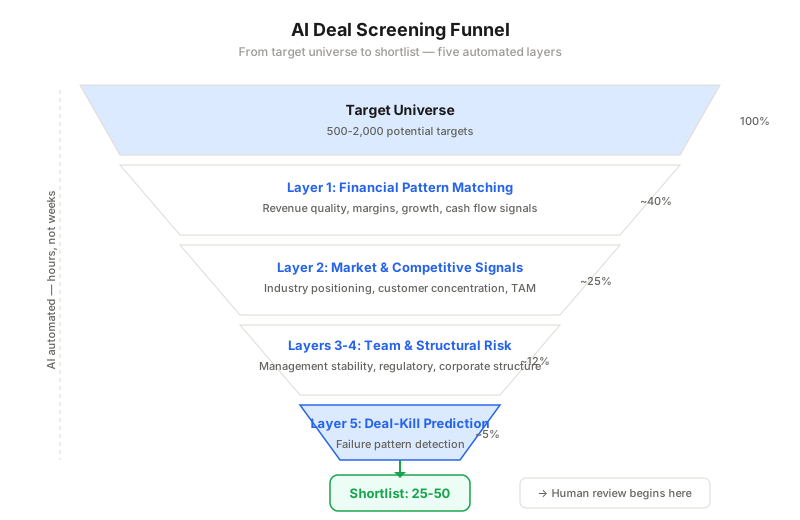
AI deal screening addresses this gap directly. Rather than applying human analyst hours to targets that should have been filtered out on day one, AI systems evaluate hundreds or thousands of targets against multi-dimensional criteria, score them on strategic fit and risk, and surface a ranked shortlist for human review. The deal team’s time is then concentrated where it matters — on the targets most likely to close and create value.
Why Traditional Screening Fails
Traditional deal screening relies on a combination of criteria-matching and analyst judgment. A PE firm defines its investment criteria — sector, geography, EBITDA range, growth profile — and analysts manually evaluate targets against those criteria using databases, broker materials, and proprietary research.
This approach has three structural problems.
Inconsistent Application
Criteria are applied inconsistently across analysts and across time. An analyst screening 40 targets in a week applies different levels of rigour to target number 3 versus target number 37. Fatigue, recency bias, and subjective interpretation mean that identical targets evaluated by different team members get different outcomes.
Network Bias
Deal teams disproportionately evaluate targets that come through existing relationships — broker introductions, conference connections, portfolio company referrals. These sourcing channels produce familiar targets, not necessarily the best targets. According to McKinsey’s 2024 M&A report, firms that cast a wider net at the screening stage and evaluate more targets per closed deal consistently achieve better post-acquisition returns.
Bandwidth Constraints
A four-person deal team can realistically screen 10 to 15 targets per week with meaningful depth. When the addressable universe contains 500 or 2,000 companies, the team either screens superficially (missing good targets) or screens a small fraction (missing the rest entirely). In cross-border M&A, where target universes span multiple countries with varying data availability, this bandwidth problem compounds.
How AI Deal Screening Works
AI deal screening operates on five layers, each progressively narrowing the target universe. The key difference from manual screening: all five layers run in parallel across the entire universe, not sequentially on one target at a time.
Layer 1: Financial Pattern Matching
The first screening layer evaluates publicly available and database-sourced financial data. AI assesses revenue trajectories, margin profiles, growth rates, working capital patterns, and free cash flow generation against the buyer’s investment criteria.
More importantly, AI identifies patterns that criteria-based screening misses. A company with flat topline growth but improving margins and declining capex may score low on a revenue-growth filter but high on an AI model trained to recognise cash-flow inflection points that precede valuation re-ratings.
Financial pattern matching also flags negative signals early: declining revenue quality, margin compression trends, working capital deterioration, and debt structures that suggest financial stress.
Layer 2: Market and Competitive Signal Analysis
AI evaluates each target’s competitive positioning by synthesising industry data, market share indicators, customer concentration signals, and sector-specific dynamics. This layer answers the question: is this company well-positioned in an attractive market, or is it riding a trend that’s already peaking?
For APAC targets, this layer is particularly valuable. English-language coverage of Southeast Asian and Northeast Asian mid-market companies is limited. AI systems processing local-language news, regulatory filings, and industry reports surface competitive intelligence that an English-only analyst would miss entirely.
Layer 3: Management and Team Assessment
AI evaluates public signals about management stability and team composition: leadership tenure, hiring patterns, organisational changes, and professional network indicators. A company that’s lost three C-suite executives in twelve months presents a different risk profile than one with a stable leadership team — and AI detects these patterns across hundreds of targets simultaneously.
This layer also identifies key-person risk, a critical screening dimension for mid-market acquisitions where one or two individuals often drive the majority of customer relationships and institutional knowledge.
Layer 4: Structural Risk Detection
Before committing to diligence, deal teams need to understand whether a target’s corporate structure, regulatory environment, and legal landscape create deal risk. AI screening maps:
- Corporate structures — SPVs, holding companies, minority stakes, joint ventures — that complicate deal execution
- Regulatory requirements by jurisdiction — particularly relevant for APAC targets operating across multiple countries with different foreign investment rules
- Litigation signals, regulatory enforcement actions, and compliance flags
- Related-party transaction indicators common in family-controlled businesses across Asia
Layer 5: Deal-Kill Prediction
The most valuable screening output is negative: identifying targets that will fail in diligence or never close, before the deal team invests time.
AI models trained on historical deal data identify patterns that correlate with deal failure. Revenue concentrated in a single customer beyond a certain threshold. Earnout structures required to bridge valuation gaps beyond a certain magnitude. Integration complexity scores that exceed the acquirer’s demonstrated capability. Regulatory approval timelines that exceed the buyer’s hold period requirements.
This predictive layer is where AI screening creates the most value — not by finding good deals (humans are reasonably good at that), but by killing bad deals before they consume resources.
AI Screening in Practice
The mathematics of AI screening are compelling. If a deal team screens 100 targets manually and selects 10 for deeper evaluation, and 2 of those ultimately close, the team spent roughly 80% of its screening time on targets that went nowhere. If AI screening can filter the initial 100 down to 25 high-probability targets with 90% accuracy, the team’s time is reallocated toward targets that are four times more likely to advance.
“The deal teams we’ve seen get this right aren’t using AI to find more deals,” says Daniel Bae, founder of Amafi and former M&A advisor with over US$30 billion in transaction experience. “They’re using it to say no faster. The faster you reject a bad target, the sooner you can focus on the right one.”
The time dimension matters too. Manual screening of 500 targets at 2 hours per target requires 1,000 analyst hours — roughly 6 months of a single analyst’s time. AI screening evaluates the same universe in hours, with human review concentrated on the 30 to 50 targets that survive the filter.
This is how we work at Amafi — our AI screens and scores potential buyers before we ever approach them, so when we contact a buyer on behalf of a client, we already know they’re likely to be interested. It means fewer wasted conversations and more serious offers.
APAC-Specific Screening Challenges
Asia Pacific presents screening challenges that amplify the value of AI-assisted filtering.
Data Availability Asymmetry
An Australian ASX-listed target offers audited IFRS financials, continuous disclosure filings, and English-language coverage. A privately-held Vietnamese manufacturer offers none of these. AI screening must adapt to radically different data environments within a single regional strategy.
Effective APAC screening systems weight financial metrics more heavily when audited data is available and shift toward alternative signals — hiring data, web traffic, import/export records, supplier relationships — when traditional financial data is sparse.
Language and Documentation Barriers
A PE firm screening targets across Japan, Korea, and Southeast Asia confronts financial documents in Japanese, Korean, Thai, Bahasa Indonesia, and Vietnamese — often without English translations. AI-powered screening that processes local-language financial filings and corporate registries dramatically expands the screenable universe.
Family Business Structures
An estimated 60% of listed companies and a far higher percentage of private companies across Asia are family-controlled, according to the Asian Development Bank. Family businesses present specific screening challenges: intermingled personal and corporate expenses, related-party transactions, informal governance structures, and succession planning risks that don’t appear in standard financial metrics.
AI screening models trained on APAC deal data learn to identify family-business risk patterns — unusual expense ratios, frequent related-party disclosures, high management tenure combined with absence of second-generation involvement — that predict integration and governance issues post-acquisition.
Multi-Jurisdictional Regulatory Complexity
A target operating across ASEAN may require regulatory clearance in five or more countries. AI screening maps regulatory requirements by jurisdiction and flags transactions that trigger antitrust review, foreign investment restrictions, or sector-specific approvals — enabling deal teams to assess regulatory execution risk before committing to a target.
Building an AI Screening Workflow
Implementing AI screening requires more than buying software. It requires rethinking how targets enter and move through your deal pipeline.
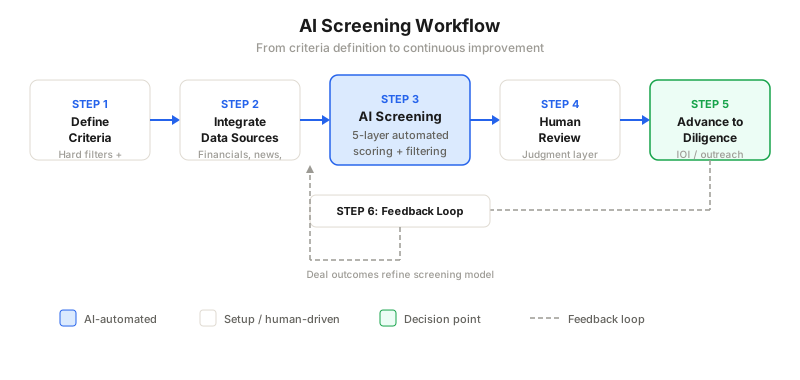
Step 1: Define Hard Filters and Soft Scores
Separate your screening criteria into two categories. Hard filters eliminate targets that fail mandatory requirements: wrong geography, wrong sector, below minimum enterprise value, regulatory exclusion. Soft scores rank surviving targets on desirable attributes: margin profile, growth trajectory, market position, cultural fit indicators.
Hard filters are binary. Soft scores are weighted. The weights should reflect your investment thesis: a platform acquisition strategy weights market position and scalability highly; a bolt-on strategy weights integration ease and geographic adjacency.
Step 2: Integrate Data Sources
AI screening is only as good as its input data. At minimum, connect financial databases (Capital IQ, PitchBook, local equivalents), corporate registries, news and media feeds, and your own proprietary deal flow data. For APAC, add local-language news sources, government filing databases, and regional industry associations.
Step 3: Configure and Calibrate
Run the AI screening model against your historical deal data — both successful acquisitions and deals that failed in diligence or post-close. Calibrate scoring weights until the model’s top-ranked historical targets align with your actual best outcomes. This calibration phase typically takes two to four weeks.
Step 4: Run Continuous Screening
Unlike manual screening (periodic, event-driven), AI screening runs continuously. New targets are scored as they enter the data set. Existing target scores update as new data arrives. This means your deal pipeline reflects current conditions, not a snapshot from the last time an analyst reviewed the universe.
Step 5: Human Review on the Shortlist
AI surfaces a ranked shortlist. Human deal professionals evaluate the top targets — assessing management quality through personal interactions, validating strategic fit against the investment thesis, and applying contextual judgment that AI cannot replicate.
The critical discipline: trust the filter. If AI screening has eliminated a target, don’t manually re-add it without understanding why. The screening model has reasons; override them only when you have information the model doesn’t.
Step 6: Feedback Loop
Every deal outcome — closed, failed in diligence, failed post-close, rejected by investment committee — feeds back into the screening model. Over successive deal cycles, the model’s accuracy improves. Firms that have run AI screening for 12 or more months report significantly tighter shortlists with higher conversion rates.
What AI Cannot Screen For
AI screening has boundaries that deal teams should understand and respect.
Willingness to transact. AI can identify attractive targets but cannot determine whether the owner is willing to sell, at what price, or on what timeline. This remains a relationship-driven discovery process.
Management chemistry. Whether the target’s leadership team will work effectively with the acquirer’s organisation is fundamentally a human-judgment question.
True competitive moats. AI can identify market share, pricing power, and customer retention signals, but the depth and durability of a competitive advantage often requires industry-specific expertise and direct customer diligence.
Strategic vision alignment. Whether an acquisition fits the acquirer’s five-year strategy in ways that create compounding value is a judgment call that requires understanding both businesses at a level AI screening data does not capture.
The right mental model: AI screening is a filter that removes 70-80% of your universe with high confidence, concentrating human attention on the 20-30% most likely to produce good outcomes. It is not a decision-maker.
This is the technology behind Amafi’s advisory practice. We screen and score potential buyers with AI before approaching them — meaning our clients’ deals reach the right buyers faster. Whether you’re selling or acquiring, AI-native advisory delivers better-qualified counterparties. Book a valuation meeting or get in touch.

About the Author
Daniel Bae
Co-founder & CEO, Amafi
Daniel is an investment banker with 15+ years of experience in M&A, having advised on deals worth over US$30 billion. His career spans Citi, Moelis, Nomura, and ANZ across London, Hong Kong, and Sydney. He holds a combined Commerce/Law degree from the University of New South Wales. Daniel founded Amafi to solve the pain points in M&A, enabling bankers to focus on what matters most — delivering trusted advice to clients.
About Amafi
Amafi is an M&A advisory firm built for Asia Pacific. We help business owners sell their companies and corporate teams make strategic acquisitions — with bulge bracket execution quality at lower fees, powered by AI and a network of senior dealmakers.
Book a valuation meetingGet M&A insights delivered
AI-powered deal sourcing strategies, market analysis, and Asia Pacific insights — straight to your inbox.