The US PE Push into Asia Pacific
American private equity firms have committed more capital to Asia Pacific over the past five years than in any comparable period. According to Bain & Company’s Asia-Pacific Private Equity Report 2025, APAC PE deal value rose 11% to US$176 billion in 2024, with US-headquartered firms accounting for a significant share of large-cap transactions. The average deal size climbed 22% to US$133 million, and megadeals above US$1 billion increased by 50% year-over-year.
This is not a cyclical spike. US PE firms have been systematically building APAC infrastructure — dedicated funds, local offices, sector-specialist teams, and operating partner networks — that signal a long-term commitment to the region. The strategic logic is straightforward: APAC offers GDP growth rates that Western markets cannot match, fragmented industries ripe for platform-and-bolt-on strategies, governance-driven deal flow in Japan and Korea, and a succession wave across family-owned businesses that is creating a generational transfer of assets.
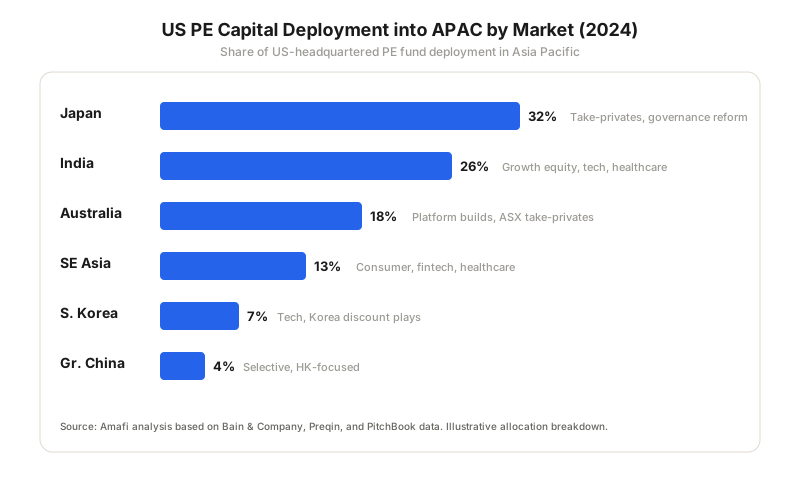
For US-based PE professionals evaluating APAC allocations, the question is no longer whether to invest in the region — it is how to build the capabilities required to source, execute, and manage investments across markets that operate very differently from domestic US deals.
The Major US PE Players in APAC
KKR
KKR has been investing in Asia Pacific since 2005 and has built one of the largest APAC PE platforms among US firms. The firm raised a US$15 billion Asia fund (KKR Asian Fund IV) and has deployed capital across Japan, India, Australia, South Korea, and Southeast Asia. In Japan, KKR has been particularly active in take-private transactions, acquiring listed companies trading below intrinsic value and driving operational improvements. KKR’s Japan team has executed landmark deals including Hitachi Transport System and Fuji Soft. In India, the firm has built positions in financial services and technology infrastructure.
Carlyle Group
Carlyle has maintained a consistent APAC presence since 1998, with offices across Tokyo, Beijing, Hong Kong, Mumbai, Seoul, Sydney, and Singapore. The firm’s Asia buyout strategy focuses on market-leading businesses in healthcare, technology, consumer, and financial services. Carlyle has been one of the most active US firms in Japan’s management buyout market and has built significant healthcare platforms across Southeast Asia.
Bain Capital
Bain Capital’s APAC strategy has centred on Japan and Australia, where the firm has executed some of the region’s largest buyouts. The firm’s approach emphasises operational value creation — working closely with management teams to improve margins, professionalise operations, and prepare businesses for premium exits. In Japan, Bain Capital’s acquisition of Nihon Kohden’s clinical chemistry business and its participation in the Toshiba take-private consortium demonstrated the firm’s willingness to pursue complex transactions.
Warburg Pincus
Warburg Pincus has been one of the most active growth equity investors in APAC, with a particular focus on India, China, and Southeast Asia. The firm’s strategy tilts toward growth-stage companies in technology, financial services, and healthcare — a positioning that differentiates it from the pure buyout firms. Warburg Pincus’s India portfolio includes significant positions in fintech and healthcare services.
TPG and Others
TPG has committed substantial capital to APAC through its Asia-dedicated funds, with a focus on healthcare, technology, and financial services across India, Southeast Asia, and Australia. Blackstone has expanded aggressively in India and Japan, deploying capital across real estate, private equity, and credit. Apollo Global Management has grown its APAC presence through credit-oriented strategies and opportunistic buyouts. General Atlantic continues to back technology and healthcare growth companies across the region.
Where US PE Capital Is Going
Japan: Governance-Driven Golden Age
Japan represents the single largest opportunity set for US PE firms in APAC. The Tokyo Stock Exchange’s governance reforms — requiring listed companies to explain plans for improving capital efficiency and shareholder returns — have created unprecedented deal flow. Companies that cannot demonstrate a path to higher returns face pressure from increasingly activist shareholders, and many are choosing to sell non-core divisions or go private entirely.
For US PE firms, Japan offers several advantages: a deep pool of well-managed mid-market companies, relatively straightforward due diligence compared to other APAC markets, a stable legal environment, and valuations that remain attractive by global standards. According to Preqin, Japan-focused PE fundraising reached a decade high in 2024, reflecting LP confidence in the Japan thesis.
The challenge is competition. Every major US PE firm now has a Japan office, and proprietary deal sourcing — rather than reliance on investment bank-led auctions — has become the primary differentiator. Firms that can identify off-market opportunities through direct corporate relationships and AI-enhanced screening have a meaningful advantage.
India: Scale and Growth
India is APAC’s highest-growth PE market. The combination of GDP growth exceeding 6% annually, a rapidly digitalising economy, a massive consumer base, and improving governance standards has made India a core allocation for US PE firms. Bain & Company reports that India PE deal value grew at a compound rate of 25% over the past five years, with technology and healthcare leading sector allocations.
US firms in India typically pursue growth equity and buyout strategies. The growth equity approach involves minority investments in high-growth companies, while the buyout approach — increasingly common — involves control acquisitions of established businesses with operational improvement potential. India’s financial services sector, including non-banking financial companies, insurance distribution, and wealth management platforms, has attracted particularly strong US PE interest.
Australia: Mature and Transparent
Australia offers US PE firms a market that operates with familiar conventions — English language, common-law legal system, transparent disclosure requirements, and an active M&A advisory community. The ASX provides a steady pipeline of take-private candidates, and the fragmented mid-market across healthcare, business services, and technology offers significant bolt-on acquisition potential.
The AUD/USD dynamic adds a currency consideration. For USD-denominated funds, a weaker Australian dollar enhances the attractiveness of Australian assets at entry, while currency appreciation during the hold period can boost returns at exit.
Southeast Asia: The Growth Frontier
Southeast Asian markets — particularly Singapore, Vietnam, and Indonesia — represent the growth frontier for US PE in APAC. The region’s combined GDP exceeds US$3.6 trillion, with a young demographic profile and rapid urbanisation driving consumption growth across healthcare, education, financial services, and technology.
US PE firms typically enter Southeast Asia through Singapore-based platforms, using the city-state as a hub for deploying capital across ASEAN. The approach often involves acquiring a well-positioned Singapore or Malaysia business as a platform and then executing bolt-on acquisitions across Vietnam, Indonesia, Thailand, and the Philippines.
Entry Strategies for US PE in APAC
US PE firms employ several distinct strategies when deploying capital in APAC, each suited to different market conditions and return profiles.
Take-privates have become the dominant strategy in Japan and Australia, where listed companies trade at valuations that offer attractive entry points for PE buyers willing to execute complex public-to-private transactions. These deals require deep local legal expertise, regulatory navigation, and the ability to manage public market dynamics during the offer period.
Platform-and-bolt-on strategies are the standard playbook in fragmented sectors across India and Southeast Asia. A US PE firm acquires a market leader as the anchor investment, then uses it as a consolidation vehicle for bolt-on acquisitions that add geographic coverage, product capability, or customer segments. This roll-up strategy benefits from multiple expansion — the combined platform typically commands a higher EBITDA multiple than the individual bolt-ons.
Co-investment with local GPs offers a lighter-touch entry for US firms testing new APAC markets. Rather than building a full local team, US firms co-invest alongside established regional GPs who provide on-the-ground expertise, deal sourcing, and portfolio management capabilities. This approach is common in Korea, Vietnam, and Indonesia.
Carve-outs from local conglomerates represent a growing opportunity set. APAC conglomerates — Japanese keiretsu, Korean chaebols, Indian business groups, and Southeast Asian family conglomerates — are increasingly divesting non-core divisions under pressure from shareholders, regulators, and strategic focus. These transactions require deep cultural understanding and the ability to execute complex separation agreements.
How AI Is Changing APAC Deal Sourcing for US Firms
The traditional US PE approach to APAC deal sourcing — relying on investment bank-led processes and personal networks — faces structural limitations in a region as fragmented and linguistically diverse as Asia Pacific. A deal team based in New York or San Francisco cannot manually screen thousands of mid-market companies across Japan, India, Vietnam, and Australia in multiple languages with varying disclosure standards.
This is where AI-powered deal sourcing platforms are proving transformative. AI can process unstructured data across languages, screen companies against specific investment criteria, identify businesses approaching transaction-ready inflection points, and surface opportunities that would be invisible to manual processes.
“The information asymmetry in APAC markets is precisely what makes AI valuable for cross-border deal sourcing,” says Daniel Bae, founder of Amafi and former M&A advisor with over US$30 billion in transaction experience. “A US PE firm looking at mid-market healthcare in Southeast Asia faces a universe of thousands of potential targets across five countries and as many languages. AI narrows that to a qualified shortlist in hours, not months.”
This is the problem Amafi was built to solve — an AI-powered advisory firm that screens, matches, and surfaces APAC deal opportunities for global investors. For US PE firms expanding their APAC footprint, the ability to source deals systematically across markets is becoming a competitive necessity, not a luxury.
Challenges and Risks
Despite the compelling opportunity set, US PE firms face real challenges in APAC.
Regulatory complexity remains the primary friction point. Every APAC jurisdiction has its own foreign investment review process, competition clearance requirements, and sector-specific restrictions. A single cross-border transaction may require approvals in three or four countries, each with different timelines and conditions. Firms that underestimate regulatory complexity regularly see deals delayed or repriced.
Cultural misalignment in post-deal management is a common source of value destruction. US PE firms accustomed to aggressive operational transformations may encounter resistance from management teams in Japan, Korea, or Southeast Asia, where relationship-based business cultures value consensus and gradualism. Successful US firms in APAC have learned to adapt their value creation playbooks to local management styles.
Currency risk is inherent in cross-border APAC investing. USD-denominated funds acquiring businesses in JPY, AUD, INR, or THB face currency fluctuations that can materially impact returns. Hedging strategies add cost and complexity, and imperfect hedging is the norm.
Exit uncertainty is amplified in APAC’s smaller markets. While Japan and Australia offer liquid exit channels through IPOs and strategic sales, exit paths in Vietnam, Indonesia, and parts of India are less predictable. Hold periods tend to be longer in APAC, and secondary sales to other PE firms have become an increasingly important exit route.
What Comes Next
The structural drivers behind US PE expansion into APAC — growth differentials, fragmented industries, governance reform, succession dynamics — are not cyclical. They represent a multi-decade shift in where global capital can generate attractive risk-adjusted returns.
The firms that will capture the most value are those building genuine local capabilities: dedicated APAC teams with cultural fluency, sector-specialist knowledge, local advisor networks, and technology-enabled deal sourcing that can identify opportunities across the region’s fragmented markets. Fly-in, fly-out approaches from US headquarters will increasingly lose out to firms with permanent APAC infrastructure.
For US PE professionals, the message is clear: APAC allocation is no longer a niche strategy — it is a core portfolio requirement. The question is whether your firm’s sourcing, execution, and portfolio management capabilities match the scale of the opportunity.
Evaluating APAC deal opportunities from the US? Amafi helps PE firms and investors source, screen, and match deals across Asia Pacific markets — from AI-powered target identification to curated deal flow tailored to your investment criteria. Get in touch to see how we can accelerate your APAC pipeline.

About the Author
Daniel Bae
Co-founder & CEO, Amafi
Daniel is an investment banker with 15+ years of experience in M&A, having advised on deals worth over US$30 billion. His career spans Citi, Moelis, Nomura, and ANZ across London, Hong Kong, and Sydney. He holds a combined Commerce/Law degree from the University of New South Wales. Daniel founded Amafi to solve the pain points in M&A, enabling bankers to focus on what matters most — delivering trusted advice to clients.
About Amafi
Amafi is an M&A advisory firm built for Asia Pacific. We help business owners sell their companies and corporate teams make strategic acquisitions — with bulge bracket execution quality at lower fees, powered by AI and a network of senior dealmakers.
Register your investment criteriaGet M&A insights delivered
AI-powered deal sourcing strategies, market analysis, and Asia Pacific insights — straight to your inbox.