The Case for Acquisition Over Greenfield
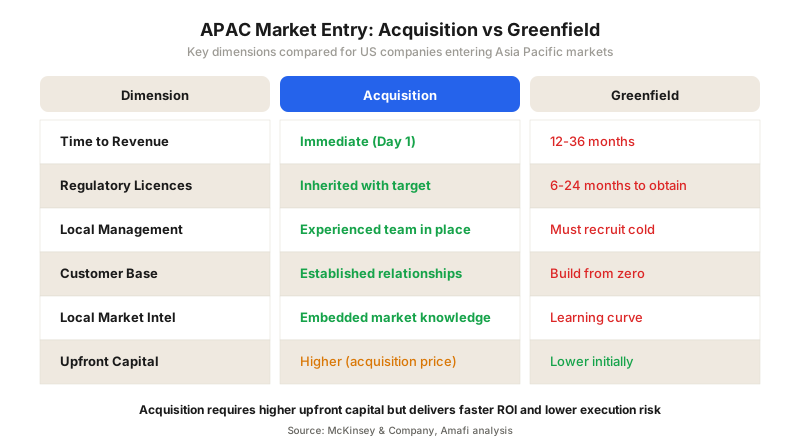
When a US company decides to expand into Asia Pacific, the first strategic question is how: build a new operation from scratch (greenfield) or acquire an existing business. For most US companies entering APAC for the first time, acquisition is the faster, lower-risk, and ultimately more cost-effective path.
The reasons are structural, not merely financial.
Greenfield operations in APAC require US companies to navigate unfamiliar regulatory environments, establish local entity structures, recruit management teams in markets where they have no employer brand, build customer relationships from zero, and absorb 2-3 years of operating losses while the business reaches scale. Many US companies that attempt greenfield APAC entry underestimate these challenges and end up spending more — in both capital and management attention — than an acquisition would have cost.
According to McKinsey & Company, companies that enter new geographic markets through acquisition achieve profitability 40-60% faster than those pursuing organic market entry. The performance gap is even wider in APAC, where market fragmentation, language barriers, and relationship-driven business cultures amplify the difficulty of building from zero.
This article examines why acquisition works, which APAC markets are most accessible for US acquirers, and how to execute a cross-border market entry transaction successfully.
Why Acquisition Wins in APAC
Immediate Market Access
An acquisition gives a US company an operating platform on day one: revenue, customers, employees, supplier relationships, regulatory licences, and local market knowledge. A greenfield operation has none of these. In markets where customer relationships take years to build — Japan and Korea in particular — the time advantage of acquisition is decisive.
Regulatory and Licensing Shortcuts
Many APAC industries require local licences, certifications, or government approvals to operate. Healthcare, financial services, education, telecommunications, and food production all have regulatory barriers that can take 12-24 months to navigate from scratch. Acquiring a licensed, operating business provides immediate regulatory standing.
Local Talent and Management
Recruiting qualified management in APAC markets without an established employer brand is one of the hardest challenges for US greenfield operations. Acquisition provides an experienced local team that understands the market, speaks the language, and has existing business relationships. Retaining this management team through appropriate incentive structures — earnouts, rollover equity, and retention packages — is critical to preserving the value of the acquisition.
Risk Mitigation
A greenfield operation is a bet on execution — the US company must build everything correctly in an unfamiliar market. An acquisition is a bet on an existing business that has already proven product-market fit, customer demand, and operational viability. The risk profile of acquiring a proven business is fundamentally different from launching an unproven operation.
Market-by-Market Guide for US Acquirers
Australia: The Familiar Gateway
Australia is often the first APAC market US companies enter through acquisition, and for good reason. The business environment is English-speaking, common law-based, and culturally similar to the US. The regulatory framework is transparent, the M&A advisory community is sophisticated, and the due diligence process follows familiar Western conventions.
Regulatory considerations. The Foreign Investment Review Board (FIRB) screens foreign acquisitions above certain thresholds. For US acquirers, the threshold for non-sensitive sectors was AUD 1.339 billion in 2024 (higher than for most other countries, due to the Australia-US Free Trade Agreement). Sensitive sectors — including media, telecommunications, and defence — have zero-dollar thresholds requiring FIRB approval regardless of transaction size.
Target sectors. Technology, healthcare services, business services, and consumer are the most active sectors for US acquirers in Australia. The country’s fragmented mid-market, particularly in professional services and healthcare, offers attractive platform acquisition opportunities.
Valuation dynamics. Australian mid-market businesses typically trade at EBITDA multiples of 6-10x, depending on sector and growth profile — often below comparable US businesses, providing a valuation arbitrage opportunity for US acquirers.
Japan: The Largest APAC Opportunity
Japan is the largest M&A market in APAC and the most complex for US acquirers. The opportunity is substantial — a US$5 trillion economy with thousands of well-managed mid-market companies, many of which face succession crises as founders age out. The Tokyo Stock Exchange’s governance reforms have created additional deal flow as listed companies divest non-core businesses.
Regulatory considerations. The Foreign Exchange and Foreign Trade Act (FEFTA) requires prior notification for foreign investment in designated sectors. Review typically takes 30 days. Most sectors are open to foreign investment, but core sectors (defence, critical infrastructure, certain technology) face enhanced scrutiny.
Cultural factors. Japan operates on relationship-based business norms that differ fundamentally from US transaction culture. Management presentations focus on long-term vision and mutual respect rather than hard financial negotiations. US acquirers who demonstrate commitment to the business’s employees, culture, and community consistently achieve better outcomes than those perceived as purely financial operators.
Succession planning opportunity. An estimated 1.27 million Japanese SMEs will face succession challenges by 2030, according to Japan’s Ministry of Economy, Trade and Industry (METI). Many founders with no successor are open to selling to foreign acquirers who will preserve their company’s legacy and employees — making this a uniquely motivated seller pool.
India: Growth at Scale
India offers US acquirers access to one of the world’s fastest-growing economies, a large English-speaking talent pool, and rapidly improving business infrastructure. The country’s technology sector — particularly IT services, SaaS, fintech, and healthtech — is the primary target for US corporate acquirers.
Regulatory considerations. India’s FDI policy is sector-specific. Many sectors are on the “automatic route” (no prior government approval needed), while others require approval. The regulatory landscape is improving but remains more complex than Australia or Singapore. Structuring and tax planning require experienced local counsel.
Valuation and deal dynamics. Indian technology businesses often command premium valuations relative to other APAC markets, reflecting the country’s growth trajectory and talent pool. US acquirers should expect competitive processes, particularly for high-quality technology assets. Quality of earnings analysis is especially important in India, where accounting standards and practices can differ from US GAAP.
Singapore: The Strategic Hub
Singapore serves dual roles for US acquirers: as a direct target market (small but sophisticated) and as a base for building APAC platforms. The city-state’s business-friendly regulatory environment, rule of law, IP protection, and deep professional services ecosystem make it the preferred domicile for US companies establishing APAC operations.
Strategic approach. Many US companies acquire a Singapore business as their APAC anchor, then use it as a base for expanding across Southeast Asia. The Singapore entity provides a familiar governance structure and access to ASEAN markets through bilateral investment treaties and free trade agreements.
Southeast Asia: The Growth Markets
Vietnam, Indonesia, Thailand, and the Philippines offer US acquirers access to high-growth economies with young demographics and expanding middle classes. However, these markets also present greater complexity — less transparent disclosure environments, more challenging regulatory frameworks, and limited institutional deal advisory infrastructure.
Practical approach. US companies entering Southeast Asian markets beyond Singapore typically do so through joint ventures with local partners or through staged acquisitions (minority stake initially, with an option to acquire control). Full buyouts of Southeast Asian businesses by US corporates do occur but require deep local advisory support and cultural sensitivity.
Executing the Acquisition
Building the Target List
Systematic target identification is the first challenge for US corporate acquirers entering APAC. Unlike the US, where comprehensive databases like PitchBook and CapIQ provide deep coverage of the private company universe, APAC’s mid-market information landscape is fragmented across languages, jurisdictions, and data sources.
AI-powered deal sourcing platforms are particularly valuable for this challenge. Rather than relying solely on investment bank-led processes — which tend to surface the same well-known targets to all potential buyers — AI-driven screening can identify companies across multiple APAC markets that match specific acquisition criteria.
This is the approach we’ve built at Amafi — an AI-powered advisory firm designed for cross-border M&A in Asia Pacific, where data fragmentation and information asymmetry make traditional target identification fall short. For US corporate development teams, the ability to systematically screen APAC markets against specific criteria — revenue, sector, geography, growth profile — accelerates the targeting phase from months to weeks.
Due Diligence Across Borders
Cross-border due diligence in APAC is more complex than domestic US DD. Key considerations include:
- Financial statements may follow local accounting standards (JGAAP, Indian GAAP, various ASEAN standards) rather than IFRS or US GAAP. Normalisation and reconciliation work is essential.
- Legal DD must cover local employment law, environmental regulations, IP registration, and contract enforceability in the target’s jurisdiction.
- Cultural DD — increasingly recognised as a distinct workstream — assesses compatibility of management styles, decision-making processes, and corporate values between the US acquirer and the target.
- Regulatory DD should identify all licences, permits, and government relationships that are critical to the target’s operations and assess transferability to a foreign-owned entity.
Integration Planning
Post-merger integration is where cross-border APAC transactions succeed or fail. The biggest integration mistakes US acquirers make:
Imposing US management practices too quickly. The acquired management team knows the local market better than the US parent. Successful acquirers maintain significant local autonomy during the first 12-18 months, making changes gradually and collaboratively rather than through top-down restructuring.
Underestimating the cultural dimension. Language barriers, time zone differences, and different working styles create friction that compounds over time if not actively managed. Dedicated integration managers who understand both cultures are worth the investment.
Neglecting key relationship holders. In relationship-driven APAC markets, key customer and supplier relationships often reside with specific individuals rather than institutional agreements. Ensuring these individuals are retained and engaged through the transition is critical.
“The most successful US acquirers in APAC are the ones who buy the business and then let the business teach them the market,” says Daniel Bae, founder of Amafi and former M&A advisor with over US$30 billion in transaction experience. “The value you’re acquiring isn’t just the revenue line — it’s the local knowledge, relationships, and operational intuition that no amount of market research can replicate.”
The Strategic Imperative
APAC’s economic gravity is pulling more US companies toward the region every year. With combined GDP exceeding US$35 trillion and home to over 4 billion consumers, Asia Pacific is too large to ignore in any serious corporate growth strategy.
Acquisition provides the most reliable entry path — immediate market access, proven operations, experienced teams, and regulatory standing. The companies that execute well will build durable competitive advantages in the world’s fastest-growing markets. Those that wait risk watching competitors establish positions that become increasingly difficult to displace.
For US corporate development teams, the question is not whether to pursue APAC acquisitions — it is how to identify the right targets, in the right markets, at the right time.
Planning APAC market entry through acquisition? Amafi helps corporate development teams identify, screen, and evaluate acquisition targets across Asia Pacific — from systematic market mapping to AI-powered target matching. Get in touch to explore how we can support your APAC M&A strategy.

About the Author
Daniel Bae
Co-founder & CEO, Amafi
Daniel is an investment banker with 15+ years of experience in M&A, having advised on deals worth over US$30 billion. His career spans Citi, Moelis, Nomura, and ANZ across London, Hong Kong, and Sydney. He holds a combined Commerce/Law degree from the University of New South Wales. Daniel founded Amafi to solve the pain points in M&A, enabling bankers to focus on what matters most — delivering trusted advice to clients.
About Amafi
Amafi is an M&A advisory firm built for Asia Pacific. We help business owners sell their companies and corporate teams make strategic acquisitions — with bulge bracket execution quality at lower fees, powered by AI and a network of senior dealmakers.
Book a valuation meetingGet M&A insights delivered
AI-powered deal sourcing strategies, market analysis, and Asia Pacific insights — straight to your inbox.