The Rise of Asian Buyers in US M&A
A decade ago, a US mid-market business owner considering a sale would typically evaluate two categories of buyers: domestic strategic acquirers and US-based private equity firms. In 2026, that buyer universe has expanded significantly. Asian corporations, PE funds, and sovereign wealth vehicles are actively acquiring US companies across technology, healthcare, consumer, industrial, and professional services sectors.
The numbers reflect this shift. Japanese companies completed over 250 outbound M&A transactions in 2024, with the US as their single largest target market, according to Recof Data. Korean corporates have accelerated US acquisitions in semiconductors, EV supply chains, and digital media. Singaporean sovereign wealth funds GIC and Temasek maintain significant US deal activity. Indian IT services and pharmaceutical companies continue to acquire US businesses for technology and market access.
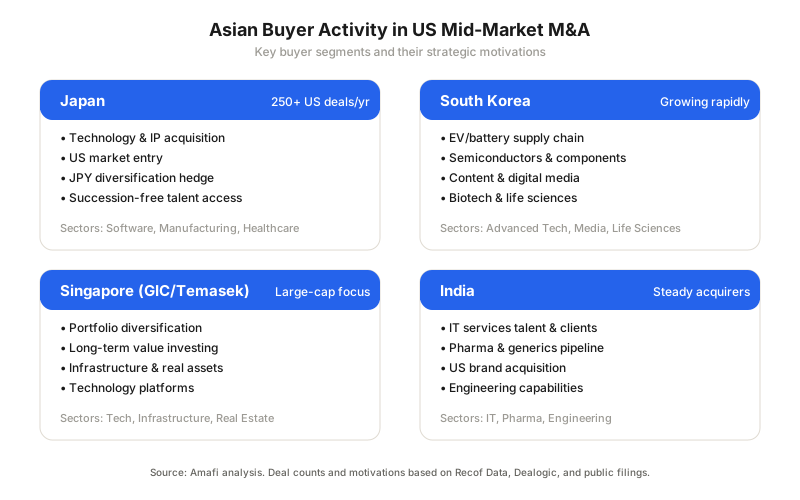
For US business owners, the practical implication is clear: excluding Asian buyers from your sale process means overlooking a significant and growing pool of motivated acquirers — many of whom will pay premiums for the strategic value a US business provides to their global platform.
Why Asian Buyers Want US Companies
Understanding the strategic logic behind Asian acquisitions of US businesses helps sellers position their companies more effectively.
Technology and IP Access
Asian corporations — particularly Japanese and Korean industrial companies — acquire US businesses to gain access to proprietary technology, engineering talent, and intellectual property that would take years to develop organically. This is especially true in software, advanced manufacturing, semiconductors, and life sciences. The acquirer is often willing to pay a premium because the technology fills a specific gap in their product portfolio or R&D pipeline.
Brand and Market Credibility
A US brand carries global credibility. Asian companies entering Western consumer or B2B markets often find it faster and more reliable to acquire an established US brand than to build one from scratch. This dynamic is particularly strong in consumer products, professional services, SaaS, and healthcare, where brand trust directly influences customer acquisition.
Access to the US Customer Base
The US remains the world’s largest consumer market and its largest enterprise technology market. For Asian companies with competitive products but limited US distribution, acquiring a US company with an established customer base and sales team provides immediate market access — bypassing the multi-year process of building a US sales operation from zero.
Diversification and Currency Plays
Some Asian buyers — particularly Japanese corporates sitting on significant JPY-denominated cash reserves — are strategically acquiring US assets as a hedge against domestic market stagnation and currency depreciation. When the JPY weakens against the USD, revenues from US subsidiaries translate back into larger JPY earnings, providing a natural currency benefit.
What the Process Looks Like
Selling to an Asian buyer follows the same fundamental sell-side M&A process as any transaction — but with important differences in pace, communication, and structural considerations.
Pre-Market Preparation
The preparation phase is identical to any well-run sale process: organise financials, prepare a CIM, build a data room, and develop a target buyer list. The key difference is that your buyer list should explicitly include Asian corporates and funds with demonstrated US acquisition interest. Your advisor should have cross-border capabilities and relationships with Asian acquirers — not just domestic US buyers.
Working with an advisor who understands Asian buyer motivations is critical. A generic buyer list that includes “Japanese corporates” without specific names, contact relationships, and an understanding of each buyer’s strategic rationale is not good enough.
Outreach and Early Engagement
The engagement phase takes longer with Asian buyers. In most Asian business cultures, the relationship-building phase is not a formality — it is a prerequisite for a transaction. Japanese and Korean corporates in particular will want to understand the seller’s management philosophy, company culture, and long-term vision before engaging on commercial terms.
Plan for early-stage conversations that feel more like mutual due diligence than a transactional sales pitch. The buyer is evaluating whether the business fits culturally, not just financially. Sellers who approach this phase with patience and openness tend to achieve better outcomes.
Due Diligence Considerations
Due diligence with an Asian buyer covers the same financial, legal, commercial, and operational areas as any transaction. However, expect additional time for translation of key documents, cultural diligence (assessing compatibility of management styles and corporate cultures), and regulatory analysis.
Asian buyers are often more thorough than US buyers in certain areas — particularly around employee matters, customer relationships, and supply chain dependencies. Japanese acquirers in particular are known for detailed, methodical diligence processes that can extend timelines by 4-6 weeks beyond what a US seller might expect.
CFIUS and Regulatory Navigation
The Committee on Foreign Investment in the United States (CFIUS) reviews foreign acquisitions that may affect US national security. Not every transaction triggers CFIUS review, but sellers should conduct a CFIUS analysis early in the process. CFIUS is most likely to be relevant for transactions involving:
- Critical technology (AI, semiconductors, quantum computing, certain biotech)
- Critical infrastructure (telecommunications, energy, transportation)
- Sensitive personal data (healthcare data, financial data, geolocation data of US persons)
- Proximity to sensitive US government facilities
For the majority of mid-market transactions in consumer, professional services, food and beverage, and general technology, CFIUS is not a significant concern. But the analysis should be done upfront — discovering a CFIUS issue after signing an LOI creates leverage for the buyer to renegotiate terms.
According to the US Department of the Treasury’s CFIUS Annual Report, the committee reviewed 285 notices in 2023, with the majority of transactions ultimately cleared. The review process typically adds 45-90 days to the transaction timeline.
Deal Structure
Cross-border transactions with Asian buyers often involve structural elements that differ from domestic US deals.
Entity structure. The buyer will typically acquire through a US-incorporated subsidiary or special purpose vehicle, simplifying the legal mechanics for the seller. The SPV structure also helps the buyer manage tax, regulatory, and operational separation.
Purchase price mechanics. Asian buyers generally prefer completion accounts (where the price is adjusted post-closing based on actual balance sheet figures) over locked-box mechanisms, though this varies by buyer sophistication. Working capital adjustments are standard, as in domestic deals.
Earnout structures. Asian buyers may propose earnouts more frequently than domestic US acquirers, particularly when the valuation reflects growth expectations the buyer wants to de-risk. Earnout structures in cross-border deals require careful drafting to account for potential changes in management, reporting, and strategic direction post-acquisition.
Representations and warranties. R&W insurance has become standard in mid-market M&A, and Asian buyers are increasingly comfortable with insured deal structures. This reduces the indemnification burden on the seller and helps bridge trust gaps that can arise in cross-border transactions.
Common Concerns — and How to Address Them
”Will they keep my employees?”
This is the most common concern from US sellers considering an Asian buyer. The answer, overwhelmingly, is yes — particularly for Japanese and Korean acquirers. Asian corporate acquirers typically prioritise management continuity and workforce stability far more than US PE firms, which may pursue aggressive headcount optimisation. Most Asian buyers acquiring US companies want the existing team to stay and run the business, with the parent company providing capital, strategic direction, and global market access.
”Will the deal actually close?”
Completion risk is a legitimate concern in cross-border transactions. Asian buyers may require internal board approvals, regulatory clearances in their home jurisdiction, and CFIUS review in the US. To mitigate this risk, sellers should negotiate a meaningful break-up fee (typically 3-5% of deal value), set clear closing conditions and outside dates, and conduct thorough buyer diligence to verify the acquirer’s financial capacity and approval pathway before signing.
”Is the process too slow?”
Cross-border timelines are typically 20-30% longer than domestic transactions — plan for 6-9 months from engagement to close, versus 4-6 months for a domestic deal. The incremental time is driven by relationship building, cultural due diligence, CFIUS review (if applicable), and coordination across time zones and languages. Sellers who build this timeline into their expectations from the outset report significantly better experiences than those who expect domestic US speed.
Positioning Your Business for Asian Buyers
Sellers who actively position their businesses for Asian buyer interest can expand their buyer universe and often achieve better valuations.
Highlight your US market position. Asian buyers value established market share, recurring revenue relationships, and brand recognition in the US market. Quantify your competitive position clearly.
Demonstrate management depth. Since most Asian acquirers want the existing team to continue operating the business, a strong management team below the founder level is a significant value driver. Businesses that are overly dependent on the founder face a discount from any buyer, but particularly from Asian acquirers who plan to operate the business from overseas.
Clean up IP and technology documentation. Asian acquirers acquiring for technology access will scrutinise your IP portfolio, licensing agreements, and technology architecture. Clear documentation accelerates diligence and supports valuation.
Prepare for cultural compatibility questions. Be ready to discuss your management philosophy, employee culture, and how you envision the business operating as part of a larger Asian corporate group. These conversations are not soft — they directly influence the buyer’s willingness to proceed and their valuation.
“The best outcomes in US-to-Asia transactions happen when the seller treats the cultural dimension with the same rigour as the financial dimension,” says Daniel Bae, founder of Amafi and former M&A advisor with over US$30 billion in transaction experience. “Sellers who understand what drives Asian buyers — and who position their business accordingly — consistently achieve better valuations and smoother post-close transitions.”
The Opportunity for US Business Owners
The pool of Asian buyers interested in US mid-market companies is larger today than at any point in history. Japanese, Korean, Singaporean, and Indian acquirers are actively seeking US businesses that offer technology, market access, brand credibility, and operational scale. For US business owners considering a sale, expanding the buyer universe to include qualified Asian acquirers is one of the most direct ways to improve competitive tension and transaction outcomes.
The process is manageable with the right advisory support. The fundamentals of a well-run sell-side process do not change — but the buyer identification, cultural navigation, and regulatory coordination require advisors with genuine cross-border experience and Asian buyer relationships.
Considering a sale and want to explore Asian buyer interest? Amafi connects US business owners with qualified PE firms and corporate acquirers across Asia Pacific — from AI-powered buyer matching to confidential outreach. Get in touch to learn how expanding your buyer universe could improve your outcome.

About the Author
Daniel Bae
Co-founder & CEO, Amafi
Daniel is an investment banker with 15+ years of experience in M&A, having advised on deals worth over US$30 billion. His career spans Citi, Moelis, Nomura, and ANZ across London, Hong Kong, and Sydney. He holds a combined Commerce/Law degree from the University of New South Wales. Daniel founded Amafi to solve the pain points in M&A, enabling bankers to focus on what matters most — delivering trusted advice to clients.
About Amafi
Amafi is an M&A advisory firm built for Asia Pacific. We help business owners sell their companies and corporate teams make strategic acquisitions — with bulge bracket execution quality at lower fees, powered by AI and a network of senior dealmakers.
Learn about selling your businessGet M&A insights delivered
AI-powered deal sourcing strategies, market analysis, and Asia Pacific insights — straight to your inbox.