Most business owners spend years perfecting their operations but almost no time thinking about when to exit. The timing question gets deferred — there’s always another quarter to grow, another initiative to complete, another reason to wait.
Then something shifts. A health scare. A competitor’s acquisition that reshapes the market. A call from a buyer. Suddenly, the question of when to sell your business moves from abstract to urgent, and the owner is making the most consequential financial decision of their life without a framework for the timing.
This isn’t about market timing in the stock-picking sense. It’s about recognizing when three forces — your business trajectory, the market environment, and your personal readiness — align to create an optimal exit window. Miss that window, and the cost compounds quickly.
The Three-Signal Framework
The right time to sell sits at the intersection of three independent signals. All three don’t need to be perfect, but at least two should be strongly favorable — and none should be flashing red.
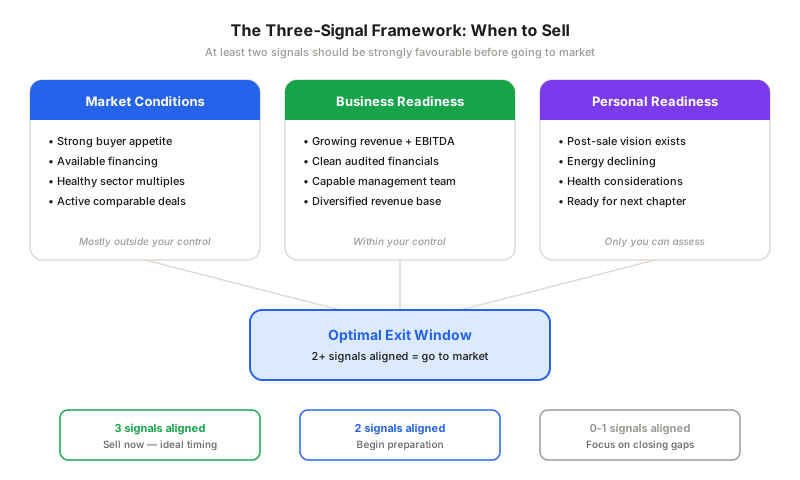
Signal 1: Market Conditions
Market conditions determine how many buyers are active, how aggressively they compete for deals, and what valuation multiples they’re willing to pay. These conditions are largely outside your control, which is exactly why they matter — you can’t manufacture a hot market when you’re ready to sell.
Key indicators of a favorable seller’s market:
- Buyer appetite is strong. Private equity firms globally are sitting on a record US$2.59 trillion in undeployed capital — dry powder that needs to be invested before fund timelines expire, according to Preqin’s 2025 Global Private Equity Report. When PE firms are flush with capital and under pressure to deploy, sellers benefit.
- Financing is available. When interest rates are manageable and credit markets are open, buyers can structure deals with more leverage, which supports higher purchase prices. Tightening credit markets — like 2022-2023 — compress multiples because buyers have less financing capacity.
- Industry multiples are healthy. EBITDA multiples fluctuate by sector and cycle. In a strong market, a well-run SME might trade at 6-8x EBITDA. In a contraction, the same business might attract 4-5x. That difference on a $2 million EBITDA business is $4-6 million in enterprise value.
- Comparable transactions are active. A steady flow of closed deals in your sector gives buyers confidence in valuation benchmarks and gives sellers precedent transactions to support their pricing expectations.
None of these conditions need to be at their peak. They just need to be at least “good” — not deteriorating rapidly.
Signal 2: Business Readiness
This is the signal most within your control, and the one most often overlooked. A business that’s truly ready to sell has fundamentally different characteristics from one that’s merely profitable.
Growth trajectory matters more than absolute size. Buyers pay the highest multiples for businesses that are growing. A company producing $3 million in EBITDA with 15% annual growth will command a higher multiple than one producing $5 million in EBITDA with flat or declining growth. The growth signals future value that the buyer can capture.
According to GF Data’s mid-market report, businesses with EBITDA growth above 10% in the year of sale command a 1.5-2.0x multiple premium over companies with flat or declining earnings. On a $3 million EBITDA business, that premium translates to $4.5-6 million in additional enterprise value.
The practical implication: the best time to sell is while your business is still on the upswing — not after the growth has plateaued.
Operational independence is non-negotiable. If the business cannot function for six months without the founder, buyers discount for key-person risk. Every month spent building management depth and documenting processes increases the business’s transferable value.
Financial clarity accelerates deals. Clean, audited financials with a sell-side quality of earnings report eliminate the biggest source of deal friction. Buyers who trust the numbers move faster and pay more.
Signal 3: Personal Readiness
This is the signal owners are most reluctant to examine honestly, and the one that most often determines whether a sale succeeds or fails.
Burnout is a real and measurable risk. Running a business for 15-25 years takes a cumulative toll. The danger isn’t just reduced quality of life — it’s that burnout shows up in the numbers. Deferred investments, declining innovation, missed opportunities. Buyers read this as a business past its peak, and they price accordingly.
A PwC survey of business owners found that 65% of family business owners who delayed their exit by more than three years beyond their initial planned timeline sold at a lower multiple than what was available when they first considered selling.
You need a post-sale identity. Founders who sell without a plan for what comes next often experience “seller’s remorse” and sabotage their own deals — dragging out negotiations, adding conditions, or walking away from fair offers. Before you go to market, you should have a concrete vision for your next chapter: another venture, board roles, philanthropy, travel — anything that gives you a reason to complete the transition.
Health is a ticking clock. No one wants to think about this, but an unexpected health event can force a distressed sale at 30-50% of fair market value. A voluntary sale from a position of strength always outperforms a forced sale under pressure.
When the Window Opens — and Closes
Exit windows don’t stay open forever. The forces that create favorable conditions shift, and they can shift fast.
“The best exits I’ve seen share one trait — the owner sold when they didn’t have to,” says Daniel Bae, founder of Amafi and former M&A advisor with over US$30 billion in transaction experience. “They were growing, profitable, and had options. That leverage changes everything at the negotiating table.”
Most owners intuitively understand this but act in the opposite direction. They think: “If things are going well, why sell?” The answer is that going well is precisely what creates buyer premium. Selling when things plateau or decline means selling when leverage has evaporated.
Consider the lifecycle of a typical SME:
| Phase | EBITDA Trend | Buyer Appetite | Owner Leverage | Multiple Range |
|---|---|---|---|---|
| Growth | Rising 10%+ annually | Very high | Maximum | 6-8x |
| Mature peak | Stable, strong margins | High | Strong | 5-7x |
| Early plateau | Flat, margins holding | Moderate | Adequate | 4-6x |
| Decline | Falling, margin pressure | Low | Weak | 3-4x |
| Distress | Losses or forced sale | Minimal | None | 1-2x or asset value |
The difference between selling at the growth phase and the early plateau can be 2-3x multiples — on a $2 million EBITDA business, that’s $4-6 million in deal value. The difference between early plateau and distress is the difference between a life-changing exit and a loss.
The Cost of Waiting Too Long
Every “one more year” carries risk that compounds:
Revenue concentration deepens. Losing a top customer during a sale process can crater the deal. The longer you wait, the more your revenue concentrates around a few key relationships — and buyers know it.
Key employees leave. Your best people have options. If they sense the business has peaked or the founder has checked out, they start looking. Losing your VP of Sales or your lead engineer six months before a sale is devastating.
Technology shifts. Industry disruption doesn’t wait for your exit timeline. An AI startup entering your market, a regulatory change, or a shift in customer preferences can erode your competitive position faster than you can rebuild it.
Your energy declines. A sale process demands 6-12 months of intense parallel effort — running the business and managing the deal simultaneously. Owners who are already burned out rarely have the stamina. The process drags, the business suffers, and the buyer retrades.
McKinsey’s 2024 global M&A analysis found that seller-initiated transactions completed during business growth phases achieved 23% higher multiples on average than sales initiated during business plateaus — even when the underlying businesses had comparable EBITDA.
A Practical Self-Assessment
Before you decide, work through these five questions honestly. If you answer “yes” to three or more, the timing is likely right.
- Is the business growing? Revenue and EBITDA have increased in at least two of the last three years.
- Is the market favorable? Buyer activity in your sector is healthy, financing is available, and comparable transactions are closing at reasonable multiples.
- Could the business run without you? You have a capable management team and documented processes. A six-month absence wouldn’t cause material damage.
- Are you personally ready? You have a vision for life after the sale, and continuing to run the business doesn’t excite you the way it once did.
- Is there asymmetric risk in waiting? Key-person dependency, customer concentration, technology shifts, or health concerns that could force a less favorable exit if you delay.
If only one or two conditions are met, focus on the gaps. Build management depth. Diversify revenue. Clean up financials. These are actions you can take now that expand the exit window when other conditions align.
Starting the Process Before You’re “Ready”
One counterintuitive insight from advising on hundreds of transactions: preparation creates readiness. Business owners who begin exit planning 18-24 months before a target sale date consistently achieve better outcomes than those who wait until they feel “ready.”
The preparation itself — cleaning financials, building a data room, reducing founder dependency, documenting processes — makes the business more valuable and more transferable whether or not you ultimately sell.
At Amafi, we work with business owners to assess their exit readiness and develop a timeline that maximises value. Our exit readiness assessment is designed to help you identify which signals are aligned and which gaps to close. It takes 10 minutes and gives you a practical starting point.
If you’re asking the question — “Is now the right time?” — that question itself is usually the first signal that it’s time to start preparing, even if the actual sale is still a year or two away. The owners who start early have options. The owners who wait for the perfect moment often find it’s already passed.
Considering whether it’s time to sell? Amafi is an M&A advisory firm that guides business owners from exit readiness through closing — with AI-powered buyer matching, transparent fees, and no retainers. Book a confidential valuation meeting to explore your options.

About the Author
Daniel Bae
Co-founder & CEO, Amafi
Daniel is an investment banker with 15+ years of experience in M&A, having advised on deals worth over US$30 billion. His career spans Citi, Moelis, Nomura, and ANZ across London, Hong Kong, and Sydney. He holds a combined Commerce/Law degree from the University of New South Wales. Daniel founded Amafi to solve the pain points in M&A, enabling bankers to focus on what matters most — delivering trusted advice to clients.
About Amafi
Amafi is an M&A advisory firm built for Asia Pacific. We help business owners sell their companies and corporate teams make strategic acquisitions — with bulge bracket execution quality at lower fees, powered by AI and a network of senior dealmakers.
Learn about selling your businessGet M&A insights delivered
AI-powered deal sourcing strategies, market analysis, and Asia Pacific insights — straight to your inbox.